


Gold World News Flash |

- COMEX Commercials Take a Stand at Gold Highs
- The Lesson from Japan for PM Investors
- Silver Market Update March 31st, 2011
- Gold Market Update April 2nd, 2011
- Dow Jones BEV Plot 1885 to 2011 & Credit Market Indicators
- The Bedrock of the Gold Bull Rally
- Gene Arensberg: New 28-year low for the gold/silver ratio
- Meet The 171 Banks For Which The Margin Of Failure Is One Thousand Dollars
- MUDDLING TOWARDS COLLAPSE
- Food Commodities Rise Seen Swamping Consumers With Inflation
- 60 Minutes | Foreclosure Fraud Featured this Sunday on 60 Minutes
- King World News interviews Davies, Turk, Haynes, and Norcini
- TaKaSHi UeSuGi: AN ANGRY JaPaNeSe JouRNaLiST
- New 28 Year Lows for the Gold Silver Ratio
- Update on Japan's Nuclear Crisis
- The Best of the Bozeman Police Reports
- A Visual Presentation Of What Happens To The Market During Rising Interest Rate Cycles
- Peter Schiff on jobs, rates and faux counterfeiters – watch the second vid – and then buy MORE SILVER
- Silver Very Overbought
- Gold Real Money in a World of Fiat Currency
- Price controls, cartels, and the collapse of price discovery
- Gold, silver coins now officially legal tender in Utah
- The King's Speech: Will It Mark The Top in Stocks?
- Gold Market Update
- Silver Market Update
- JPM Stock Price expressed in Oz’s of Silver
- The Best of the Week
- ===== SILVER PRICES UNSTOPPABLE =====
- Bernanke shows his cards to the WSJ (again)
- Ben Davies - Gold Will Advance $400 on Price Discovery
| COMEX Commercials Take a Stand at Gold Highs Posted: 02 Apr 2011 07:00 PM PDT HOUSTON – Remember that last week gold attempted a breakout to new highs but was turned back? Evidence in the Commodity Futures Trading Commission (CFTC) commitments of traders (COT) report suggests that the largest commercial sellers of gold futures took a stand in opposition as gold made new highs. Going into this past Tuesday, the cutoff day for COT reporting, we thought at first glance that perhaps the Big Sellers of paper gold sensed an opportunity to get some downside traction – something they have found increasingly difficult to achieve in recent months because of intense dip buying in the physical gold market. Now, however, it is apparent that the Big Sellers took their stand as gold attempted a breakout last week. ...
|
| The Lesson from Japan for PM Investors Posted: 02 Apr 2011 06:09 PM PDT By Jeff Clark, BIG GOLDIt feels a little callous writing about Japan with respect to precious metals after the country suffered such a terrible tragedy. However, I think it's worth discussing because there's a lesson in it for all of us. In fact, I think the moral could be couched in terms of a warning.Japan's Background with Precious MetalsIt's commonly known in Japanese culture that citizens harbor gold to protect against unforeseen events. The gold isn't sold unless it's needed for an emergency. With respect to the Japanese government, the country's central bank is the 8th largest holder of the metal (including the IMF and GLD). Beyond investment, Japan represents about 6% of worldwide gold fabrication (excluding investment demand), the majority of which is in electronics. Scrap recycling has been heavy in recent years, while jewelry demand is low.Regarding silver, the tiny island represents about 9% of global demand. Industrial uses comprise the biggest part of that, which includes...
|
| Silver Market Update March 31st, 2011 Posted: 02 Apr 2011 05:58 PM PDT Silver is very overbought and this fact coupled with the dramatic spike in the silver gold ratio would normally be expected to lead to a significant reaction by both gold and silver, as usually happened following such a situation in the past, but these are not normal times. On its 2-year chart we can see how silver has been romping ahead since it broke out last August and following its latest upleg had become critically overbought by early March, but only a minor reaction followed. On the long-term chart for silver going back to 1999 we can see that it has hit a target, and while it may continue to an even higher one, gold is looking like a better place to be over the short to medium-term. The silver/gold ratio chart makes clear in a dramatic manner how silver has greatly outperformed gold in the recent past. In the past this has normally lead to an intermediate reversal in both, but given the predicament the shorts find themselves in, and the extraordinary situati...
|
| Gold Market Update April 2nd, 2011 Posted: 02 Apr 2011 05:55 PM PDT Gold Market Update originally published April 2nd, 2011 Since the Masters of the System have decided to arbitrarily "move the goalposts" to suit themselves by printing money in unlimited quantities, fixing interest rates at artificially low levels, and backstopping the bond market etc, it is incumbent on us as investors to find a fixed point of reference and safe anchorage, the better to weather the financial storms that their crassly irresponsible policies are bringing upon us. That fixed point of reference is gold. As gold is real money it is aloof from the mess and mayhem that now exists in the world of fiat and which is rapidly getting worse - and here it is necessary to make a crucially important point, which is that at this time in world history you have to completely reorder your thinking with respect with gold. STOP nervously going online or picking up the newspaper to check the price of gold against fiat - it is IRRELEVANT. The question you have to ask yourself is this -...
|
| Dow Jones BEV Plot 1885 to 2011 & Credit Market Indicators Posted: 02 Apr 2011 05:44 PM PDT [EMAIL="Mlundeen2@Comcast.net"]Mlundeen2@Comcast.net[/EMAIL] 01 April 2011 It's been the better part of a year since I last covered the Bear's Eye View (BEV) Plots in depth. So, since Part 3 on US Currency in Circulation (CinC), which examines the Barron's Gold Mining Index & the Dow Jones from 1920 to 2011 is not yet ready for publication, I'm going to take a long overdue look at my favorite BEV Plot: the weekly Dow Jones Industrials from 1885 to 2011. I'm a retired US Navy Chief Petty Officer, whose passion for markets began in 1977 when I first began visiting the library at San Diego's 32nd Street Naval Station and discovered Barron's magazine. Later, when I was on the decommissioning crew for the USS Midway, at San Diego's Coronado Naval Air Station, I purchased a laptop computer with a hard-drive, running DOS 5.0. Real cutting edge stuff 20 years ago. A fellow Chief from the Midway, and I used to visit the San Diego city library when on liberty, and enter data from old iss...
|
| The Bedrock of the Gold Bull Rally Posted: 02 Apr 2011 05:16 PM PDT The Bedrock of the Gold Bull Rally By Frank Holmes CEO and Chief Investment Officer U.S. Global Investors This week I had the pleasure of participating in a webcast for Bloomberg Markets Magazine regarding gold investing. It was a very insightful presentation and I suggest you view the replay at Bloomberg Markets Magazine - Bloomberg. What struck me on the call was the negativity surrounding the gold market. Call it a bubble, a frenzy or mania, there seems to be a large number of voices in the marketplace who just are not fans of gold, whether prices are moving up, down or sideways. Naysayers started calling gold a bubble back when prices hit $250 an ounce and though gold’s bull market has tossed and flung the bubble callers around for almost a decade now, their voices have only gotten increasingly louder as prices broke through $1,000, $1,200 and now $1,400 an ounce. However, gold prices appear asymptomatic of the signs generally associated with financial bubbles. For instance...
|
| Gene Arensberg: New 28-year low for the gold/silver ratio Posted: 02 Apr 2011 02:12 PM PDT 10:10p ET Saturday, April 2, 2011 Dear Friend of GATA and Gold (and Silver): Over at the Got Gold Report, Gene Arensberg reports that the gold/silver ratio has fallen to a 28-year low. He expects the ratio to continue toward the historic ratio of between 15 and 20 to 1, which would put silver between $71 and $95 per ounce. Arensberg also quotes approvingly the observations of Sprott Asset Management's Eric Sprott about how gold is too little owned to be in a "bubble." Arensberg's commentary is headlined "New 28-Year Lows for the Gold/Silver Ratio" and you can find it at the Got Gold Report here: http://www.gotgoldreport.com/2011/04/new-28-year-lows-for-the-gold-silve... CHRIS POWELL, Secretary/Treasurer ADVERTISEMENT The Gold Standard Now: It Can Work Today a dollar is worth 80 percent less than it was 40 years ago, and less than 5 percent of its value a hundred years ago. We deserve a dollar that is as good as gold, a dollar that will hold its value from year to year so we can be financially secure and our economy can generate more and better jobs. For most of America's history, our dollar was literally as good as gold. But on August 15, 1971, our politicians destroyed the link between gold and the dollar. They destroyed the foundations of our economic system. A new Internet site, TheGoldStandardNow.org, provides news and cutting-edge analysis about this most important issue and explains how the gold standard worked in the past and how it can work in the future. Visit us today: http://www.thegoldstandardnow.org/about/137-welcome-newsmax Join GATA here: An Evening with Bill Murphy and James Turk https://www.amsterdamgold.eu/gata/index.asp?BiD=12 Or by purchasing a colorful GATA T-shirt: Or a colorful poster of GATA's full-page ad in The Wall Street Journal on January 31, 2009: http://gata.org/node/wallstreetjournal Or a video disc of GATA's 2005 Gold Rush 21 conference in the Yukon: Help keep GATA going GATA is a civil rights and educational organization based in the United States and tax-exempt under the U.S. Internal Revenue Code. Its e-mail dispatches are free, and you can subscribe at: To contribute to GATA, please visit: http://www.gata.org/node/16 ADVERTISEMENT Prophecy Resource Spins Off Platinum/Palladium Venture: Company Press Release, January 18, 2011 VANCOUVER, British Columbia -- Prophecy Resource Corp. (TSX-V:PCY)and Pacific Coast Nickel Corp. announce that they have agreed that PCNC will acquire Prophecy's Nickel PGM projects by issuing common shares to Prophecy. PCNC will acquire the Wellgreen PGM Ni-Cu and Lynn Lake nickel projects in the Yukon Territory and Manitoba respectively by issuing up to 550 million common shares of PCNC to Prophecy. PCNC has 55.7 million shares outstanding. Following the transaction: -- Prophecy will own approximately 90 percent of PCNC. -- PCNC will consolidate its share capital on a 10 old for one new basis. -- Prophecy will change its name to Prophecy Coal Corp. and PCNC will be renamed Prophecy Platinum Corp. -- Prophecy intends to distribute half of its PCNC shares to shareholders pro-rata in accordance with their holdings. Based on the closing price of the common shares of PCNC on January 17, $0.195 per share, the gross value of the transaction is $107,250,000. For the complete announcement, please visit: http://prophecyresource.com/news_2011_jan18.php
|
| Meet The 171 Banks For Which The Margin Of Failure Is One Thousand Dollars Posted: 02 Apr 2011 01:53 PM PDT
At this point the majority of the population is transfixed by the biggest borrowers from the discount window. Yes, we know by now that the bulk of these were foreign banks, primarily Dexia and Depfa, but that is simply because only Bank Holding Companies, or depository institutions (and yes, last we checked Goldman deposit branches are still sorely missing), are allowed discount window access. Keep in mind that most banks were Investment Banks and not under the BHC umbrella until after the Lehman collapse. Which is why most banks only had access to the PDCF, which is how the Fed eliminated the loophole for emergency liquidity trickling down to everyone. The majority of US investment banks therefore accessed Fed rescue funding via the PDCF, of which JPMorgan and BofNY Mellon were intermediaries due to their position as the only two tri-party repo clearers and keymasters of the shadow banking mechanism. A quick glance at the PDCF confirms that all banks, pre their conversion to Bank Holdings Companies in the week following Lehman's failure, borrowed from the Fed, if not necessarily from the Discount Window (and yes, as Bob Ivry confirmed, Goldman did borrow directly from the Discount Window on at least five occasions post its "depository status" conversion despite Gary Cohn's perjury to the contrary even as Goldman repeatedly dipped in the PDCF both before and after Lehman's failure, even setting the precedent of first pledging defaulted bonds as collateral before any other solvent bank). Yet what we are more concerned by is not the mega borrowings: after all, it makes sense that if you need tens of billions you will go to the Fed. We are far more concerned by the banks for whom the marginal amount of cash was smallest. Below we present the 171 banks that had to access the Discount Window for the paltry sum of $1,000.00. That's right - these are the banks for whom the margin of failure is as low as one thousand dollars. Any readers who have cash deposited with these banks (many of whom have not yet been visited by the FDIC's Failure Friday phenomenon), are urged to immediately remove all funds and run, Forrest, run. The banks in question: 1St Source Bk For those wondering what the full borrowing histogram looks like by bucket, here it is, by key distributions, with the mode between $10,000,000 and $50,000,000. And on the top side, there were 3 distinct discount window borrowings for over $50 billion, the biggest of which was for $61 billion by, surprise, AIG, and the next two were for CPFF (Commercial Paper Funding Facility) in yet another SPV shell funding scheme.
|
| Posted: 02 Apr 2011 12:50 PM PDT John Mauldin is usually Mr. Muddle Through. He is one the more reasonable analysts out there. When he writes an article this negative, you should take notice. He is convinced that our debt bomb will explode by 2013. I'd have to agree with his timing. There is no way we make it to 2015 with [...]
|
| Food Commodities Rise Seen Swamping Consumers With Inflation Posted: 02 Apr 2011 12:28 PM PDT Coffee, sugar and cocoa prices will rise five- to 10-fold by 2014 because of shortages that will mean consumers getting "swamped" by food-price inflation, according to Superfund Financial. A lack of farmland and rising costs means growers will fail to keep up with demand, said Aaron Smith, managing director of Superfund Financial (Hong Kong) Ltd. and Superfund USA Inc. Commodities account for about 40 percent of Superfund's $1.25 billion assets under management. Smith correctly predicted record copper prices in November and a month later rightly anticipated that silver would outperform gold. A United Nations index of world food prices jumped to a record last month, contributing to riots across northern Africa and the Middle East that already toppled leaders in Egypt and Tunisia. Global food security is threatened by "excessive price volatility and speculation," farm ministers from 48 countries said in a joint statement after meeting in Berlin in January. "There's a tremendous shortage of food, there's a tremendous shortage of arable land," Smith said in interview in London. "Any kind of food products are going to increase." More Here.. 
|
| 60 Minutes | Foreclosure Fraud Featured this Sunday on 60 Minutes Posted: 02 Apr 2011 12:19 PM PDT
|
| King World News interviews Davies, Turk, Haynes, and Norcini Posted: 02 Apr 2011 10:40 AM PDT 6p ET Saturday, April 2, 2011 Dear Friend of GATA and Gold (and Silver): Interviewed this week by King World News, Hinde Capital CEO Ben Davies examines the harm done by price controls and argues that the biggest price controllers are central banks, whose manipulation of interest rates distorts all markets along with the money market. The silver market, Davies adds, long has been under a system of price control. The interview is 16 minutes long and you can listen to it at King World News here: http://www.kingworldnews.com/kingworldnews/Broadcast/Entries/2011/4/2_KW... Audio of this week's King World News interview with GoldMoney founder James Turk can be found here: http://www.kingworldnews.com/kingworldnews/Broadcast/Entries/2011/4/2_Ja... And the weekly precious metals market review with Bill Haynes of CMI Gold and Silver and market analyst Dan Norcini can be heard here: http://www.kingworldnews.com/kingworldnews/Broadcast/Entries/2011/4/2_Be... CHRIS POWELL, Secretary/Treasurer ADVERTISEMENT Prophecy Resource Spins Off Platinum/Palladium Venture: Company Press Release, January 18, 2011 VANCOUVER, British Columbia -- Prophecy Resource Corp. (TSX-V:PCY)and Pacific Coast Nickel Corp. announce that they have agreed that PCNC will acquire Prophecy's Nickel PGM projects by issuing common shares to Prophecy. PCNC will acquire the Wellgreen PGM Ni-Cu and Lynn Lake nickel projects in the Yukon Territory and Manitoba respectively by issuing up to 550 million common shares of PCNC to Prophecy. PCNC has 55.7 million shares outstanding. Following the transaction: -- Prophecy will own approximately 90 percent of PCNC. -- PCNC will consolidate its share capital on a 10 old for one new basis. -- Prophecy will change its name to Prophecy Coal Corp. and PCNC will be renamed Prophecy Platinum Corp. -- Prophecy intends to distribute half of its PCNC shares to shareholders pro-rata in accordance with their holdings. Based on the closing price of the common shares of PCNC on January 17, $0.195 per share, the gross value of the transaction is $107,250,000. For the complete announcement, please visit: http://prophecyresource.com/news_2011_jan18.php Join GATA here: An Evening with Bill Murphy and James Turk https://www.amsterdamgold.eu/gata/index.asp?BiD=12 Or a colorful GATA T-shirt: Or a colorful poster of GATA's full-page ad in The Wall Street Journal on January 31, 2009: http://gata.org/node/wallstreetjournal Or a video disc of GATA's 2005 Gold Rush 21 conference in the Yukon: Help keep GATA going GATA is a civil rights and educational organization based in the United States and tax-exempt under the U.S. Internal Revenue Code. Its e-mail dispatches are free, and you can subscribe at: To contribute to GATA, please visit: ADVERTISEMENT Sona Drills 85.4g Gold/Ton Over 4 Metres at Elizabeth Gold Deposit, Company Press Release, October 27, 2010 VANCOUVER, British Columbia -- Sona Resources Corp. reports on five drillling holes in the third round of assay results from the recently completed drill program at its 100 percent-owned Elizabeth Gold Deposit Property in the Lillooet Mining District of southern British Columbia. Highlights from the diamond drilling include: -- Hole E10-66 intersected 17.4g gold/ton over 1.54 metres. -- Hole E10-67 intersected 96.4g gold/ton over 2.5 metres, including one assay interval of 383g of gold/ton over 0.5 metres. -- Hole E10-69 intersected 85.4g gold/ton over 4.03 metres, including one assay interval of 230g gold/ton over 1 metre. Four drill holes, E10-66 to E10-69, targeted the southwestern end of the Southwest Vein, and three of the holes have expanded the mineralized zone in that direction. The Southwest Vein gold mineralization has now been intersected over a strike length of 325 metres, with the deepest hole drilled less than 200 metres from surface. "The assay results from the Southwest Zone quartz vein continue to be extremely positive," says John P. Thompson, Sona's president and CEO. "We are expanding the Southwest Vein, and this high-grade gold mineralization remains wide open down dip and along strike to the southwest." For the company's full press release, please visit: http://sonaresources.com/_resources/news/SONA_NR19_2010.pdf
|
| TaKaSHi UeSuGi: AN ANGRY JaPaNeSe JouRNaLiST Posted: 02 Apr 2011 08:00 AM PDT
FROM TIME OUT TOKYO In the immediate aftermath of the March 11 earthquake and tsunami, the Japanese media stayed remarkably calm. While overseas news outlets fretted about nuclear meltdown and terrified expats stranded in a 'City of Ghosts', their Japanese counterparts generally hewed closer to the official line: stay calm, go about your business as usual. And, yes, you can still drink the tap water. But that was only part of the picture. While the mainstream media presented a reasonably united front, a group of freelance and internet journalists were openly dissatisfied with the explanations being given at Tokyo Electric Power Co.'s seemingly endless stream of press conferences. Why wasn't the company mentioning levels of plutonium around the stricken Fukushima Daiichi power plant? What had happened to TEPCO's president, Masataka Shimizu – last seen on March 13? One of the most influential members of this group of dissenters is Takashi Uesugi, a former New York Times journalist and, in an earlier incarnation, aide to Liberal Democratic Party bigwig Kunio Hatoyama. The author of books including The Collapse of Journalism, Uesugi is a vociferous critic of Japan's 'Kisha Club' system – a network of exclusive press clubs that, he says, nurtures excessively close relationships between reporters and the organisations they are supposed to cover. Gadfly to some, hero to others, Uesugi is a much-sought commentator. He makes weekly appearances on Tokyo FM and Asahi Newstar, and is a regular contributor to the Diamond Weekly business website, along with various weekly tabloids. However, he's most prolific on his own website and via Twitter, where he commands a following of 177,000 and counting. One place place he won't be appearing any more is TBS Radio, who booted Uesugi from his regular weekly guest slot this month (more on that later). Time Out caught up with Uesugi last Monday, during a brief lull between press conferences at the TEPCO head office in Shimbashi. We'd gone expecting to have a nice chat about tweets and microsieverts, but smalltalk apparently wasn't an option. What followed was a eye-opening, if occasionally paranoid tirade against TEPCO, the government and the mass media, delivered in rapid-fire Japanese.
Here is the link to the full interview: Takashi Uesugi I have sent a communication to Mr. Uesugi offering to republish on Zero Hedge any reports that he would like to see published outside of Japan. Remember who told you they were lying from the very beginning ;-) WB7
|
| New 28 Year Lows for the Gold Silver Ratio Posted: 02 Apr 2011 07:17 AM PDT HOUSTON -- With gold still unable to punch through its $1,440s resistance, but with silver simmering just pennies under its $38 lid, the gold/silver ratio (GSR) has fallen to a fresh new bull market low. Sporting a now 37-handle, meaning that it takes about 37 and change ounces of silver to "buy" an ounce of gold metal, the GSR just put in its lowest weekly close in 28 years as shown in the chart just below. ...
|
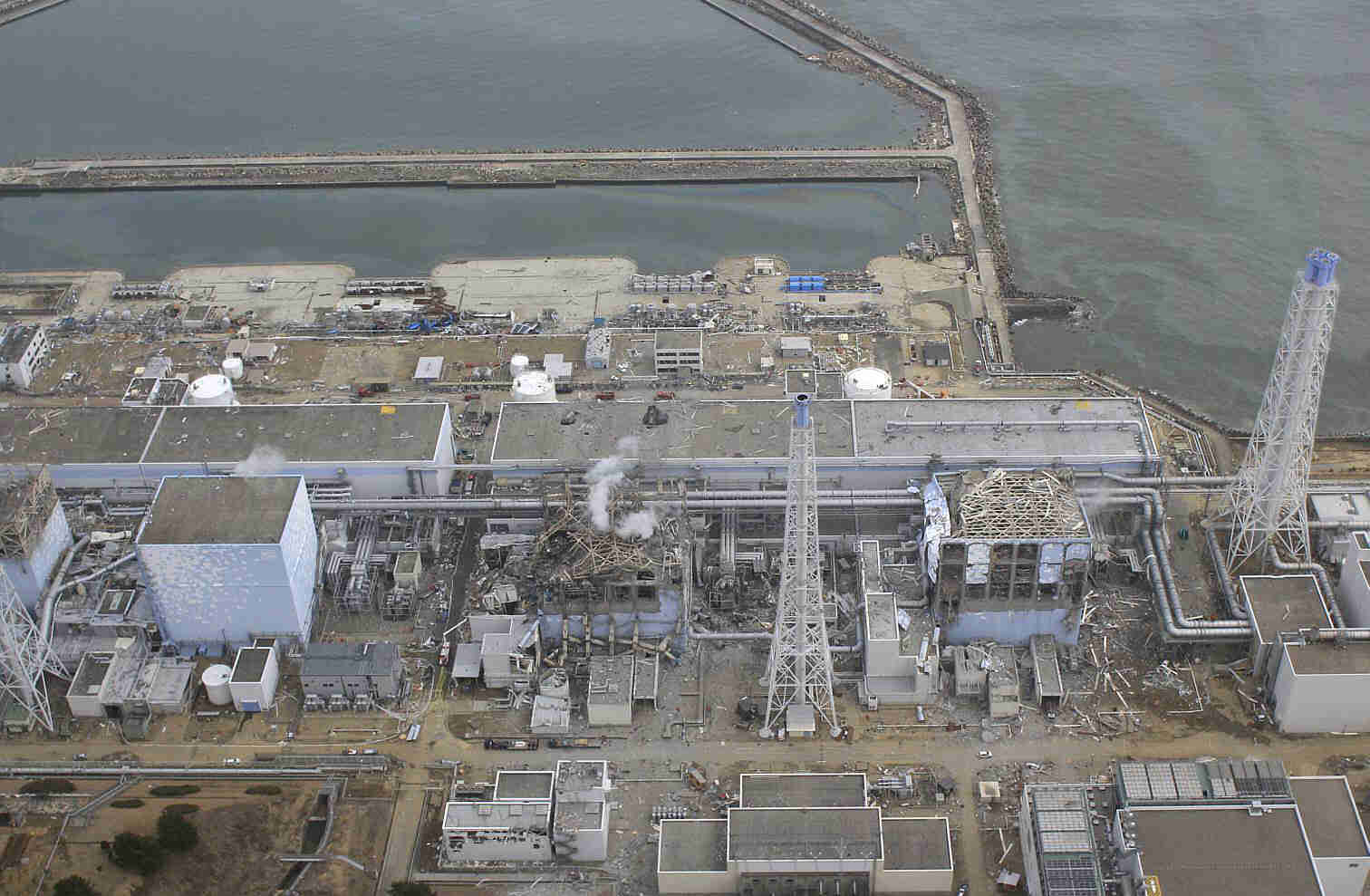
| Update on Japan's Nuclear Crisis Posted: 02 Apr 2011 06:49 AM PDT
The situation at the Fukushima Daiichi nuclear complex is getting worse in many ways, but better in same ways. Here's a quick roundup. Reactor 1 Energy Secretary Steven Chu said that roughly 70 percent of the core of reactor number 1 suffered severe damage. In other words, it came very close to a total meltdown. But things appear now to be stabilizing:
Reactor 2 Tepco announced that there is a crack in the concrete pit of reactor number 2 that is leaking radiation into the ocean from a crippled reactor:
Reuters noted that workers were attempting to plug the crack with concrete, but were facing challenges:
Reactor 3 As previously noted, CNN reported: The New York Times pointed out:
And NHK notes that a giant crane fell over and probably crushed spent fuel rods at in Fukushima reactor number 3, which contain a plutonium-uranium mix: (starting around 1:40 into video). Reactor 4 Nuclear engineer Arnie Gundersen notes that the spent fuel rods in reactor number 4 have water, and the rods are exposed:
Aerial Views of the Destruction As can be seen from the following aerial photograph, there is severe damage at several of the reactors (click the images for larger, high-res versions):
Localized nuclear reactions ("re-criticalities") have re-started at Fukushima causing "blue flashes" above the plant:
|
| The Best of the Bozeman Police Reports Posted: 02 Apr 2011 06:11 AM PDT Culled from the Police Reports page of the Bozeman Daily Chronicle are the best of the Bozeman police reports from the last week along with some items from the Sheriff's Office.
It hit 60 degrees the other day and everyone's got spring fever, but the local ski area will still be open for another two weeks, though snow conditions are likely to deteriorate quickly in the days ahead. It may not come as much of a surprise to regular readers of these Saturday offerings, but Bozeman was recently ranked the fifth drunkest town in the nation while, at the same time, ranked the healthiest county in the state. While the college has a lot to do with both of those surveys (it makes up nearly half the population), other factors are involved, not the least of which are lenient drunk driving laws and this AP story Montana lawmaker's speech perpetuates boozy image goes a long way in explaining how those laws came to be. Without any further ado…
|
| A Visual Presentation Of What Happens To The Market During Rising Interest Rate Cycles Posted: 02 Apr 2011 03:58 AM PDT
While it is no surprise that there is nothing in this world that can derail the optimism of Goldman's David Kostin (GS S&P 2011 target 1,500 until Jan Hatzius and his double Bill Dudley say otherwise), in his latest Weekly Kickstart he does provide a useful visual analysis of what happens in a period of rising interest rate cycles. Of course, this is only to create the illusion that rates are indeed set to rise: as we indicated said illusion was roughly two times stronger this time last year when the market once again didn't remember what a downtick looked like, and yet it all turned out to be a function of QE1, which upon ending on March 31 caused a correction, and QE2 a few months later. We wonder how many professional investors actually are naive enough to equate constant pumping of billions of dollars into the market by the Fed with economic improvement. But while we will get our answer in the next several weeks, here are the key signs to look for in the latter part of the interest rate cycle. The first chart looks at what happens when rates are rising. What is stunning is that the last time we had the commencement of a real interest rate rise was back in 2004. And even that ended up to be far too late to make an impact. Not to mention that all such hikes were in a period of lower lows. Too bad we can't go much below zero (thank you ZIRP).
The next table looks at sector and general market returns X months into a tightening period. For those who buy that much can be gleaned from IR analysis during the great 30 year moderation, the best sector to buy would be IT and Materials.
Then again, since the IT sector return is massively skewed due to the 32% performance from the 1998 dot com bubble, perhaps it is best to avoid it...
The most useless chart of all is the expectation for the Fed Funds rate by Goldman and consensus. In a year we will all be laughing about this one.
Next, for those who care, here is Kostin's traditionally permabullish commentary:
Kostin's full presentation: Charts That Matter 3.31
|
| Posted: 02 Apr 2011 03:17 AM PDT Share this:
|
| Posted: 02 Apr 2011 03:13 AM PDT Silver is very overbought and this fact coupled with the dramatic spike in the silver gold ratio would normally be expected to lead to a significant reaction by both gold and silver, as usually happened following such a situation in the past, but these are not normal times. On its 2-year chart we can see how silver has been romping ahead since it broke out last August and following its latest upleg had become critically overbought by early March, but only a minor reaction followed.
|
| Gold Real Money in a World of Fiat Currency Posted: 02 Apr 2011 03:02 AM PDT Since the Masters of the System have decided to arbitrarily "move the goalposts" to suit themselves by printing money in unlimited quantities, fixing interest rates at artificially low levels, and backstopping the bond market etc, it is incumbent on us as investors to find a fixed point of reference and safe anchorage, the better to weather the financial storms that their crassly irresponsible policies are bringing upon us. That fixed point of reference is gold. As gold is real money it is aloof from the mess and mayhem that now exists in the world of fiat and which is rapidly getting worse - and here it is necessary to make a crucially important point, which is that at this time in world history you have to completely reorder your thinking with respect with gold.
|
| Price controls, cartels, and the collapse of price discovery Posted: 02 Apr 2011 02:46 AM PDT Ben Davies – Gold Will Advance $400 on Price Discovery podcast: Eric King talks to Ben Davies Share this:
|
| Gold, silver coins now officially legal tender in Utah Posted: 02 Apr 2011 02:45 AM PDT ¤ Yesterday in Gold and Silver All was quiet in the gold market on Friday until the jobs numbers came out at 8:30 a.m. Eastern time yesterday...then gold got hit for over twenty bucks. Gold's low price of the day came at the London p.m. gold fix minutes before 10:00 a.m. in New York...and that was the dollar's exact low tick as well. Coincidence? Not likely. The gold price recovered from that point, but still closed the day down $2.90 from Thursday. Silver's fate was a carbon copy of gold's...but it managed to close sixteen cents higher than Thursday. It's been a long while since the bullion banks reacted to the jobs report like this. In 'olden days' it would normally take days or weeks for the price to recover from these sorts of shenanigans...but this time it took less than a day...as the buyers showed up as soon as the selling stopped. The jobs report set off a half-hearted rally in the dollar that came to an end at the London p.m. gold fix. From there,...
|
| The King's Speech: Will It Mark The Top in Stocks? Posted: 02 Apr 2011 02:37 AM PDT
Next week is bound to be a doozy. The SPY and NYA are sitting just under their highs, and The Bernank is scheduled to give his post-FOMC "King's Speech" on April 27. What are the odds that the market is going to have a significant correction going into this speech? At the same time, thousands of hedge fund managers who stepped aside during the recent correction will be forced to get back in to stocks if they take out new highs. After all, the desperation is reaching March Madness levels to "make your year" so they can temporarily "retire" at The Hamptons for the summer. Odds are high that we could have a buying frenzy into the FOMC, and perhaps the day after we could mark a top with a short-covering buying orgy. Because if there is any adverse intraday market action during the FOMC announcement, Ben typically pulls his levers the following day to goose the ES futures in his typical "in your face" fashion. You can imagine the hoopla surrounding this "speech", or press conference, whatever you want to call it. I wonder if Cramer will be moderating? Ags Nightmare over at Wall St. Examiner has an excellent piece on this idea. Absolutely hilarious! http://takemystockplease.com/?p=1200
Why is Ben Bernanke "The King"? Because he has singlehandedly pulled off one of the greatest bull rallies of all time, during a time when the economic fundamentals have been absolutely horrid, and the world is getting hit by one disaster after another. Seems like every day, we hear from the "experts" about how the market is overbought, it has gone up too many weeks and months in a row, and a massive bear market implosion is right around the corner. Even the technical traders like Tom O'Brien over at TFNN.com have been calling tops virtually every day for the last 6 months, making up a myriad number of excuses as to why the market is going to crack the very next day, commodities are going to crash, and the U.S. Dollar is about to embark on a vicious rally. Poor Tom seems to be so convinced, he is starting to believe that he can force the market into submission by sheer force of will. The last couple of weeks, he sounds like he has chugged a 40 oz. can of Red Bull before he does his broadcast. He's getting more hysterical as the market grinds higher and higher. You can hear his latest rant on Friday here: http://www.tigeruniversity.com/mp3/TOS040111.mp3 I seem to be more and more convinced that we must be entering some type of blowoff phase, as I look at several charts which, quite simply, are eye-popping. There must be thousands of fund managers who look at these charts, kicking themselves, wondering how they could have missed out on one of the most astounding stock market rallies of all time.
And none of it would have been possible without the expert engineering by The Bernank, who also must be looking at the same charts, and high fiving with the rest of the staff at the Fed. And no doubt, every other central banker on the planet must also be looking at the same charts, knowing that in the event that there is a financial convulsion somewhere, they will copy Ben Bernanke's move, and try to pull off the same feat. Right now, according to the official statistics, which are constantly regurgitated by Bob Brinker on his radio show, the inflation rate according to the TIPS spread is a paltry 2.9%. And until this "official" inflation rate passes 6%, people are going to continue to heap praise upon "The King", even if gasoline is $7/gallon by the end of the year. After all, who cares if your monthly gasoline bill doubles, if your stock portfolio full of mo-mo stocks has gone up 300% - 600% in two years? And on top of that, the stocks that have gone up the fastest have been travel, leisure, mattresses, rental car companies, internet stocks, etc. Who says the same bubbles cannot be blown up over and over again?
Once again, The Bernank has done the impossible. Blow up bubbles in the exact same sectors that caused all the previous market crashes. Any wonder why he is "The King"??? Of course, this would have been impossible without the FemBots cracking the whip at all the 19-year old crack pipe traders at the big funds, trained to follow momentum and nothing else.
When will this run stop? Nobody knows. Just have to wait for the market to run out of gas and reverse. Maybe Monday? Maybe in three weeks? Who knows? There is no single adjective that can describe the size and scope of these runs.... "Stunning"
"Extraordinary"
"Eye-Popping"
|
| Posted: 02 Apr 2011 02:30 AM PDT Since the Masters of the System have decided to arbitrarily "move the goalposts" to suit themselves by printing money in unlimited quantities, fixing interest rates at artificially low levels, and backstopping the bond market etc, it is ...
|
| Posted: 02 Apr 2011 02:29 AM PDT Silver is very overbought and this fact coupled with the dramatic spike in the silver gold ratio would normally be expected to lead to a significant reaction by both gold and silver, as usually happened following such a situation ...
|
| JPM Stock Price expressed in Oz’s of Silver Posted: 02 Apr 2011 02:12 AM PDT JPM:$SILVER Share this:
|
| Posted: 02 Apr 2011 01:00 AM PDT syndicate: 0 Synopsis: Welcome to the weekend edition of Casey's Daily Dispatch, a compilation of our favorite stories from the week for the time-stressed readers. Dear Reader, Welcome to the weekend edition of Casey's Daily Dispatch, a compilation of our favorite stories from the week for the time-stressed readers. Of course, if you want to read all of the Daily Dispatches from the week, you may do so in the archives at CaseyResearch.com.
|
| ===== SILVER PRICES UNSTOPPABLE ===== Posted: 02 Apr 2011 12:09 AM PDT Silver Shortages (Again!) ATTENTION SLA – LET’S PUSH TO GET SILVER PRICE ABOVE JPM’S CURRENT STOCK PRICE OF $46.35 – JPM HAS PLEDGED ITS OWN STOCK AS COLLATERAL AS PART OF THE NAKED SHORTS THEY HAVE ON SILVER – DRIVING THE PRICE OF SILVER ABOVE THEIR CURRENT STOCK PRICE WILL START TO MULTIPLE THEIR (FOR [...]
|
| Bernanke shows his cards to the WSJ (again) Posted: 02 Apr 2011 12:03 AM PDT
13 Fed officials have given us speeches over the past fortnight. We have heard various views. From Kocherlakota who suggested that interest rate should rise by the end of the year, to Dudley who made it pretty clear that he thinks it would be a mistake to back off the gas pedal anytime soon. None of those speeches matter much. The only thing that counts is Bernanke. The Fed will end up doing what he wants. There is no true debate at the Fed. All the speeches are show ponies to demonstrate that there is open thinking at the Fed. I don’t believe a word of it. But I do believe when Jon Hilsenrath echoes Ben’s thinking. I believe the Ben/Jon duo was at work in this WSJ article today. The critical words from Ben’s lips: (link) a $600 billion program of Treasury bond purchases known as quantitative easing looks likely to run its course as planned in June. This will effectively mean the Fed is moving to a neutral stance of no longer easing while not beginning to tighten policy. Mark Ben’s, Jon’s and my words. This is what the future will bring us. QE will end in June. But the policy of ZIRP will be with us for a long time to come. There are so many factors at play in the big capital markets these days. The Fed is just one element in the equation. But if you focused on just their effort you would have to conclude that the end of QE but never ending ZIRP will bring us the following: -Long end yields are going higher. I think the Fed moves have set us up for a 5% long bond and a 4% 10-year. Long bonds are a sucker play when the Fed continues to pour on the gas. -ZIRP is good for stocks. We shall see about this. One can’t deny that equities are a better place to be than in cash that has a negative return. -The dollar is going to get crushed. The Yen is a wild card that is influenced today by the uncertainties of Fukushima. We could see more weakness there. But the rest of the currencies of the world are going to have to move higher. I see the Euro over 1.5 the Pound pushing 1.7 and the CHF at around 85 to the dollar. The C&A dollars will be a good place to hide as well. -PMs have to move higher. We will maintain a policy of cheap money and dollar debasement. How could the metals not respond? -Inflation is going to roar. The food and energy component of the puzzle that Bernanke refuses to consider is going straight up in my opinion. I wouldn’t be at all surprised to see the non-core CPI up by 5% by the end of the year. We could easily see $5 gas in six months. I think this is an insane next step for monetary policy. We will all pay a very dear price for this. I think it is also insane to have monetary policy conducted through speeches, innuendo and newspaper leaks. 
|
| Ben Davies - Gold Will Advance $400 on Price Discovery Posted: 02 Apr 2011 12:00 AM PDT  With gold and silver hovering near their recent highs, today King World News interviewed Ben Davies, CEO of Hinde Capital. When asked about a possible breakout in gold Ben stated, "The reasons why I believe there is potential for gold to catch up on the upside is that $1,440 level that we have talked about so many times on the show, I mean it's amazing how that has capped the market, and I said we have to get through $1,440. Once we are through that on a weekly closing basis we're going to get discovery which in my opinion can take the market up easily $400." With gold and silver hovering near their recent highs, today King World News interviewed Ben Davies, CEO of Hinde Capital. When asked about a possible breakout in gold Ben stated, "The reasons why I believe there is potential for gold to catch up on the upside is that $1,440 level that we have talked about so many times on the show, I mean it's amazing how that has capped the market, and I said we have to get through $1,440. Once we are through that on a weekly closing basis we're going to get discovery which in my opinion can take the market up easily $400."
This posting includes an audio/video/photo media file: Download Now |




| You are subscribed to email updates from Save Your ASSets First To stop receiving these emails, you may unsubscribe now. | Email delivery powered by Google |
| Google Inc., 20 West Kinzie, Chicago IL USA 60610 | |

No comments:
Post a Comment