


Gold World News Flash |

- Turk - Record Silver Backwardation Spells Danger for US Dollar
- The Swiss Franc or Euro: Good as Gold...?
- A History of Rigged & Fraudulent Oil Prices (and What It Can Teach Us About Gold & Silver)
- Gold Seeker Closing Report: Gold and Silver Rise Almost 1%
- Showing grassroots strength, Paul raises $3 million in Q1 2011
- StockResearchPortal.com?s Gold & Silver Survey Results Very Revealing
- IceCap Asset Management - Kudlow's Foot Meets His Mouth
- In The News Today
- The Five-Million-Dollar Reason for Going Global
- Gold in a Bubble? Keep Telling Yourself That
- Things That Make You Go Hmmm - On Silver Conspiracy Theories And Other Oddities
- Guest Post: Legerdemath II: Anatomy Of A Banking Trick
- Extremes in Silver Sentiment? Don't Worry Yet
- Monthly Gold Charts - March 2011
- Rob Arnott - US In Danger Of Greek Style Collapse
- Gold Price Rose $15.10 to Close Comex at $1438.90, Barely a New High
- When the Government Should Do Nothing
- Food Wars
- Gold Daily and Silver Weekly Charts
- Guest Post: The Five-Million-Dollar Reason for Going Offshore
- The Five-Million-Dollar Reason for Going Offshore
- Silver Set for All-Time Record Quarterly Close
- Welcome to Colombia!
- The best [worst] alternative to a new global currency
- A Dollar as Good as Gold
- Gold settles at record high
- Facebook, your future bank
- Why Consumer Spending is Down Despite Economic Upticks
- LGMR: Euro Escapes Gold's New Highs as ECB Fights for "Credibility", Inflation Rises
- Silver Coin Sales Continue Rising
| Turk - Record Silver Backwardation Spells Danger for US Dollar Posted: 31 Mar 2011 09:00 PM PDT  With gold near all-time highs and silver approaching multi-decade highs, today King World News interviewed James Turk out of London. When asked about silver specifically Turk stated, "We're now at a record backwardation in silver in terms of length of time. I think what we need to do is compare what is happening now to 2009 when silver was in backwardation the last time. Over a period of just about two months silver rose 40% from approximately $10 to $14, and that rise in price eliminated the backwardation." With gold near all-time highs and silver approaching multi-decade highs, today King World News interviewed James Turk out of London. When asked about silver specifically Turk stated, "We're now at a record backwardation in silver in terms of length of time. I think what we need to do is compare what is happening now to 2009 when silver was in backwardation the last time. Over a period of just about two months silver rose 40% from approximately $10 to $14, and that rise in price eliminated the backwardation."
This posting includes an audio/video/photo media file: Download Now |
| The Swiss Franc or Euro: Good as Gold...? Posted: 31 Mar 2011 07:04 PM PDT Bullion Vault
|
| A History of Rigged & Fraudulent Oil Prices (and What It Can Teach Us About Gold & Silver) Posted: 31 Mar 2011 06:30 PM PDT Smart Knowledge U
|
| Gold Seeker Closing Report: Gold and Silver Rise Almost 1% Posted: 31 Mar 2011 04:00 PM PDT Gold climbed to as high as $1439.33 by midmorning in New York and closed just 40 cents away from a new all-time closing high with a gain of 0.93%. Silver climbed to as high as $37.938 and closed with a gain of 0.88% at a new 31-year closing high.
|
| Showing grassroots strength, Paul raises $3 million in Q1 2011 Posted: 31 Mar 2011 03:45 PM PDT Ron Paul's $3 Million Pot of Gold By Andy Barr http://www.politico.com/news/stories/0311/52317.html Ron Paul raked in roughly $3 million during the first quarter through his various political organizations, Politico has learned. Though not all of that money can be transferred to a potential presidential campaign, the big haul demonstrates Paul's continuing force as a grassroots-powered online fundraiser. The Texas congressman raised $1 million through his federal PAC and $2 million through Campaign for Liberty, a 501C(4) that cannot transfer funds directly to political organizations. Paul's fundraising documents, which was to be filed today with the Federal Elections Commission, will also show he has $1.7 million on hand in his congressional campaign account. ... Dispatch continues below ... ADVERTISEMENT Prophecy Resource Spins Off Platinum/Palladium Venture: Company Press Release, January 18, 2011 VANCOUVER, British Columbia -- Prophecy Resource Corp. (TSX-V:PCY)and Pacific Coast Nickel Corp. announce that they have agreed that PCNC will acquire Prophecy's Nickel PGM projects by issuing common shares to Prophecy. PCNC will acquire the Wellgreen PGM Ni-Cu and Lynn Lake nickel projects in the Yukon Territory and Manitoba respectively by issuing up to 550 million common shares of PCNC to Prophecy. PCNC has 55.7 million shares outstanding. Following the transaction: -- Prophecy will own approximately 90 percent of PCNC. -- PCNC will consolidate its share capital on a 10 old for one new basis. -- Prophecy will change its name to Prophecy Coal Corp. and PCNC will be renamed Prophecy Platinum Corp. -- Prophecy intends to distribute half of its PCNC shares to shareholders pro-rata in accordance with their holdings. Based on the closing price of the common shares of PCNC on January 17, $0.195 per share, the gross value of the transaction is $107,250,000. For the complete announcement, please visit: http://prophecyresource.com/news_2011_jan18.php "Dr. Paul's fundraising comes almost exclusively from individuals, not special interests," LibertyPAC director Jesse Benton told Politico. "He received contributions from all 50 states, and his average gift this quarter was under $70, demonstrating his broad grassroots support. "Dr. Paul's grassroots fundraising prowess is unmatched, and any 2012 political endeavor on which he embarks will have the financial backing it takes to win," Benton added. Much of Paul's funds came via a Presidents' Day money bomb that netted $700,000 for his federal PAC. The money bomb was promoted through Paul's Facebook page and libertarian websites promising his fans that "if we show him enough support, he will announce his official candidacy for 2012." Join GATA here: An Evening with Bill Murphy and James Turk https://www.amsterdamgold.eu/gata/index.asp?BiD=12 Or a colorful GATA T-shirt: Or a colorful poster of GATA's full-page ad in The Wall Street Journal on January 31, 2009: http://gata.org/node/wallstreetjournal Or a video disc of GATA's 2005 Gold Rush 21 conference in the Yukon: Help keep GATA going GATA is a civil rights and educational organization based in the United States and tax-exempt under the U.S. Internal Revenue Code. Its e-mail dispatches are free, and you can subscribe at: To contribute to GATA, please visit: ADVERTISEMENT Sona Drills 85.4g Gold/Ton Over 4 Metres at Elizabeth Gold Deposit, Company Press Release, October 27, 2010 VANCOUVER, British Columbia -- Sona Resources Corp. reports on five drillling holes in the third round of assay results from the recently completed drill program at its 100 percent-owned Elizabeth Gold Deposit Property in the Lillooet Mining District of southern British Columbia. Highlights from the diamond drilling include: -- Hole E10-66 intersected 17.4g gold/ton over 1.54 metres. -- Hole E10-67 intersected 96.4g gold/ton over 2.5 metres, including one assay interval of 383g of gold/ton over 0.5 metres. -- Hole E10-69 intersected 85.4g gold/ton over 4.03 metres, including one assay interval of 230g gold/ton over 1 metre. Four drill holes, E10-66 to E10-69, targeted the southwestern end of the Southwest Vein, and three of the holes have expanded the mineralized zone in that direction. The Southwest Vein gold mineralization has now been intersected over a strike length of 325 metres, with the deepest hole drilled less than 200 metres from surface. "The assay results from the Southwest Zone quartz vein continue to be extremely positive," says John P. Thompson, Sona's president and CEO. "We are expanding the Southwest Vein, and this high-grade gold mineralization remains wide open down dip and along strike to the southwest." For the company's full press release, please visit: http://sonaresources.com/_resources/news/SONA_NR19_2010.pdf
|
| StockResearchPortal.com?s Gold & Silver Survey Results Very Revealing Posted: 31 Mar 2011 03:43 PM PDT A survey of 181 investors regarding their expectations for gold and silver over the course of 2011 and the consensus is that precious metals will continue to escalate in price. No surprise there but there were a few other very interesting revelations. Let me explain. Words: 664 So*says*Ian Campbell*(http://www.StockResearchPortal.com) in*an article* which Lorimer Wilson, editor of www.munKNEE.com, has further edited ([* ]), abridged (…) and*reformatted*below for the sake of clarity and brevity to ensure a fast and easy read. (Please note that this paragraph must be included in any article re-posting to avoid copyright infringement.)*Campbell goes*on to say: Vast Majority of Respondents Bullish on Future Gold and Silver Price Trends With respect to gold and silver price trends for the balance of 2011, 84% of the 181 respondents said they thought gold price would trend higher and 89% said they thought that silver would trend higher. * * Majority of Respondents Were 60+* Surprising...
|
| IceCap Asset Management - Kudlow's Foot Meets His Mouth Posted: 31 Mar 2011 02:44 PM PDT
From IceCap Asset Management:
Full report: IceCap-Asset-Management-Limited-Global-Markets March 2011
|
| Posted: 31 Mar 2011 01:40 PM PDT View the original post at jsmineset.com... March 31, 2011 09:22 AM Jim Sinclair's Commentary The madness will not stop. The situation is over the edge. It is not a question of what going forward. The damage is done. Hyperinflation is assured. The new reserve currency will be a virtual currency (average of all major currencies). It will be tied to gold via a worldwide M3 type liquidity. It will not be convertible. All situations like now resolve themselves via a commodity currency. That is the entire story. Stop The Madness: Make The Dollar As Good As Gold Mar. 30 2011 – 1:04 pm Unstable money creates anxiety. By now, the dollar has been unstable enough, for long enough, that this anxiety is popping out everywhere. TV commercials are urging people to buy gold, sales of "survivalist" books are rising, and consumer confidence is plunging. And, on March 22, "money" featured more prominently than tax cuts at a "Supply Side" conference in New York City, at...
|
| The Five-Million-Dollar Reason for Going Global Posted: 31 Mar 2011 01:20 PM PDT http://www.caseyresearch.com/editorial.php?page=articles/five-million-dollar-reason-going-offshore&ppref=TBP231ED0311A Terry Coxon, co-editor of The Casey Report,is president of Passport Financial, Inc., and for over 30 years has advised clients on legal ways to internationalize their assets to optimize tax, wealth protection and estate planning goals. Read here how you can take advantage of a U.S. tax act and save a lot of money [...]
|
| Gold in a Bubble? Keep Telling Yourself That Posted: 31 Mar 2011 12:28 PM PDT Ananthan Thangavel submits: The past few weeks and months have witnessed an impressive rally in the price of precious metals. When any commodity has such an impressive run as silver and gold have, it would be natural to question how far it has left to go. While many market pundits have turned bearish on gold's prospects, we remain steadfast in our belief that precious metals are in a secular bull market, and have quite a ways left to go. As usual, we'll start with technical considerations and move into fundamentals. Is This What a Bubble Looks Like? There has been much talk recently about precious metals being in a "bubble." To be honest, we attribute much of this discussion to the fact that there were two bubbles in the past 10 years, and it is now the craze to try to call the next one. However, such terms should not be taken lightly, Complete Story »
|
| Things That Make You Go Hmmm - On Silver Conspiracy Theories And Other Oddities Posted: 31 Mar 2011 12:26 PM PDT
From Grant Williams: "There are many commentators for whom I have the utmost respect, who completely discount any silver conspiracy theories. They cite the fact that it would be impossible for the manipulation to be conducted in the way that the conspiracy theorists allege or that there are corresponding longs for every short, but yet answers from either the regulators or those supposedly involved in the manipulation are conspicuous by their absence. Let’s face it - if this were a simple case of a misunderstanding it wouldn’t take much in the way of evidence to clear it up now, would it? Over the past several months, each time a futures contract has expired since the price break in silver began in earnest, the delivery situation has gotten progressively tighter until progressively closer to the wire and talk of a commercial signal failure has become progressively louder. The number of people opting to take warehouse receipts for delivery on first notice day has been climbing and stocks in the various warehouses have been declining to the point that it has been touch-and-go as to whether there would be enough physical silver on hand in the warehouses to satisfy demand for delivery. If, at some point in the (near?) future, time runs out and enough people stand for physical delivery, we will find out once and for all whether there is any truth to the manipulation/massive short position stories, and we will CERTAINLY discover how much physical metal there is available for delivery." Full report: Hmmm Mar 30 2011 (2)
|
| Guest Post: Legerdemath II: Anatomy Of A Banking Trick Posted: 31 Mar 2011 12:03 PM PDT
Submitted by Omer Rosen of Legedermath, who will gladly answer any reader questions related to the matter presented in the comment section. Legerdemath II: Anatomy of a Banking Trick In my previous article, “Legerdemath: Tricks of the Banking Trade,” I made brief mention of Treasury-rate locks:
A number of readers expressed a doubt that using a settlement method based on Treasury prices was appropriate. What follows is as good an explanation of Treasury-rate lock settlements as 2,000 words will allow. I have simplified some of the bond math and concepts and will end with an analogy that I hope will elucidate what the math did not. However, as this post hardly qualifies as an easy read, feel free to ask questions in the comments section. Confession: I fudged the word count a few sentences ago to increase the likelihood of you reading on. Forget for a moment, everything you have heard or think you know about Treasury bonds. Taken in isolation, the purchase of a Treasury bond is nothing more than the purchase of a fixed set of future cash flows. If you find the term “cash flows” confusing, think instead of the following: buy a bond today, receive predetermined amounts of money on predetermined dates in the future. In this column I will be referencing a 10-year Treasury bond paying a coupon of 5.00%, with a notional amount of $100. For convenience, I will christen this bond “Bondie.” Sans jargon, the fixed set of cash flows received when purchasing Bondie would be $2.50 every 6 months for 10 years and an additional $100 at the end of the 10th year. There are two basic ways to describe the value of this fixed set of cash flows, either by price or by yield. Price answers a simple question: How much would it cost you to purchase this fixed set of cash flows? This price will change over time, in much the same way that the price of a stock changes over time. Yield expresses the return earned by purchasing these cash flows at a certain price. If you had to pay $100 in order to receive the fixed set of cash flows I described above, then your yield would be 5.00%. If you had to pay more to purchase these same cash flows, say $105, then the return you would be earning (the yield) would be lower than 5.00% – it would be 4.3772%. Intuitively this should make sense – the more you have to pay for a given set of cash flows the lower your return will be. Or, more simply, when prices go up, yields come down. Conversely, if you had to pay only $95 for these same cash flows, the yield earned would be higher than 5.00% – it would be 5.6617%. Algebraically speaking, price and yield are linked by an equation where all the other variables are known. Therefore, if you know the yield of a given bond you can calculate the price of that bond and vice versa. In plain terms, saying you are willing to pay $100 for Bondie is the same as saying you are willing to buy Bondie at a yield of 5.00% (i.e. at a price that will allow you to earn a return of 5.00%). It is similar to how one can describe the speed of a car either by the number of miles per hour it is traveling at or by the time it takes it to travel one mile – if you know one you can solve for the other, and if one goes up the other comes down. To belabor the point, if a car is traveling around a 1-mile track at an average speed of 1 mph then it is easy to solve for the time needed to complete a single lap: 60 minutes. Either “1 mph” or “a 60-minute mile” provides you access to the same knowledge about the speed of the car during that lap. And, if the car’s speed were to increase, the time it would take to complete another lap would decrease (At 2 mph a mile would only take 30 minutes). The same inverse relationship holds true between prices and yields. Now back to Treasury-rate locks. When a company puts on a Treasury-rate lock, it is doing nothing more than taking a short position in a Treasury bond. A short position is a bet that will pay off for the company if Treasury prices go down and go against them if prices go up. Why would they do this? That is a subject for another column and I ask that you accept as an article of faith that sometimes this bet, rather than being a gamble, reduces risk and uncertainty for a company. The short position can be viewed as an agreement under which the client will sell the bank Treasury bonds at a certain price on a set date in the future. This price is determined based on current market conditions. For example, let us say, that based on what current market conditions dictate, the client agrees to sell Bondie to the bank at $95 one month hence. A month passes and Bondie is now trading at $100. The client will have to go into the market, buy Bondie at the current price of $100, and then sell it at a loss of $5 to the bank at the previously agreed upon price of $95. For expediency’s sake, the client just pays the bank the $5 it has lost and the bank takes care of all the buying and selling behind the scenes. The calculation of $5 in the above manner – subtraction – is an example of the price-settlement method of Treasury-rate locks. However, when it comes to bonds, corporate clients do not think in terms of price; they think in terms of yield because yield is expressed in the language of interest rates, the same language companies are familiar with from business concepts such as rates of return and borrowing costs. In theory, this should add only a simple step to the settlement process. The company locks in a sale of Bondie at the same level as before, $95, but rather than quoting them that price the bank quotes them the corresponding yield of 5.6617%. We can refer to this yield as the locked-in yield. A month passes and the Treasury rate lock is settled. Rather than telling the client that Bondie is now trading at $100, the bank tells them that the yield is now 5.00%, having fallen by 0.6617%. But 0.6617% is not a dollar value that can be paid out as a settlement. To calculate the settlement, both yields, 5.6617% and 5.00%, need to first be converted back to their respective corresponding prices, $95 and $100. Taking the difference between the two prices results in the same settlement value we calculated before: $5. But the client is never shown how to settle based on prices. Instead they are introduced to a nonsensical and more complicated method called yield settlement. The sole purpose of this settlement method is to trick the client into allowing the bank extra profit. Whereas price settlement asks the question, “By how much did Treasury prices change?” yield settlement asks, “By how much did Treasury yields change?” As mentioned in the previous paragraph, the yield decreased by 0.6617%. But how does one convert 0.6617% into a dollar value that can be paid out? First, a unit conversion is necessary. For clarity and convenience, finance makes use of a unit called a basis point. Each basis point is equal to 0.01%. Using this new unit, the above decrease of 0.6617% can be expressed as 66.17 basis points. Of course, this solves nothing, only modifying our most recent question slightly: now we ask, how much is each of the 66.17 basis points worth in dollar terms? At this point the client is introduced to a concept called DV01 (Dollar Value of One Basis Point). DV01 is defined as the change in price of a bond for a one basis-point change in yield. For example, if the yield on a bond changes from 5.00% to 5.01% or from 5.00% to 4.99%, by how much would the corresponding price of that bond change? This change in price is the DV01. If yields shifted by 66.17 basis points, DV01 will answer the question of how much each of these basis points is worth. The starting point for this calculation is the yield at the time of settlement. In our example, the yield at the time of settlement is 5.00%. At this yield, the corresponding price of Bondie is $100. If the yield were to rise by one basis point to 5.01%, the corresponding price of the bond would fall to $99.922091, a decrease of 7.7909 cents. If instead the yield were to decrease by one basis point to 4.99%, the corresponding price would rise to $100.077983, an increase of 7.7983 cents. By convention, the average of these two changes in bond prices is taken to be the DV01. So, at a yield of 5.00%, the DV01 would be 7.7946 cents per one basis-point move ((7.7983 7.7909) ÷ 2). If the yield changes by one basis point, price is said to move by 7.7946 cents. Or, in more plain terms, each basis point has been assigned a value of 7.7946 cents. The DV01 is then multiplied by the difference between the current yield and the locked-in yield. In our example the difference between 5.00% and 5.6617% is 66.17 basis points. From the previous paragraph we know that each of these 66.17 basis points is worth 7.7946 cents. Multiplying 66.17 by 7.7946 cents we arrive at a settlement value of $5.1577. This is the yield-settlement method of Treasury-rate locks. Apart from being confusing, the yield-settlement method has resulted in a settlement value that is greater than the $5 calculated using the price-settlement methodology. For a good-sized rate lock, say $500 million dollars worth of 10-year Treasuries, the client would pay the bank an extra $788,500 (500 million x (5.1577 – 5.00) ÷ 100) when settling using the yield-based methodology. This “extra” is profit for the bank. I ask that you stop reading here for a moment. I have stated from the beginning that yield settlement is incorrect. However, when reading the explanation of yield settlement, did you find yourself agreeing with the logic? At what point, if any, did you spot the flaw? And can you guess what happens if prices had gone the other way? If prices had gone down instead of up, say to $90, the bank would have owed the client money. However, yield settlement would have allowed the bank to earn a profit by paying the client less than it actually owed them. No matter what happens to prices, yield settlement allows the bank to earn extra profit. Now picture yourself as a client receiving a tutorial on Treasury-rate locks. You are being instructed by a banker on a matter that seems procedural, in a manner that seems advisory and helpful, without any warning that something might be amiss. You are led through the yield-based settlement process and taught how the DV01 is calculated. If you have access to a Bloomberg terminal you are shown where the DV01 can be found on the relevant Treasury bond’s profile page. Perhaps presentation materials are sent over detailing the mechanics of rate locks and different possible outcomes depending on various possible market movements. And all this is part of a larger interaction, a relationship even, during which the banker is nothing but genuinely friendly and informative. Furthermore, there is a good chance that someone from a different part of the bank, someone who has advised you before, was the one that introduced the two of you in the first place. Would you question your banker? Clients, among them some of the largest corporations in the world, never did. Confident in the tools provided them and blinded by specious logic, the client never even thinks to question the underlying methodology. And, especially since the client is never made aware of price settlement, the methodology does sound logical: Check to see by how many basis points Treasury yields moved. Calculate the dollar value of each basis point. Multiply the two and arrive at a settlement value. However, this methodology is an approximation that always works out in the bank’s favor. Why? Because each of the 66.17 basis points has erroneously been assigned the same value of 7.7946 cents. The DV01 calculated at a certain yield is only valid for a one basis-point move away from that yield. Therefore, while the first basis-point shift away from 5.00% is indeed worth 7.7946 cents, successive ones are not. Put another way, DV01 at 5.00% is different than DV01 at 5.01% is different than DV01 at 5.02% is different than DV01 at every other yield. And so the value of the basis-point change from 5.00% to 5.01% is different than the value of the basis-point change from 5.01% to 5.02% is different than the value of all successive basis-point changes. In fact, even the original DV01 is inaccurate because it was taken to be an average of two different movements. Multiplying the 66.17 basis-point change by a single DV01 ignores all this and assumes that the relationship between changes in yield and changes in price is constant – that each one basis-point move results in a fixed change in price no matter what the yield. Yield settlement takes the graphical representation of the relationship between prices and yields – a curve – and flattens it into a straight line. Admittedly, all this can be a bit confusing. After all, if price and yield are both valid ways of expressing the value of a bond, shouldn’t you also be able to measure the change in value of a bond by looking at either the change in its price or the change in its yield? The math says no. Resorting to hyperbole, teaching the client yield-based settlement is akin to selling them on time travel. Return for a moment to the example of a car driving along a 1-mile track (a conceptual, though not mathematical, equivalent to rate lock settlements). In this analogy, “mph” will play the role of “yield” and “travel time” will play the role of “price.” Assume the car is traveling at a speed of 1 mph. If the car speeds up to 2 mph, the time required to travel a mile decreases from 60 minutes to only 30 minutes – a 30-minute decrease in travel time. This 30-minute change plays the role of “DV01″. Now assume that the car is traveling at a speed of 120 mph. If again the car’s speed increases by 1 mph, here to 121 miles per hour, does the time needed to travel a mile again decrease by 30 minutes? Since a mile only takes 30 seconds to complete at a speed of 120 miles per hour, short of a DeLorean and some lightning, reducing the completion time by 30 minutes would be impossible. The actual reduction in travel time – the “DV01″ – would be only a fraction of a second at this high speed. “DV01″ is not a constant in this analogy either. To extend the analogy, calculating a rate lock settlement would be akin to calculating the difference in travel times for each of two laps. If lap 1 were completed at a speed of 120 mph and lap 2 at a speed of 1 mph, how would you calculate the difference in travel time between the first and the second lap? Would you take the difference between 120 mph and 1 mph and multiply that difference by the 30-minute “DV01″ calculated above? Doing so would imply an impossibly high difference between the two lap times: 3,570 minutes ((120 – 1) x 30). This calculation is the parallel of the yield-settlement method. For makes and models without a flux capacitor, you would simply look at the difference between the times the car took to complete each lap. If a stopwatch is not handy, the following quick math provides the answer: a 120-mph lap takes 30 seconds to complete and a 1-mph lap takes 60 minutes to complete. The difference in travel time between the two laps is therefore 59.5 minutes. This calculation is the parallel of the price-settlement method. As you can see, the 3,570 minutes calculated using the other method is far off the mark. In price/yield relationships the same problem exists – that problem being the realities of math. Yet banks I encountered almost always instructed clients to use the yield-based settlement method. And so a product that is meant to return the difference between two Treasury prices, a matter of elementary subtraction, is perverted for profit. If yields change by very little, this profit does not amount to much. Fortunately, depending on one’s point of view, banks have other tricks for profiting from rate locks and do not rely solely on yield-based settlement. In fact, miseducating clients with yield-based settlement is almost an afterthought, just a bonus that pays off with large movements in yield. Because as yields move by more and more basis points two things happen: First, there are more basis points to infect with an erroneously constant DV01. Second, the constant DV01 becomes an even worse approximation for the proper DV01 of each basis point. In behavior that might be considered yet more sinister, sometimes banks had to implicitly agree with one another to use yield settlement. This transpired if a client decided to divvy up a single rate-lock transaction, with each bank getting a piece of the deal and each bank knowing that settlement of the rate lock would have to be a coordinated affair. All this mathiness is hidden in plain sight. Some examples of yield settlement can be found online. Or you can just ask a company that put on a rate lock to dig up some trade confirmations and see what settlement methodology was used. There are hundreds, if not thousands, such documents in corporate offices around the country, each one part of an unwarranted transfer of millions of dollars from clients to banks.
|
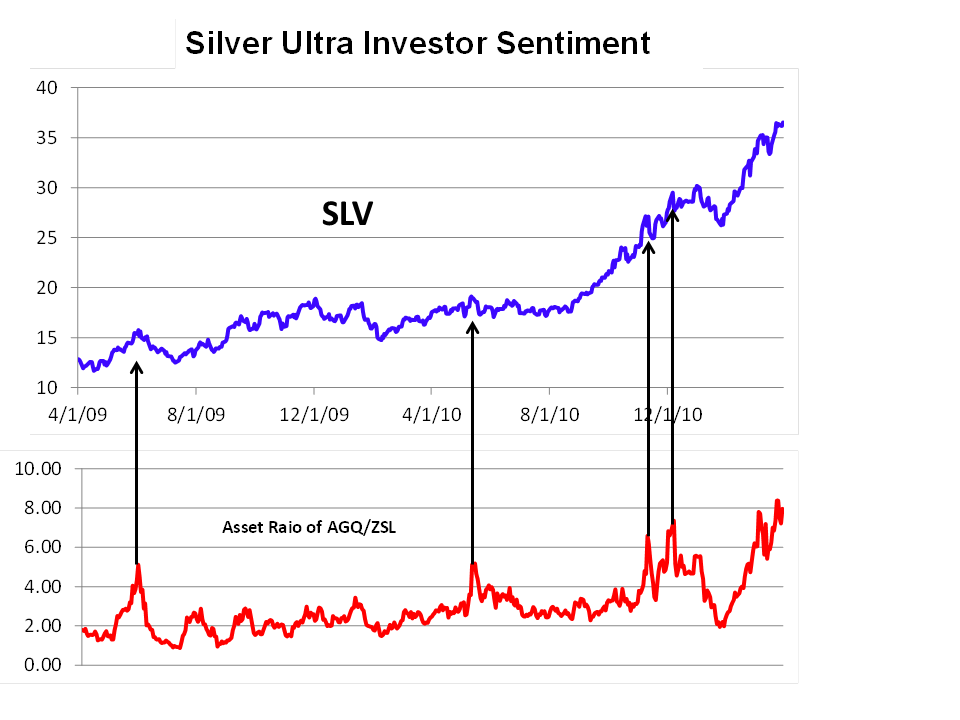
| Extremes in Silver Sentiment? Don't Worry Yet Posted: 31 Mar 2011 11:34 AM PDT Michael James McDonald submits: In an earlier article "ETFs to Consider in Case of a Silver Blowoff" a sentiment indicator made from Ultra silver ETFs was presented. The indicator was the ratio of dollar assets in the double long Ultra silver ETF (AGQ) to those in the double short Ultra silver ETF (ZSL). The ratio was plotted against the price of silver (SLV). It in essence is a contrary opinion indicator showing that at market tops, the ratio is high, indicating an inordinate amount of investor money on the bullish side of silver. The opposite occurs at price lows for silver. The chart from this article is shown below: While an indicator like this is very useful it can be criticized that a lot of the ratio change is from the changing price of the two ETFs and not from investors moving money into and out of the ETFs. Because of this, a complimentary Complete Story »
|
| Monthly Gold Charts - March 2011 Posted: 31 Mar 2011 11:31 AM PDT [url]http://www.traderdannorcini.blogspot.com/[/url] [url]http://www.fortwealth.com/[/url] Gold scored an all time high record monthly close! Gold has now pushed solidly past the 75% Fibonacci retracement level from the 1979 high to the 2001 low in inflation adjusted terms. Note - that this chart uses the government's CPI number which is utterly useless but at least can serve as a type of benchmark against which to compare the current gold price in real terms. ...
|
| Rob Arnott - US In Danger Of Greek Style Collapse Posted: 31 Mar 2011 11:19 AM PDT  King World News today interviewed one of the titans of the financial world Rob Arnott of Research Affiliates who licenses and oversees $75 billion. When asked is there a possibility the United States could experience a collapse similar to that of Greece Arnott stated,"I think there is, I think the US is playing Russian roulette the same way the Greeks were. We're using phony accounting just as they were using phony accounting. The GAP accounting if it was applied to the US government would have shown our deficit in 2009 not at 10% of GDP, but at 18%. King World News today interviewed one of the titans of the financial world Rob Arnott of Research Affiliates who licenses and oversees $75 billion. When asked is there a possibility the United States could experience a collapse similar to that of Greece Arnott stated,"I think there is, I think the US is playing Russian roulette the same way the Greeks were. We're using phony accounting just as they were using phony accounting. The GAP accounting if it was applied to the US government would have shown our deficit in 2009 not at 10% of GDP, but at 18%. 18% of GDP if you factor in new unfunded social security and medicare obligations, if you factor in GSE's, if you factor in the off balance sheet spending that doesn't appear on the balance sheet. If you factor all of these in we spent 18% more than we produced as a nation in '09, well that's horrific. And so is it worse than Greece before they hit the wall? Yeah it is. Is our aggregate debt worse than Greece? Yes, under correct accounting it's worse."
This posting includes an audio/video/photo media file: Download Now |
| Gold Price Rose $15.10 to Close Comex at $1438.90, Barely a New High Posted: 31 Mar 2011 11:18 AM PDT Gold Price Close Today : 1438.90 Change : 15.10 or 1.1% Silver Price Close Today : 37.872 Change : 37.1 cents or 1.0% Gold Silver Ratio Today : 37.99 Change : 0.027 or 0.1% Silver Gold Ratio Today : 0.02632 Change : -0.000019 or -0.1% Platinum Price Close Today : 1767.40 Change : -3.10 or -0.2% Palladium Price Close Today : 763.20 Change : 11.90 or 1.6% S&P 500 : 1,325.83 Change : -2.43 or -0.2% Dow In GOLD$ : $176.99 Change : $ (2.31) or -1.3% Dow in GOLD oz : 8.562 Change : -0.112 or -1.3% Dow in SILVER oz : 325.30 Change : -0.85 or -0.3% Dow Industrial : 12,319.73 Change : -30.88 or -0.3% US Dollar Index : 75.99 Change : -0.128 or -0.2% Here's how y'all can always tell if I have misspoken myself: (1) if it contradicts what I am steadily telling y'all otherwise, and (2) if it makes no sense whatever. Yesterday I typed "swap gold for silver," which clearly was a mistaken inversion. Why? Because I have been telling you to swap silver for gold since the ratio was 47.5, and because you only need to look at a chart and remember that you swap gold for silver when the ratio is HIGH relative to where it has been recently, and swap silver for gold when the ratio is LOW relative to recent level. Sorry, but when I write these in a white hot heat at day's end with other duties yet crying to be done, I will make mistakes. Please forgive me. I took a trip today to go look over some milch cows, but silver and gold did not disappoint me. Dollar may be breaking down. Stocks wavered. Since we live not in a perfect world, we take the best we can get and run home with it. Yes, it would have been better had the GOLD PRICE risen $100 today, but it rose only $15.10 to close Comex at $1,438.90, barely a new high, yet will I hug that to my breast and run home smiling. Now the gold price is clean above its 20 day moving average and has room and momentum to run. It needs only to post an intraday high greater than the last one at $1,447.30. Gold really has no excuse to fall back tomorrow, but if hath strength genuine and lasting, 'twill burst thru $1,439 and close above $1,440. Gold must not decline below $1,425, or 'twill lose this inertia. The SILVER PRICE reached a new high today by adding 37.1c on Comex and closing at 3787.2c. High came at 3792.9c. Now 3800c assumes the role of roadblock and silver must run it over. Underneath silver lie the strong arms of 3740c, and that it must hold. With this running start, like broad jumping, silver may not now stop, pause, and look around but must press heartily toward the goal and leap over 3800c. Expect to see that tomorrow. Bull markets: they climb a wall of worry. Don't y'all think it strange that the Euro is so very jumpy? Today it popped up again, closed at 1.4159, not quite reaching the last high. Is it a double top, or lead up to a higher breakout? Beats me. I can't imagine why anyone would buy euros in the first place, unless he was planning a European vacation. It's a scrofulous fiat currency not one whit prettier than the scrofulous US dollar. Speaking of dollars, the dollar index sank 12.8 basis points to a portentous 75.99. Why portentous? High and heavy symbolism lives within that demoralizing close below 76.00. Right, it's only one point, but why didn't the market allow that point to the upside rather than the down? Technically the dollar hasn't broken down YET, but it is pointed to that last intraday low at 75.25. If it catches there and rebounds, then that's probably the dollar's bottom for this move. If it sinks thru 75.25, then hello 74. STOCKS wavered and faltered today. 'Twas a ragged day. A rally was defeated early, by 10:45. Then down, then a feeble climb above unchanged, then more vibrating, but in the end sinking 30.88 to close at 12,319.73. S&P500 lost 2.43 to 1,325.83. Now picture yourself throwing a basketball straight up in the air. The force of your big, bulging muscles sends it shooting into the air. It's acceleration slows, then it seems to hover an instant, then gravity resumes control and it accelerates toward earth and because you are muscle-bound and so slow moving, it smacks you right across the bridge of the nose and gives you two black eyes and a broken nose. Stocks were doing the hovering part of that today. At the Top of the World Farm we have two (2) mules for sale, one coming 3 and one coming 1. Both were imprint trained at birth, and the coming-3 is gentle as a dog, the coming-1 not so. Both are out of fine Percheron mares. Jack that sired the coming-3 was 18 hands high, huge. Both mules are for sale, so if you are interested call my son Justin at (888) 218-9226. Serious calls only, please. MILESTONES OF AMERICAN TECHNOLOGICAL ACHIEVEMENT: On this day in 1896 Chicago's Whitcomb Judson patented a hookless fastener known colloquially as the "zipper." On this day in 1933 the socialists in the US congress authorized the Civilization Conservation Corps to relieve unemployment by government created jobs. That's what they had to do in the dark times before "stimulus packages" were invented. All things considered, it wasn't too bad. The CCC built some nice state parks and lookout towers and killed some mosquitoes. Argentum et aurum comparenda sunt -- -- Gold and silver must be bought. - Franklin Sanders, The Moneychanger The-MoneyChanger.com © 2011, The Moneychanger. May not be republished in any form, including electronically, without our express permission. To avoid confusion, please remember that the comments above have a very short time horizon. Always invest with the primary trend. Gold's primary trend is up, targeting at least $3,130.00; silver's primary is up targeting 16:1 gold/silver ratio or $195.66; stocks' primary trend is down, targeting Dow under 2,900 and worth only one ounce of gold; US$ or US$-denominated assets, primary trend down; real estate in a bubble, primary trend way down. Whenever I write "Stay out of stocks" readers inevitably ask, "Do you mean precious metals mining stocks, too?" No, I don't. 
|
| When the Government Should Do Nothing Posted: 31 Mar 2011 10:00 AM PDT Gary North in his Reality Check newsletter penned the essay "Gold vs. Guns and Badges," wherein he notes that "There are only two conceptual options in monetary theory: a full gold coin standard in which the citizens hold the golden hammers or a system of economic planning in which elite members of the planning bureaucracy hold the digital hammers. There is no third choice." Not only is he perfectly correct, but we on the lunatic fringe are indebted to Mr. North for making sure that we get some guns and badges on our side, so next time perhaps he will write "Gold, Mogambo Junior Ranger (JMR) badges, and Large-Caliber Weapons vs. Guns and Badges," which will make it a little more even. I am personally indebted for teaching me something clever said by Ludwig von Mises, who, when asked what the government should do to overcome a recession, said, "Nothing. Earlier." Hahaha! Excellent! And to show you that there are new depths of profound meaning all the way through those two little words "Nothing. Earlier," let me also say that I have reconstructed, entirely from memory, the subsequent sentence fragment that was destroyed by, as they say, unseen hands, unwittingly creating this masterpiece of economics and wit. The quote of Mises should correctly go, if I understand both him and the Austrian school of economics correctly, "Nothing. Earlier, you should have rounded up every moron economist advocating for more government spending and/or more creation of money by the Federal Reserve, and lock up the ones for whom you can get enough evidence for a confession or an easy conviction, and persecute the rest of their fellow-traveler academic and government scum, like when they hatch plots against me, like just yesterday, when the glass coffee pot mysteriously developed a crack near the bottom! Continuing, commenting on this, Mises would have surely said, "So sometimes, a small drop or two would leak out of the glass carafe, and it would make a little sizzle on the heated part of the drip-coffee maker, so that every time you went by the pot, it would make a little sizzling noise, and you think to yourself 'The last person to use this pot to pour themselves a cup of coffee was a real slob and dripped it down the side, and now it is boiling away on that heating element, probably as part of a plan to burn the place down and kill me in the blaze, which I now see is their nefarious plan, those rotten, murderous, backstabbing bastards! I'll get my revenge!" Well, now that I re-read that, I'm not sure Mr. Mises would have really said those EXACT words, but you get the drift, even though I was planning on using this as a springboard to segue to a discussion of whether I am irritating because I am loud, or am I loud because I am irritating, which I am required to be because you ignore me when I am not loud and don't get right in your face and say, "Hey! Moron! Go out and buy gold, silver and oil as a save-your-butt defense against a catastrophic economic collapse because of the Federal Reserve creating so much excess money, which they do to commit the horrifying economic sin of monetizing government debt so that the government can borrow the money, thus increasing the national debt, and then spend the money, increasing the money supply, and thus increasing the penalty we will pay in terrifying price inflation for committing such fiscal and monetary arrogance and stupidity, felt most keenly among those who have little or no income to start with, and thus cannot afford higher prices, and who have nothing to lose by rioting and just taking what they want, making the dollar a bigger piece of crap than it is, making gold and silver prices soar." Of course, I was going to use the phrase, "Whee! This investing stuff is easy!" at the end, and I am just waiting until I figure out how to do it. The Mogambo Guru When the Government Should Do Nothing originally appeared in the Daily Reckoning. Daily Reckoning founder Bill Bonner recently wrote articles on stagflation and the great correction.
|
| Posted: 31 Mar 2011 09:57 AM PDT syndicate: 0 Author: Vedran Vuk Synopsis: World food prices are on a rocket track upward, according to the UN's Food and Agriculture Organization – and experts warn that they might pose a serious threat to global stability. Also in this edition: The mining industry is in desperate need for skilled workers, and Doug Casey smashes Warren Buffett's giant-cube theory. Dear Reader, For a while now, I've wanted to write an article on some of Warren Buffett's ridiculous economic statements. But it feels a bit wrong to throw rocks at such a successful investor. However, in the most recent issue of The Casey Report, Doug Casey put it much better than I could. In the edition, Doug dispels about 20 common reasons not to own gold. Of course, one reason is that Warren Buffett is a huge gold bear. Here is Doug's excell...
|
| Gold Daily and Silver Weekly Charts Posted: 31 Mar 2011 09:37 AM PDT |
| Guest Post: The Five-Million-Dollar Reason for Going Offshore Posted: 31 Mar 2011 09:34 AM PDT
Submitted by Terry Coxon of The Casey Report The Five-Million-Dollar Reason for Going Offshore Just when you thought there was nothing more the U.S. government could do to motivate you to ship your financial life offshore, they came up with another one. And if you have a sizeable net worth, it’s a big one; you could save your family $2.2 million in taxes by acting on the opportunity during the next 21 months. A husband-and-wife effort could save twice as much. Included in the 2010 Tax Act passed by Congress late last year are gift and estate tax rules that apply only in 2011 and 2012. Compared to the rules they replaced, and compared to the rules that will take effect in 2013, they are especially permissive. The tax savings come from exploiting those interim rules before they expire. For this year and next, you are granted a $5 million exemption from gift tax. If your bank account can handle it, you could write a check today for $5 million to someone in the next generation and incur no gift tax. But it’s a use-it-or-lose-it opportunity. Starting in 2013, the exemption from gift and estate tax drops to $1 million, and the top tax rate on gifts and estates rises to 55%. (That’s substantially a reversion to the rules in effect in 2002.) So if you do nothing, you lose a free opportunity to reduce your taxable estate by a net amount of $4 million – which, at a 55% tax rate, means your family loses an opportunity to avoid $2.2 million in estate tax. Estate tax has always been an avoidable levy. Regardless of the level of wealth, for those who planned well and planned early, the tax eventually incurred was trivial. The 2010 Tax Act doesn’t change that fact, it just makes it easier, until the end of next year, to exploit the fact. Even so, most people will let the $5 million opportunity slip by, as people always do with estate-tax saving opportunities. Because I hope you won't be one of them, let’s look at the practical impediments to effective estate planning, the things that get in the way and eventually cost the survivors so much in unnecessary tax. Haven’t Gotten to It. Estate planning is not the kind of topic that draws most people in. And it’s generally about the far future, so it’s easy to tell yourself there will be plenty of time to deal with it later. If that sounds like you, maybe the $5 million opportunity that Congress is offering for just the next 21 months will spark some action. Already Did It. If you’ve already done your estate planning homework, you probably don’t want to reopen the matter. But if you have a large estate, making that effort could save your heirs $2.2 million in estate tax. They’ll Waste It. The thought of your 16-year-old grandson touring America on a $50,000 motorcycle likely does not live up to your highest hopes for posterity. Many wealthy individuals hold back from making gifts to younger generations because they don’t want to see the money wasted. Concern that gifts would remove capital from the control of the family’s most astute investor and cunning financial manager also discourages gifts. But such concerns are easily dealt with by using a trust. You can make a gift to an irrevocable trust of which you are the trustee. The property escapes the reach of estate tax, but you continue to decide how the money is invested and when it turns into spendable cash for the beneficiaries. I Might Need It. You don’t want to do such a thorough job of estate planning that you plan yourself into the poorhouse. It’s pleasant to contemplate the financial head start you can provide for future generations, but not if you see yourself at the margin of the picture signing up for food stamps. Offshore SolutionThose are the four reasons the government is able to collect billions of dollars in otherwise avoidable estate taxes every year. There's a way to shrink every one of those reasons and keep your family from eventually contributing to the government’s annual take: use an offshore trust. Here's what happens when you put an offshore trust at the center of your financial planning. Haven’t Gotten to It. For reasons I’ll touch on, an offshore trust is the optimal environment for estate planning. But that’s really just a footnote. An offshore trust is a cornucopia of benefits you can enjoy now. It provides unbeatable protection for your assets – protection from aggressive lawsuits, protection from lightning asset seizures and protection from the possible gold confiscation and currency controls that have many investors worried. It gives you entry to all types of foreign financial institutions, most of which no longer want to deal directly with Americans. That means more and better opportunities for profit and for truly effective diversification, and it means access to tax-efficient investment products you can’t get in the U.S. Because those benefits begin right from the start, they counter the psychology of procrastination. And once you’ve established an offshore trust to gain those benefits, it only takes about 5 minutes of your attention to use the trust to capture the $5 million advantage I’ve been discussing. Already Did It. An offshore trust can accommodate every estate-planning strategy your lawyer has told you about. You won't need to reinvent your estate plan, you'll just need to relocate it. And while you're doing so, you can bring it up to date to exploit the opportunity that was handed to you by the 2010 Tax Act. Moving your estate plan offshore achieves an additional, highly attractive advantage. After your lifetime, the trust completely disconnects from the U.S. tax system. Distributions to your survivors will be reportable and partly taxable, but no one will be subject to U.S. tax on earnings the trust accumulates. The trust needn't be in anyone's taxable estate ever again. And no one will have a U.S. reporting obligation for the trust itself. That's as out of town as money can lawfully get. They'll Waste It. An offshore trust can do as well as a domestic trust in dealing with the spendthrift problem, and maybe a little better. It has an edge because it provides better protection from the creditors some of your heirs someday might attract. In the meantime, it allows you to continue to manage the underlying investments just as you do now. I Might Need It. Here is where an offshore trust shines for anyone who wants to exploit the $5 million opportunity. If you transfer money to a trust, whether offshore or not, and you include yourself as a discretionary beneficiary (one who is eligible to receive a distribution but who has no fixed right to demand a distribution), and you later discover that you need the money for yourself, the trustee will have the power to give it to you. But if the trust is formed in the U.S., the money in the trust probably will remain in your taxable estate, because courts in the U.S. generally will tap into such a trust to satisfy your creditors. By the standards of U.S. gift tax rules, if something is still available to your creditors, you haven't really given it away. (A few states have passed laws that attempt to protect such a trust from the grantor's creditors, but those laws can't protect a trust formed in the U.S. from lawsuits against the grantor in federal courts. The money is still available to at least some of the grantor's creditors, so it is still in the grantor's estate.) The situation in some offshore jurisdictions is different. You can include yourself as a discretionary beneficiary of your trust, and if you later have a problem with a creditor, the courts there will tell your creditor to go away. Because the trust is protected from your personal creditors, your transfers to it move the money out of your taxable estate – even though the trustee has the authority to give the money back to you if you later need it. With an offshore trust, the money's continued availability for your own support makes it far easier to exploit the $5 million opportunity that Congress has handed to you. And if you are married, it's a $10 million opportunity, but it runs out at the end of 2012. Terry Coxon, co-editor of The Casey Report, is president of Passport Financial, Inc., and for over 30 years has advised clients on legal ways to internationalize their assets to optimize tax, wealth protection and estate planning goals. Read here how you can take advantage of a U.S. tax act and save a lot of money in the process…
|
| The Five-Million-Dollar Reason for Going Offshore Posted: 31 Mar 2011 09:24 AM PDT Just when you thought there was nothing more the U.S. government could do to motivate you to ship your financial life offshore, they came up with another one. And if you have a sizeable net worth, it's a big one you could save your ... Read More...
|
| Silver Set for All-Time Record Quarterly Close Posted: 31 Mar 2011 09:18 AM PDT Mark O'Byrne submits: Gold and silver have consolidated on recent gains as inflation, geopolitical and eurozone debt concerns support. Silver has risen above its 31-year record closing price of yesterday and looks set to target new record nominal intraday highs above $38.16/oz. "Poor man's gold" is set for a record nominal quarterly close which will be bullish technically and set silver up to target the psychological resistance at $40/oz and then the nominal high of $50.35/oz . Silver's record quarterly close was $32.20/oz on December 31st, 1979. Click to enlarge While silver is up 22% this year and is heading for a ninth straight quarterly advance, its fundamentals remain very sound. With gold above its nominal record of 1980, poor man's gold continues to be seen as offering better value. To the masses in India, China and Asia, silver is the cheap alternative to gold and an attractive store of value and hedge Complete Story »
|
| Posted: 31 Mar 2011 09:00 AM PDT "Would you invest in Brazil 15 years ago if you had the chance?" our Colombian host asked me one night, in an effort to frame the opportunity here. "Of course, that would've been a home run," I said. "Welcome to Colombia." We were sitting in a comfortable restaurant in Medellin's downtown area. Medellin is a pretty city that spills out across a river valley and creeps up the walls of the surrounding mountains. Medellin's nickname is the City of Eternal Spring, thanks to its temperate weather. If you have an image of Medellin (and Colombia) as a violent place, a visit here would change your opinion. We could have been in any number of cities around the world. I never felt unsafe. (As with any city, there are good and bad areas.) The bars and restaurants were full at night. The skyline was lit with tall buildings. The sidewalks busy with people. It was not always so, as Medellin was once a notoriously dangerous city. Security issues have been a huge problem in Colombia's past, but it is much improved, and most of the remaining issues are deep in the jungles, near the porous borders with Venezuela or Ecuador. (In fact, while we were here, rebels snatched 23 Talisman workers doing seismic work near the Venezuelan border. Even these occurrences, however, are now rare.) Today, Colombia is a young and growing emerging market that has a lot of catching up to do – and that is the core of the investment opportunity here. For example, one day, we visited Cementos Argos, the largest cement company in Colombia, with a 51% market share. It is an asset-rich company. In addition to its cement operations, Argos owns a huge land bank of 5,000 hectares and a portfolio with stakes in three other listed Colombian companies worth $3.3 billion and 600 million tons of coal reserves. We met with Ricardo Andres Sierra, the CFO, who told us in the bad old days, plants could work only from 6 a.m. to 6 p.m. And there were parts of the country where the company simply did not go. But today, the plants run 24/7. "We can go wherever we want," he said. Argos has a huge opportunity in Colombia. As is often the case when a boom arrives, the building of the infrastructure to support the boom comes later. Colombia is way behind in infrastructure. It needs miles and miles of roads. It needs bigger ports, expanded airports and railroads. This has been a recurring theme on our trip, something we heard everyone mention. Sierra gave us an arresting statistic. He said Colombia consumes about 220 kilograms of cement per capita annually, compared to 500 kilograms for Vietnam. The point being that Colombia is well below the consumption rates of comparable developing economies. There is lots of room to grow. We talked about new road projects, such as Ruta del Sol, which will connect Bogota, the capital in the Andes, with Santa Marta, a port city on the Caribbean Sea. We talked about the Cartagena Refinery expansion. Both are huge projects, "as big as the Panama Canal expansion," Sierra said. There is also a tunnel project that will connect Bogota to the Pacific port at Buenaventura. There are projects for hydropower plants, bus systems, pipelines and much more. "Infrastructure is the key to growth in Colombia, that's for sure," Sierra ventured. This has also been one of the surprises of the trip. We had heard and read, of course, about the relative lack of good infrastructure in Colombia. But it is another thing to be down here and see it firsthand. Traffic in Bogota, for example, is impossible – or nearly so. The roads are choked with small cars that go nowhere fast. It seems to take forever to go even short distances. One of our contacts here told us that Colombia has only 300 kilometers of two-lane two-way roads. The government knows this, and there is a lot of money slotted for infrastructure development in the coming years. Argos is in a great position to profit from the build-out of Colombia's infrastructure. So infrastructure is one of the big investment themes we've found here. Another is oil, which is not surprising, as oil makes up 40% of Colombia's exports and is one of the headline-grabbing investment stories in Colombia. The years of violence in the country hampered exploration and development of Colombia's oil assets. The easing of security issues has brought back the oil companies in a big way. Also, Hugo Chavez has chased out a lot of the talented oilmen from Venezuela. Many came to Colombia and used their expertise in heavy oil to tap Colombia's rich Llanos Basin, in the east, which shares a similar geology with Venezuela's prolific fields. What may surprise you is just how quickly it's all happened. Much of the acreage is already locked up. When new blocks come up for bid, they are heavily contested. We met with Charles Gamba, president and CEO of Canacol Energy. He told us there were 67 bidders on their latest block. This industry is developing very, very quickly. In 2003, Colombia licensed only 4% of its available acreage. Today, that's 60%. So there are several companies here that have stocked up an enviable portfolio of prospects to explore. And oil and gas will be an important driver of Colombia's economy for years to come as it develops further. In any case, there are, as in any market at any time, opportunities. And there are certainly opportunities here. Stay tuned! Regards, Chris Mayer Welcome to Colombia! originally appeared in the Daily Reckoning. Daily Reckoning founder Bill Bonner recently wrote articles on stagflation and the great correction.
|
| The best [worst] alternative to a new global currency Posted: 31 Mar 2011 08:43 AM PDT by Joseph Stiglitz … we now have a system dominated by holdings of US dollars. This has several disadvantages. The first is it creates a global recessionary bias during and after financial crises – because it places the burden of adjusting to payments imbalances on nations which run a deficit. The second is the tension it creates, due to the use of a national currency, the dollar, as the global currency. This can lead to global volatility as a result of growing US current account deficits. These deficits are necessary, for creating sufficient global liquidity, but they also generate excessive indebtedness, both external and internal. So if the US were to shrink its deficit too quickly, a deficiency of supply of the global reserve currency could result. … the G20 should encourage the IMF to issue a significant amount of new SDRs during the next three years, up to a value of $390bn a year. …Further, when crises occur in many countries simultaneously, as happened, for instance, during the 1998 east Asian crisis, IMF lending could be totally financed by new SDR issues in unlimited amounts. If and when the world economy recovered or boomed, SDR issues could then cease, or even be reabsorbed. Thus the IMF would have a greater role in creating official liquidity, in a way that curbed both recessionary and inflationary trends at different times. [source] RS View: Joe has been drinking deep from the special tank of Kool-Aid known only to professional economists, and in a fog of sugar-fueled delirium he is seen here trying to sell his fraternity's pipe dream of SDRs that NOBODY is seriously buying. But other than that, keep up the good work, Joe!
|
| Posted: 31 Mar 2011 08:25 AM PDT Mises.org
|
| Posted: 31 Mar 2011 08:04 AM PDT By Myra P. Saefong Gold for [June] delivery rose $15, or 1.1%, to settle at $1,439.90 an ounce on the Comex division of the New York Mercantile Exchange. That handily supplanted gold's March 23 close of $1,438 an ounce. Gold tapped an intraday record high of $1,448.60 an ounce on March 24. "Geopolitical concerns are taking the lead over expectations of [monetary-policy] tightening," said Jim Steel, a precious-metals analyst with HSBC in New York. A rally for oil and concerns about Portugal's sovereign debt also propelled the metal higher, he added. [source]
|
| Posted: 31 Mar 2011 07:55 AM PDT By Ben Kunz So why couldn't Facebook use them as real currency, too? In fact, why couldn't Facebook become your bank? At first blush, this seems like a crazy idea. Facebook would need to overcome consumer privacy concerns, expand its Credits into a payment system that works everywhere, and surmount regulatory hurdles to handle businesses such as deposits and mortgage servicing. Crazy, until you realize how smartphones are changing the world of money. … The next payment platform is no farther than that glass gadget in your pocket. … Facebook recently expanded its monetary systems with Facebook Payments, purportedly for paying app developers. But the incorporation documents state that Payments is "organized for the purpose of transacting any or all lawful business." Hmmm.
[source] RS View: Squarely bagged, tagged, and identified, the critter that runs amok and answers to the name 'Money' is truly little more than an ethereal form of economic communication. No wonder that smartphones and the web-dominating Facebook are well positioned to make inroads on the domain previously dominated by the traditional banks and financial houses. But no matter which entity emerges from the contest as the prevailing monetary messenger, the fact remains that notions of money, being mere words on the wind, can aid in the coordination of the immediate transaction or business at hand, but it can never do adequate service in conveying true wealth across time and space (i.e., geography). For that purpose you need tangible savings, a role for which physical gold is uniquely well-suited and already performing its part.
|
| Why Consumer Spending is Down Despite Economic Upticks Posted: 31 Mar 2011 07:48 AM PDT Today's issue of The Daily Reckoning finds a resurgent US stock market. Despite dipping – briefly – into the red for the year-to-date a couple weeks ago, the S&P 500 is closing out the first quarter with a gain of 6%! Despite the noteworthy stresses around the globe – and the considerable economic uncertainties here at home – the S&P sits less than one percent below its peak levels of the last two-and-a-half years. So the stock market's doing pretty darn well. The US consumer…not so much. The chart below, for example, looks nothing like the ascendant price chart of the S&P 500 Index.
Consumer spending, apart from spending on essentials like food and gasoline, is sluggish at best. A chart of disposable income, after taxes and inflation, would look equally dismal. In other words, despite some measurable upticks in economic activity, these upticks are failing to bear much fruit down at the level where real people earn and spend money. Inflation is chewing up almost all the statistical economic gains of the last several months. Even though incomes are rising somewhat, inflation is rising just as quickly…which means that net wealth is going nowhere. Perhaps that's why companies like Marriott International are posting disappointing earnings results. Earlier this week, Marriott disclosed that its "revenue per available room" (Revpar) will be lower than originally forecast, due to weakness in North American demand. International revenue remains "robust" however, according to Marriott.
Perhaps this "weakness in North America" is a one-off or perhaps it is a sign of things to come. Whatever the case, the contrast between the sluggish growth rates of the world's Developed Markets and the robust growth rates of the world's Emerging Markets is very real…and this contrast is becoming a staple of the global investment environment. Eric Fry Why Consumer Spending is Down Despite Economic Upticks originally appeared in the Daily Reckoning. Daily Reckoning founder Bill Bonner recently wrote articles on stagflation and the great correction.
|
| LGMR: Euro Escapes Gold's New Highs as ECB Fights for "Credibility", Inflation Rises Posted: 31 Mar 2011 07:45 AM PDT London Gold Market Report from Adrian Ash BullionVault Thurs 31 Mar., 09:20 EST Euro Escapes Gold's New Highs as ECB Fights for "Credibility", Inflation Rises, Fresh Debt Crisis Looms THE PRICE OF GOLD price jumped to $1437 per ounce Thursday lunchtime in London – less than 0.8% below last week's new Dollar high – as European stock markets fell together with Eurozone government bonds. Precious-metal trade in Asia had been "a one-way street" said one Hong Kong dealer, with silver "most responsive" to strong demand and rising to $37.80 per ounce in London – just over 1% below last week's new 31-year highs. But gold bullion dealers in India – the world's No.1 physical consumer – reported "a few bookings," says Reuters, quoting a state-owned bank, as "traders still want clarity on prices. "They are waiting for Friday's [US] jobs report." Brent crude oil meantime jumped backed above $116 per barrel as base metals held steady. The gold price in Sterling jump...
|
| Silver Coin Sales Continue Rising Posted: 31 Mar 2011 07:31 AM PDT By Joe Weisenthal By now you know that the surge in silver prices has left gold in the dust. One reason: it's just cheaper to buy silver coins. From Deutsche Bank: According to a recent article in the Financial Times, record sales have been recorded at the world's leading mints over the past several quarters; with sales being rationed [...]
|
 March 31, 2011 (MarketWatch) — Gold futures notched a nominal record high Thursday, as a weaker U.S. dollar, ongoing instability in Arab countries and euro-zone debt concerns lured investors to the precious metal.
 (Bloomberg Businessweek) — … Nongamers may have missed Facebook's clever foray into the world of "virtual currency," where Facebook Credits cost 10 cents each and can be exchanged for game points or cartoony gifts. Those dimes are adding up — the U.S. market for virtual goods will reach $2.1 billion in 2011, according to research firm Inside Network. Facebook's currency, while just part of that market, is getting real. You can now purchase gift cards for Facebook Credits at Wal-Mart, Target, and Best Buy.
 If only one of every five Facebook users adopted Credits to buy things, Facebook would be as big as PayPal. And once Facebook makes us comfortable with Credits, it could then transition to a "traditional" global bank, storing your financial assets like gem points in Bejeweled Blitz.

| You are subscribed to email updates from Save Your ASSets First To stop receiving these emails, you may unsubscribe now. | Email delivery powered by Google |
| Google Inc., 20 West Kinzie, Chicago IL USA 60610 | |



No comments:
Post a Comment