


saveyourassetsfirst3 |

- Gold and Silver Higher - Eurozone Downgrades, Libya and Japan Ignored for Now
- Gold ETF Options for Risk Tolerant Investors
- Japan's Crisis Hurts Sales of Hybrids and EVs
- Gold and Silver as Standards of Value
- <p>What China means for gold</p>
- Gold Breaks Out of "Limbo" as US Feds Tightening-Talk Is Outweighed by Euro Downgrades
- Gold and Silvers Daily Review for March 30th, 2011
- ECB : Purchase of 122 kgs of gold last week
- Warning Signals for Gold Investors
- Silver and Gold catching bid
- More on How Inflation Turns Merchants Into Con Artists
- Japan’s Quake Rattles Economy, Stocks, Bonds And Commerce
- $600 Million Per Week
- Massive Capital Wave Approaches Gold
- San Francisco Mint to join West Point Mint in striking American Eagles
- $8,000 Gold is Not Unreasonable: Robin Griffiths
- Gold: Now That's a Track Record
- World Gold Council to CFTC: Dont mess with paper gold
- Rebuttal to: Bob Moriarty Calls the Top in Silver
- Buying Silver and Avoiding the Sharks
- The Jesuit Gold of the Sierra Madre
- From Authority, With Love
- 19 Reasons Why The Federal Reserve Is At The Heart Of Our Economic Problems
- No Title: Blythe is not worthy of an 'ounce' of respect tonight for a title
- Beware of the Collector's Coach and the Deangelis Brothers
- Gold & Silver Higher as Eurozone Downgrades
| Gold and Silver Higher - Eurozone Downgrades, Libya and Japan Ignored for Now Posted: 30 Mar 2011 05:52 AM PDT gold.ie |
| Gold ETF Options for Risk Tolerant Investors Posted: 30 Mar 2011 04:05 AM PDT Michael Johnston submits: After seemingly losing interest in 2010, investors have resumed pouring money into commodity ETFs in 2011. Both broad-based basket funds and resource specific products have grown as these products have come back into style. Precious metals have without a doubt been the hottest corner of the commodity ETF market, as investors have embraced the exchange-traded structure as an efficient means of accessing an asset class that has the potential to act as both an inflation hedge and a safe haven. There are currently 20 ETFs in the Precious Metals ETFdb Category, including options for silver, platinum, palladium and even broad-based exposure to a basket of metals. But many of the products - accounting for the vast majority of assets - are focused on gold. In addition to the ultra-popular GLD and cost efficient IAU, there are now ETF options for investing in gold vaulted in Switzerland or stored in Singapore. Complete Story » |
| Japan's Crisis Hurts Sales of Hybrids and EVs Posted: 30 Mar 2011 03:38 AM PDT By John Addison The people of Japan are courageously moving forward after the devastation of a 9.0 earthquake, a tsunami that ripped apart buildings and roads, and a nuclear crisis that now threatens their food and water. The Japanese economy depends in no small measure on the success of its automotive industry and its complex eco-system of component suppliers and service providers. Just when gasoline prices are rising and hybrid cars are again hot sellers, the crisis is making hybrids and new electric cars tough to get. Let's look at the impact on three big sellers of hybrids and electrics. Toyota (TM), Honda (HMC), and Nissan (NSANY.PK) are hurt less than expected because they have diversified globally, including billion dollar plants and operations in the United States. The most advanced hybrids and electric cars Complete Story » |
| Gold and Silver as Standards of Value Posted: 30 Mar 2011 02:00 AM PDT Lysander Spooner |
| <p>What China means for gold</p> Posted: 30 Mar 2011 01:40 AM PDT Bill Bonner reflects on a lively and hip journey through LA with his daughter, before revealing the impact China's interest in gold is likely to mean. |
| Gold Breaks Out of "Limbo" as US Feds Tightening-Talk Is Outweighed by Euro Downgrades Posted: 30 Mar 2011 01:37 AM PDT
|
| Gold and Silvers Daily Review for March 30th, 2011 Posted: 30 Mar 2011 01:25 AM PDT
|
| ECB : Purchase of 122 kgs of gold last week Posted: 30 Mar 2011 01:16 AM PDT |
| Warning Signals for Gold Investors Posted: 30 Mar 2011 01:00 AM PDT SunshineProfits |
| Posted: 29 Mar 2011 11:26 PM PDT Both metals catch a bid in the last hour. I guess the downgrading continues over in the EU zone. $US dollar looks iffy here, lets see what Ben can say today that may push it higher to squeeze some shorts, or else she's coming back down to 76 and beyond shortly. Catch you in the afternoon. I am awaiting a call from the Pres. of Tinka. SO far nothing to worry about. In fact I'm hearing juicy |
| More on How Inflation Turns Merchants Into Con Artists Posted: 29 Mar 2011 09:59 PM PDT Dollar Collapse |
| Japan’s Quake Rattles Economy, Stocks, Bonds And Commerce Posted: 29 Mar 2011 09:43 PM PDT "Bank of Japan Pumps Cash, Boosts Asset Purchases by $61B" "The Bank of Japan poured a record amount of cash into the financial system and doubled the size of its asset-purchase plan to shield the economy from the effects of the nation's strongest earthquake on record." "The central bank pumped 15 trillion Yen ($183 billion) into money markets today to assure financial stability amid a plunge in stocks and surge in credit risk. Governor Masaaki Shirakawa and his board enlarged a program buying assets from government bonds to exchange-traded funds by 5 trillion Yen, about one-tenth the size of the Federal Reserve's quantitative easing." "Policy makers said they were concerned corporate and household sentiment will worsen, with production set to decline in the aftermath of the temblor and an ensuing tsunami. The March 11 catastrophe killed an estimated number of more than 10,000 people, shut down factories, prompted rolling power cuts and sparked the risk of a meltdown at a nuclear power plant." "The disaster will push down gross domestic product in the short run, and the BOJ wants to mitigate the deflationary impact through liquidity injections," said Tomo Kinoshita, a Hong Kong-based economist at Nomura Holdings Inc. Japan's currency, which initially climbed against the dollar then retreated in the wake of the central bank's cash injections, stayed lower after the policy decision. It traded at 81.95 as of 6:04 p.m. in Tokyo. Stocks stayed lower, with the Nikkei 225 (NKY) Stock Average closing down -6.2 percent minutes following the announcement." "Manufacturers from Sony Corp. to Toyota Motor Corp. closed plants today, with Sony, Japan's biggest exporter of consumer electronics, halting operation at 10 factories and two research centers. Toyota, the world's largest automaker, said it closed all 12 factories in Japan through March 16." "The BOJ chief told reporters cash injections will continue as needed and it is "crucial" the central bank stabilizes money markets, an indication it will take further steps in coming days. Policy makers boosted their asset-purchase program to 10 trillion yen. The bank said it will increase buying of government debt in the fund by 500 billion yen and boost purchases of short-term government securities by 1 trillion yen. Corporate debt will rise by 1.5 trillion yen and it will also take on an additional 450 billion yen in ETFs and 50 billion yen in Real Estate Investment Trusts, today's statement said." "Today's steps go beyond the forecast of analysts including Takehiro Sato, chief Japan economist at Morgan Stanley MUFG Securities Co., who anticipated that the bank would limit its response to short-term liquidity provision." "The asset-purchase fund was increased in size "with a view to pre-empting a deterioration in business sentiment and an increase in risk aversion in financial markets from adversely affecting economic activity," the BOJ policy board said in its statement. Since the earthquake "the Bank of Japan has been trying to gauge "The disaster may have killed 10,000 in Miyagi prefecture north of Tokyo, said Go Sugawara, a spokesman for the prefectural police department. The official toll reached 1,597, with 1,481 more missing and 1,683 injured, the National Police Agency said. With Prime Minister Naoto Kan planning a supplemental budget to pay for reconstruction, Moody's Investors Service said today that Japan may "at some point" reach a fiscal "tipping point" if investors lose confidence in the soundness of public finances and demand a risk premium on government bonds" -Mayumi Otsuma and Keiko Ujikane Bloomberg.net 3-14-11 Our Northern Advisor On The Japanese Earthquake: "That was a biggie. This tragedy will be a game changer for Japan. In the short term, the recovery spending should boost their GDP. There is no problem paying for the infrastructure rebuilding…just print more Yen. But, just like post-Katrina, there will be a lot of finger-pointing on the negatives of how the recovery operation and re-building is managed. The political fallout will be the real economic game changer. The present Japanese government is very weak, not having a majority, so it is likely the earthquake will also bring down the current political structure. A major earthquake like this one makes the entire earth vibrate and ring like a bell. Besides the continuing after-shocks in Japan, I wouldn't be a bit surprised to see another big Pacific area earthquake in the next few days, or         This posting includes an audio/video/photo media file: Download Now |
| Posted: 29 Mar 2011 09:22 PM PDT
Mercenary Links Roundup for Tuesday, March 29th (below the jump).
03-29 Tuesday
|
| Massive Capital Wave Approaches Gold Posted: 29 Mar 2011 09:00 PM PDT |
| San Francisco Mint to join West Point Mint in striking American Eagles Posted: 29 Mar 2011 08:07 PM PDT  Here's an interesting story that was posted over at coinworld.com on Monday. Tom Jurkowsky, director of the U.S. Mint's Office of Public Information, confirmed March 23rd that trial strikes are currently being produced at the San Francisco Mint, with full-scale, temporary production to begin sometime in May. The trial strikes are being produced to ensure that the quality of the American Eagle silver bullion coins struck at the San Francisco Mint replicate the quality of those produced at the West Point Mint, according to Jurkowsky. |
| $8,000 Gold is Not Unreasonable: Robin Griffiths Posted: 29 Mar 2011 08:07 PM PDT  I don't have too many precious metals-related stories today...and the first one is a short King World News blog that Eric sent me late last night. Griffiths says that..."Most western economies can't get what Lord Keynes said about gold out of their head, he said it was a barbarous relic. And in our western culture it still is a barbarous relic, but we're moving into a world where the cultures of China and India are going to be more dominant...and they are the engine of the world's growth. In their culture, gold is real money, has been for thousands of years...and will be in the future." |
| Gold: Now That's a Track Record Posted: 29 Mar 2011 08:07 PM PDT ¤ Yesterday in Gold and SilverTuesday's action in both gold and silver was a virtually carbon copy of what happened on Monday...with the highs and lows pretty much occurring at the same times on both days. The charts are eerily similar...but if there is something nefarious about it...what might it be?
The dollar fell a bit in Far East trading...and hit its nadir at precisely 10:00 a.m. during the London trading day [5:00 a.m. Eastern]. From there it rose to its zenith at precisely 9:00 a.m. Eastern time exactly four hours later. From there it went into slow decline until the close of New York electronic trading at 5:15 p.m. Eastern time. One thing is for sure...the precious metals prices were not influenced by anything the currency markets were doing.
The top in the gold price on Tuesday is not hard to find on the HUI chart below. From there, the gold stocks sold off gently into the close of trading. Unlike Monday, when the HUI was down 1.62% on the day, the gold stocks finished slightly in the black yesterday...with the HUI up 0.18%. This, despite the fact that gold was down a few more dollars from the Monday close. With silver virtually unchanged from Monday, the silver stocks themselves closed basically flat on the day.
I mentioned in this column yesterday that there were about 40 silver contracts left to deliver in March...so the latest CME's Delivery Report was no surprise. There were zero gold along with 41 silver contracts posted for delivery on Thursday...but since Thursday is first notice day for the April gold contract, the deliveries/transfers will probably be made late today. There were quite a few issuers and stoppers in this delivery report...and, considering this delivery month in silver got dragged right down to the wire, it was all very strange. The link is here. There were no changes in either GLD or SLV yesterday...and the U.S. Mint only reported selling 1,500 one-ounce 24K gold buffaloes. There was pretty big activity over at the Comex-approved warehouses on Monday...and I would suspect that the activity had something to do with the March delivery month. They received 1,199,831 ounces of silver...and shipped 320,170 ounces out the door, for a net increase of 879,661 ounces. It wouldn't surprise me in the slightest that the silver brought in was by the short contract holders for delivery to the longs...and it's possible that more may be shipped in during the next couple of business days. We'll see. The link to yesterday's action is here. I read the other day that the Perth Mint is ending it's unallocated silver program [pool accounts] as of May 1st. These are accounts that have no physical silver backing them. All the 'silver owner' has is a piece of paper that says they own silver. Anyone already in, will be grandfathered...but they won't accept any new customers. There's probably a good fundamental reason why the Perth Mint [soon to be followed by every other mint/bullion dealer/bank that have pool-type accounts] will be closing their doors to new buyers...and that's because of the current liabilities that these companies face with the paper silver holders that they already have on their books. As a 'for instance'...let's say that the Perth Mint has 5 million ounces of paper silver sold in their pool/unallocated account under $10 the ounce. They got less than $50 million free dollars in exchange for little pieces of paper they gave the buyers...but they're all still sitting out there waiting to be redeemed at some point in time...and I would bet these are mostly unfunded liabilities to boot. When silver hits $50 or $100 the ounce...those 10 million ounces under $10...and a lot more above that price...are going to be heading for the exits. It's easy to see that in a very short period of time, the Perth Mint could be on the hook for $250 million to $500 million or more in payouts. Do they have that kind of cash laying around? Now repeat this scenario with every other company that has a pool or unallocated silver account set up for cheapskates who don't want to pay the storage fees for the real metal...and you could see big trouble in River City. This announcement by the Perth Mint should be a clarion call to get the heck out of paper silver asap...because the mint can already see the handwriting on the wall...and are moving to protect themselves. As you know, I've never been a fan of pool accounts, ever since silver analyst Ted Butler explained to me what they were. So do yourself a big favour. If you own one of these types of paper accounts...sell, and then buy the real deal...and take delivery while you still can. This announcement by the Perth Mint should be a clarion call to get the heck out of paper silver asap. $8,000 Gold is Not Unreasonable: Robin Griffiths. San Francisco Mint to join West Point Mint in striking American Eagles. Perth Mint closes unallocated silver accounts for new customers as of May 1st. ¤ Critical ReadsSubscribeFood Inflation Kept Hidden in Smaller BagsMy first story today was sent to me in the wee hours of yesterday morning by Russian reader Alex Lvov...which I just didn't have the space for in Tuesday's column. Companies in recent months have tried to camouflage price increases by selling their products in tiny and tinier packages. So far, the changes are most visible at the grocery store, where shoppers are paying the same amount, but getting less. This cnbc.com story is well worth reading...and the link is here.  Forget About a Raise; More Consumers Expecting Pay CutHere's another cnbc.com story...this one courtesy of Australian reader Wesley Legrand. More Americans expect their salaries to be cut soon, reversing a steady decline in the number of workers who fear pay cuts, according to a March survey. Adding insult to injury, those same consumers expect to take a bigger hit on expenses because of rising inflation. The link is here.  US consumers use savings to pay for basicsThis next story is from The Telegraph out of London...and I 'borrowed' it from yesterday's King Report. Americans' savings rate dropped last month as new figures showed that consumers are using more of their disposable income to cope with the rising cost of food and petrol. This is important story is not overly long...and the link is here.  Home prices decline in all but two of 20 major U.S. marketsHere's a real estate story courtesy of Washington state reader S.A. that was posted in the L.A. Times yesterday...and the headline pretty much says it all. There's nothing to read...just a graph...and the graph is worth 1,000 words, as they say. It's well worth looking at...and the link is here.  China bank regulator warns of property bubble risksHere's a Reuters piece that was filed from Beijing that showed up posted over at finance.yahoo.com yesterday. As you are already aware, China is experiencing its biggest real estate bubble in history...and this bubble is just floating around looking for a pin. Risks that could lead to a property bubble are still building up in China, and more action is needed to cool speculative fervor, the country's banking regulator said on Tuesday. "The quantitative easing policies adopted by the U.S., European countries and Japan have added more pressure to emerging market inflation and asset prices, creating uncertainties for the world economy," it added. Given this context, Chinese banks have to make full preparations for future difficulties, the China Banking Regulatory Commission said. This is another 'whistling past the graveyard' type of story...and I thank reader Scott Pluschau for bringing it to our attention. The link is here.  Argentine government hopes to apply new index this yearHere's another story that I 'borrowed' from yesterday's King Report. Earlier this year I ran a piece about Argentina's inflation rate where the story stated that the government was going to come out with a 'new and improved' inflation rate index that would cook their inflation rate lower...and this story is a follow-up on that one. The government says the 2010 inflation rate was 'only' 10.9%. The International Financial Institute says that it was more like 30%. This very short story is posted in the Buenos Aires Herald...and the link is here.  $8,000 Gold is Not Unreasonable: Robin GriffithsI don't have too many precious metals-related stories today...and the first one is a short King World News blog that Eric sent me late last night. Griffiths says that..."Most western economies can't get what Lord Keynes said about gold out of their head, he said it was a barbarous relic. And in our western culture it still is a barbarous relic, but we're moving into a world where the cultures of China and India are going to be more dominant...and they are the engine of the world's growth. In their culture, gold is real money, has been for thousands of years...and will be in the future." As I mentioned, it's a short read...and the link is here.  San Francisco Mint to join West Point Mint in striking American EaglesHere's an interesting story that was posted over at coinworld.com on Monday. Tom Jurkowsky, director of the U.S. Mint's Office of Public Information, confirmed March 23rd that trial strikes are currently being produced at the San Francisco Mint, with full-scale, temporary production to begin sometime in May. The trial strikes are being produced to ensure that the quality of the American Eagle silver bullion coins struck at the San Francisco Mint replicate the quality of those produced at the West Point Mint, according to Jurkowsky. I thank reader 'Jon from Washington state' for sharing this story with us...and it's well worth reading. The link is here.  |
| World Gold Council to CFTC: Dont mess with paper gold Posted: 29 Mar 2011 07:47 PM PDT
|
| Rebuttal to: Bob Moriarty Calls the Top in Silver Posted: 29 Mar 2011 05:32 PM PDT The Moriarty Factor Wallace, Idaho – The recent skirmish between the publishers of "Don't Tread on Me" (Max Kaiser) and 321 Gold's Bob Moriarty highlights again the latter's utter ignorance of the dynamics of the silver market and its potential. Thankfully, the former has published this email exchange with Moriarty, whose arrogant, vicious, crude, personal and uninformed comments resemble more a psychotic episode than a mere temper tantrum. You can read the Zipperhead's toned-down version of it here, sans the expletives. It's disheartening such level of discourse could emit from the owner of a Cayman Islands website whose sheeple follow this guy for advice even as he shorts into their 18-hour post-recommendation buying spree and shakes down his latest fair-haired company for free stock and advertising revenue. Moriarty's disclaimer at the end of each of his blow-jobs, to wit: "We own shares, they advertise with us, and we are prejudiced" hardly dismisses his duty to perform objective analysis. Admitting you're crooked doesn't absolve you of being a crook. It's also reminiscent of the putrid, personal and vicious attacks Moriarty has launched against movers and shakers in the Coeur d'Alene Mining District of northern Idaho, where he has spent, to our knowledge, the sum of about 6 hours but claims expertise far beyond those who live, work and invest here – or, one suspects, any other mining district he elects to bash or pump. So, how does a guy whose every major "call" in the silver sector has been wrong since he discovered it six years ago get on? Good question. He'll sure never speak at the Silver Summit; we'd take Thom Calandra pumping Ivanhoe first, and that ain't going to happen, either. The young Turks in this game, like Moriarty, who in the 1970s didn't know silver from galena or gold from porphyry copper, and never studied Aristotle or Descartes, can be forgiven their grotesque misapprehension of the dynamics forming up in silver. But until the markets have slammed them up against the wall a few times they ought to proceed with curiosity and humility, not bombast and threats. A newby's innocence can be forgiven. A newby's aggressive, belligerent ignorance is another matter. There are silver zealots, to be sure, bristling with Biblical exhortations and end-of-the-world humdiddlin', and there even people who like Coeur d'Alene Mines, but we don't see any zealotry in what Kaiser wrote about the white metal. To which we'll add some immutable truths: 1. The death of the silver price in the early 1980s was, in fact, a political act, not a market correction. Bunker Hunt spoke out of class to National Geographic in 1980, saying the Hunts ought to issue Silver Certificates since the U$ Dollar was no good anymore. Carter's Fed and Treasury had to protect the U$D, and broke dollar-fears over the back of silver; 2. Event No. (1) cannot happen again, because the billion-plus ounce "surplus" silver in the U.S. Strategic stockpile used to crash the price has all been sold. There is no physical metal with which the Fed can ever again crush silver; 3. Back in the late 1970s and early 1980s, whenever silver showed a pulse, we had an office pool at the newspaper as to how quickly Eastman-Kodak would issue a press release saying it was near to discovering a substitute for silver in silver-halide photo film. Kodak hated $5 silver. That ephemeral "discovery" momentarily depressed the price, but guess what? They never found one. It took digital imagery to get silver out of the photo business, but guess what again? That turned out to be a zero-sum game: for all those ounces of silver not going into the manufacture of photo film, there were an equal number of ounces of silver not being recovered in the film-developing process to be returned to the market as "scrap"; 4. Silver disappears. Its use in cell phones, computers, autos, medicine, as a flux or a reflector, while ubiquitous, is no threat to the supply chain. Silver would have to cost as much as gold (i.e. 40-x or so) to render it economic to recover; 5. Primary silver mining is a small part of the supply equation. Most newly-mined silver is a byproduct of copper, lead, zinc and even gold mining. So yes, at $35, you'll see some ratcheting-up of new silver from primary mines. But 70 percent of silver production on the planet is not driven by the silver price. So there's no chance that $35 silver (or $50 or $100 or even $200) silver will significantly boost new production – at least not in the next few decades; 6. There are substitutes for silver in some critical industrial applications. They are gold, currently $1,425 an ounce, and palladium, currently $746 an ounce. Until there is a price parity with either of those other two metals, silver remains the economic choice. No religion here, just cold, hard facts. And we didn't even get into the area that is most important: that silver as money predates gold. It's a means of commerce and exchange, a store of value, and a hedge against the hegemony of dishonest magistrates. Moriarty may periodically proclaim silver to be in bubble-shape, but he neglects millennia of monetary history to the contrary. We're defensive of our little primary-silver mining district here in the mountains of northern Idaho, especially when it is under attack by ignorant slatterns. So we were a tad amused when, in the aftermath of Moriarty's latest attack upon us two years ago, we offered our defence up to a senior manager at Sprott Asset Management and we were confronted with a dumb stare. http://www.24hgold.com/english/news-...08108190G10020 |
| Buying Silver and Avoiding the Sharks Posted: 29 Mar 2011 05:02 PM PDT I keep pounding, pounding, pounding the table that silver is the biggest bargain out there, for, at last count, a jillion reasons, and that anybody who does not buy silver Right Freaking Now (RFN) is making the mistake of a lifetime, and the family is all, like, "Will you please stop pounding the table? It is irritating and is making things spill, aside from the fact that we don't have any money with which to buy silver, and you know that!" which devolved into a lengthy discussion about who among them was the most irritated with me and everything I say or do. |
| The Jesuit Gold of the Sierra Madre Posted: 29 Mar 2011 05:00 PM PDT BC alter |
| Posted: 29 Mar 2011 03:18 PM PDT --First off, yesterday's DR finished with the promise that today's would be about the Reserve Bank of Australia...its history...its mandate...and its similarities and differences to the U.S. Federal Reserve. It will have to wait until next week. --The more we read yesterday, the more we realised it would take more than the usual superficial treatment we give such subjects in the Daily Reckoning. And with today's announcement that the Board will have two new directors, there is more grist for the mill. But don't worry! It's too important a story not to be told, so we'll keep working on it. --It's worth working on because the story contains the answers to some key investment questions...like what happens to the Aussie dollar in a U.S. dollar crash...what happens to Aussie interest rates next...and whether the RBA can or would print money like the Fed if (when) Australia has its next financial crisis. --In the meantime, we're going to ignore all the price action in the market and focus on two other stories; the banking sector's denial of financial reality and Ross Garnaut's academic understanding of innovation and knowledge. We'll begin with the banks. --The global banking sector—Australia included—is generally in a state of denial about the future. Major banking reforms (Basel III) came out of the last crisis to prevent the same problem from happening again. The main problem was too much leverage. Banks built huge pyramids of assets on a tiny little base of liquid capital. When asset values fell quickly, capital was wiped out and had to be replaced (either by private investors or mostly by the government and central banks). --What compounded the problem is that bank's financed long-term lending (expansion of assets on the balance sheet) with short-term borrowing (expansion of liabilities). But while the assets and the liabilities might be matched in terms of size, they weren't matched in terms of duration. --Without getting too technical, the "duration gap" is a measure of the risk associated with having mismatched liabilities and assets. That risk is mostly from interest rates. For example, if you've borrowed short and lent long and interest rates rise, it means your borrowing costs go up right away while the value of your long-term assets goes down (interest rates tending to rise with inflation). --Double plus un-good. --Of course the main problem is that in the last 30 years banking has become an incredibly profitable business, especially for the men who run the banks. Expanding the balance sheet (more loans) is the way to grow earnings. And most bank managers seemed happy to do this in the credit boom, especially since the global cost of capital was absurdly (and artifically) cheap and all asset markets everywhere were going up. --No one (except Dr. Kurt Richebacher) seemed to recognise it as a worldwide credit-fuelled asset bubble. And when banks finally realised what had really happened (what they in part created), they were caught with falling assets and an urgent need to raise new capital. Which brings us to today. --Europe's banks alone will have to raise as much as $3.2 trillion in order to meet the new liquidity requirements of the Basel III bank regulations. "Basel III, due to be implemented in 2019, proposes requiring banks to hold enough cash or liquid assets to meet liabilities for a year," Bloomberg reports. "The aim is to wean banks off the short-term funding from other lenders that dried up during the crisis and sent Lehman Brothers Holding Inc. into bankruptcy." --You wouldn't expect banks to like any kind of rule that limits their profitability. But that's where all this, if left unchanged, is headed. Another set of regulations—the European Union's Solvency II regulations (which are due to come into effect in two years)—would make it more difficult for insurance companies to buy long-term bank debt. Banks would be unable t match long-term loans with long-term bonds. --Simon Willis from Daniel Stewart Securities Plc. in London says if banks can't sell corporate bonds to insurers, they will have to borrow more from other banks, increase their deposit base to use as a source of funding, or, horror of horrors, lend less. An increased cost of funds eats into profits. And lower lending levels definitely eat into profits. It is hard to build your art collection with lower profits. --It's no wonder Australian banks (and the Treasury) are resisting the G-20's push to label Australia's big four banks as "too big to fail." This would require them to hold even more capital than already proposed. The Aussie banks assure us they are well-regulated and not at risk of causing a systemic crisis because they have lent prudently and have plenty of liquid capital. Got that? --There are two forces at work here, then. One is the banks, who really want to go back to the good old days when they could borrow freely and loan liberally and not be constrained by capital and liquidity requirements. The other force is regulatory, which sees unlimited bank balance sheet growth (and low interest rates) as the sort of thing that can blow up a global economy (not desirable). --What does any of this have to do with covered bonds? Funny you ask! That question came up yesterday over a beer with a friend. The conversation went something like this... --"Come on, Dan. You're not seriously arguing that an Australian bank is going to fail if the housing market crashes...and that the RBA is going to have to print money so the government can bail out depositors...are you? I mean, covered bonds wouldn't cause all that, would they?" --"No, that wasn't my point." --"Well you should make your point, because it wasn't very clear." --"Okay. My point was that Australia's financial system looks a lot like all the other ones that got into trouble. Introducing loan guarantees...buying up residential mortgage-backed securities...allowing for covered bonds...and introducing the Financial Claims Scheme...all of it manages to accomplish one major result." --"Which is?" --"Australian banks offload all of the risk from bad lending decisions to the taxpayer, via the government. The banks have every incentive to maximise profit because all the losses are going to be backstopped by the government. This isn't capitalism at all. It's what I called it yesterday, The Great Australian Bank Robbery, only the banks are robbing the people by forcing a set of regulatory changes that shift the risks on to the public." --"Oh. Well, you act like it's a bad thing that banks are trying to find a way to funnel more money to the housing market. A lot of Australians own houses. The government and the banks should support the housing market or else a lot of people might lose a lot of money." --"That's not capitalism either. That's organised asset price inflation. And it's just inflation. It's not real wealth. Increasing a nation's productive capacity (its capital stock) through investment produces real wealth. Trading houses between one another at higher and higher prices using more and more borrowed money is not wealth creation. It's gambling. And it's going to blow up." --"You're such a buzz kill." --Apparently we are also a hatchet man, at least according to one reader:
--Well Ross, at least you got one thing right. Garnaut, as the government's climate adviser, is little more than a mouthpiece for a predetermined position, and is probably being compensated for his efforts. His job is to produce a credible sounding and authoritative looking report that supports the government's position, preferably filled with a lot of impressive jargon, bullet points, charts, and footnotes. --But if you're still reading, you should go back and read what we said again. Our criticism of Garnaut was that being an economist doesn't make one a climate change expert. This is nothing more than an argument from authority, which is a tried-and-true logical fallacy. As an American nutter, our view is that authority can stick it in its ear. --Being a doctor doesn't make Garnaut right. Being in the majority doesn't make him right. What would make him right is if he had a winning argument. If he wants to win the argument about climate change, he should stop treating the Australian public like a bunch of ignorant children who need to be told what to do. --Yet this is what he said recently, according to the ABC: There's no doubt that there is a battle, an awful battle between ignorance and knowledge going on. It's a great contest between the academies of sciences of Australia ... the academies of science of all of the countries of scientific achievement on the one side, and the shock jocks of Australia on the other. We've had these battles before in the history of our civilisation. This battle will have quite a lot to do with the future prosperity of Australia, the future quality of our civilisation. --Can't you just smell the condescension in that statement? This is an indirect way of saying, "Don't argue with me because I'm smart," or its corollary, "You should shut up because you're stupid." --But have a look at the key points in Garnaut's latest update (number 8!) to his 2008 climate change report. This update is about nothing less than "Transforming the electricity sector." In this report, Garnaut concludes that, "the introduction of a carbon price is highly unlikely to threaten physical energy security." In other words, he's saying it won't put coal companies out of business. That's disputable (although many would find it desirable), but he adds this bit: Nevertheless, it may be prudent to implement cost effective policy measures to assuage concerns about energy security and to improve the regulatory functions of the energy market. These measures include
--Did you get that? He doesn't think his reforms will put the power industry out of business. Why? Because he's going to form a committee with new powers to, you know, do things...and then have the government back-stop loans to keep newly unprofitable power companies from going out of business, if necessarry. --Hmm. It seems like it would be easier to not introduce 'reforms' that could put Australia's power companies out of business. But that would not be transformative. And the ultimate goal of the central planner and bureaucrat is to transform the nature of free markets so that everything flows through an elite bureaucracy of technocrats, of which Garnaut happens to be a high priest. --But you have to give him credit. He does have faith. And strangely, he seems to have a lot of faith in the private sector to spontaneously generate technological improvements in response to a new carbon price introduced by the public sector. He says, "We need a lot of technological change, fast," as if it's like ordering, saying, a lot of fried chicken when you're hungry. --This seems like a fairly academic (and unrealistic) understanding of innovation; a kind of "just in time" technology change which eliminates all the negative effects of your policy change. What's worse, Garnaut thinks that spending more money will magically produce the innovation required. Of course it's government money (your money). He writes that: One potential driver of accelerated technological development in low-emissions technology is the recent increase in public investment in innovation following the Great Crash of 2008. The injection of substantial 'green' stimulus spending by governments within stimulus packages following the Great Crash reversed the 35-year decline in real terms in low-emissions energy research, development and demonstration (IEA 2010) and raises the prospect of significant breakthroughs. This may extend beyond breakthroughs in learning by doing to shifts in technological processes or shifts in the production function. --Translation, "Garble garble blah blah blah. Spend more public money on innovation and you'll get the breakthroughs you need to make your policy workable or mitigate its wealth-destroying effects. Garble garble blah blah blah." --It's important to point out that we're not making an ad hominem attack on Garnaut the man. We're merely raising two important points about how bad his ideas are. First, Garnaut has been selected as the point man on climate change to give credibility and authority to a report on a policy the government has already selected. There's nothing objective about his 'expert' opinion. --You might think of this as an argument, "From authority, with love." He seems likable enough. And he is a doctor. He's just the sort of guy to give covering fire to a government eager for more revenue and power over private and public life. But likable or not, the argument is from authority and for authority. And that should not be the basis of changing the cost of energy and the whole structure of production in the Australian economy. --Our second important point is that Garnaut doesn't know as much as he thinks he does. Neither do we. Neither do you. He's only human in this regard. But perhaps he doesn't recognise it. A bit of self-knowledge (and modesty) wouldn't go amiss (yes , we aspire to this modesty as well). --Specifically, he's making the text-book economic mistake made by central planners and government bureaucrats. Like most people with a great faith in planning, he's confident that his knowledge is complete and superior. But total knowledge in a complex and dynamic system is never possible. Friederich Hayek makes this point in his essay, The Use of Knowledge in Society (emphasis added is ours): The peculiar character of the problem of a rational economic order is determined precisely by the fact that the knowledge of the circumstances of which we must make use never exists in concentrated or integrated form but solely as the dispersed bits of incomplete and frequently contradictory knowledge which all the separate individuals possess. The economic problem of society is thus not merely a problem of how to allocate "given" resources—if "given" is taken to mean given to a single mind which deliberately solves the problem set by these "data." It is rather a problem of how to secure the best use of resources known to any of the members of society, for ends whose relative importance only these individuals know. Or, to put it briefly, it is a problem of the utilization of knowledge which is not given to anyone in its totality. --Hayek's point, admittedly, is about planning in general, and prices. But the point remains: Garnaut is bulldozing through the climate change debate with pages and pages of predictions and prescriptions without complete knowledge of a) whether carbon dioxide is a pollutant, b) whether human beings are causing global warming, c) how the climate even changes over the long term. --That is a lot of known unknowns. And it's a lot of ambiguity to sweep under the rug as you make even more sweeping changes to Australia's economy. But maybe we should just take his word for it and hope for the best. After all, with the government and a bunch of economists and academics in charge of the economy, what could possibly go wrong? You should shut up and do what you're told. Dan Denning |
| 19 Reasons Why The Federal Reserve Is At The Heart Of Our Economic Problems Posted: 29 Mar 2011 03:06 PM PDT 
If you really want to understand what is causing our economic problems, it is absolutely crucial that you understand exactly what the Federal Reserve system is and how it is systematically destroying our economy. Once you understand the truth about the Federal Reserve, you will view economic issues a whole lot differently. The following are 19 reasons why the Federal Reserve is at the very heart of our economic problems.... #1 The Federal Reserve system is a debt-based financial system. The way our system is designed, normally no money comes into existence without more debt being created. But this creates a huge problem, because when a new dollar is created, the interest owed to the banking system on that dollar is not also created at the same time. Therefore, the amount money that is created is not equal to the larger amount of debt that is also created. This is a Ponzi scheme that is designed to drain wealth from the American people and transfer it to the banking system. Today, the amount of debt in our economic system is far, far, far greater than the total amount of money. The only way to keep the game going is to create even more money which creates even more debt. #2 The Federal Reserve and the bankers have a monopoly on the creation of this debt-based money. In the United States today, the only people that can create money are the bankers. You cannot create money. You would go to jail if you tried. Even the U.S. government cannot create money. Although the U.S. Constitution specifically gives Congress the power to create money, the U.S. Congress has given that power to the Federal Reserve and to the banking system. This gives them an enormous amount of power. So how does money creation actually work? Most Americans don't understand this. As I have written about previously, the way our system is designed is that all money is supposed to originally come into existence as government debt....
Once "Federal Reserve Notes" are in circulation, there is another way that money is created. It is called "fractional reserve lending". Once you or I deposit money into a bank, the bank is only required to keep a very small amount of it actually in the bank. The rest of it the bank can loan out to others (at interest of course). This process can be repeated over and over and over, creating more money and an even larger amount of debt. But the important part to take away from all this is that normally money is only created when debt is created, and the amount of debt to be paid back is always larger than the amount of money created. This entire system is designed to drain our wealth and to put it into the hands of the bankers. #3 The power of money creation and debt creation is in the hands of private individuals - not the government. The Federal Reserve claims that it is an "entity within the government, having both public purposes and private aspects." That sounds so reasonable, but the truth is that the Federal Reserve is a legalized banking cartel that is privately-owned. In fact, the Federal Reserve is about as "federal" as Federal Express is. In defending itself against a Bloomberg request for information under the Freedom of Information Act, the Federal Reserve objected by declaring that it was "not an agency" of the U.S. government and therefore it was not subject to the Freedom of Information Act. It is kind of funny how Fed officials are always talking about how important their "independence" is, but whenever anyone starts criticizing them for being private they start stressing their ties with the government. So who owns the Federal Reserve? As the Federal Reserve's own website describes, it is the member banks that own it....
In particular, as we will see below, the banks of the New York Federal Reserve have the most influence over the system. So who owns the member banks? Well, when you trace the ownership of the member banks to the very top you find that the international banking elite are very strongly represented. #4 The Federal Reserve itself is not much of a profit-making institution. Rather, it is a tool that enables others to make obscene amounts of money. There are many that think of the Federal Reserve as an evil profit-making machine. But the truth is that the Fed doesn't make that much money. Rather, the system was set up so that others could make an obscene amount of money from U.S. government debt. Many of those opposed to the Federal Reserve point to the record $80.9 billion in profits that the Federal Reserve made last year as evidence that they are robbing the American people blind. But then those defending the Federal Reserve will point out that the Fed returned $78.4 billion to the U.S. Treasury. In the end, those numbers are not nearly as important as the hundreds of billions of dollars in interest that are made off of U.S. government debt each year. If the U.S. government had been issuing debt-free money all this time, the U.S. government would likely not be spending one penny on interest payments. Instead, the U.S. government spent over 413 billion dollars on interest on the national debt during fiscal 2010. This is money that belonged to U.S. taxpayers that was transferred to the U.S. government which in turn was transferred to wealthy international bankers and other foreign governments. This is where the magic of the Federal Reserve system is. It is in getting the U.S. government enslaved to debt and using that debt to transfer hundreds of billions of dollars of our wealth into the hands of others. As interest rates go up, this phenomenon is going to become even more brutal. Right now it is being projected that the U.S. government will be paying 900 billion dollars just in interest on the national debt by the year 2019. As you fill out your tax return this year, just keep in mind that vast quantities of our money is going to pay interest on debt that the U.S. government never needed to become enslaved to. There are some very happy people out there that are becoming fabulously wealthy at our expense. What a system, eh? #5 The Federal Reserve is a perpetual debt machine. As mentioned above, the U.S. government is enslaved to debt. So how did it get enslaved? Well, instead of printing up and spending the money that it needs, the U.S. government borrows it through the Federal Reserve system at interest. In fact, as noted above, the U.S. government cannot create a single new dollar without borrowing it. But each new dollar that the U.S. government borrows creates more than a dollar of new debt. As a result, the government eventually has to collect more in taxes than what it has borrowed. This phenomenon creates an endless debt spiral. And is that not what we have in the United States today? In fact, you see this in almost every nation on earth where a similar central banking system has been established. Did you know that the U.S. national debt is more than 5,000 times larger than it was 100 years ago? That's right - back in 1910, prior to the passage of the Federal Reserve Act, the national debt was only about $2.6 billion. The only way that the U.S. government can inject more money into the economy is by going into more debt. But when new government debt is created, the amount of money to pay the interest on that debt is not also created. In this way, it was intended by the international bankers that U.S. government debt would expand indefinitely and the U.S. money supply would also expand indefinitely. In the process, the international bankers would become insanely wealthy by lending money to the U.S. government. However, things did not have to turn out this way. If the Federal Reserve had never been created, and the U.S. government had been issuing debt-free currency all this time, it is entirely conceivable that we would have absolutely no federal government debt at this point. Unfortunately, we are now trapped in a debt-based system. The U.S. national debt simply cannot ever be paid off. U.S. government debt has been mathematically designed to expand forever. It is a trap from which there is no escape. Sadly, we have now gotten to a terminal phase of the debt spiral. The Congressional Budget Office is projecting that U.S. government debt held by the public will reach a staggering 716 percent of GDP by the year 2080. Remember when I used the term "debt spiral" earlier? This is what a debt spiral looks like....
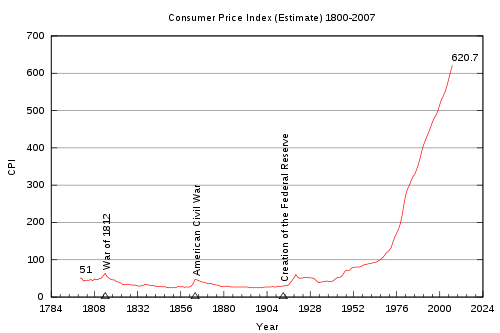
#6 The Federal Reserve system is designed to cause inflation. As U.S. government debt expands at an exponential pace, it inevitably causes inflation. Most Americans believe that inflation is a fact of life, but the truth is that the United States has only had a major, ongoing problem with inflation since the Federal Reserve was created back in 1913. Sadly, the U.S. dollar has lost well over 95 percent of its value since the Federal Reserve was created. If the Federal Reserve did not exist, it is theoretically conceivable that we could have an economy with little to no inflation. Of course that would greatly depend on the discipline of our government officials (which is not very great at this point), but the sad truth is that our current system is always going to produce inflation. In fact, the Federal Reserve system was originally designed to be inflationary. Just check out the inflation chart posted below. The U.S. never had massive problems with inflation before the Fed was created, but now it is just wildly out of control....
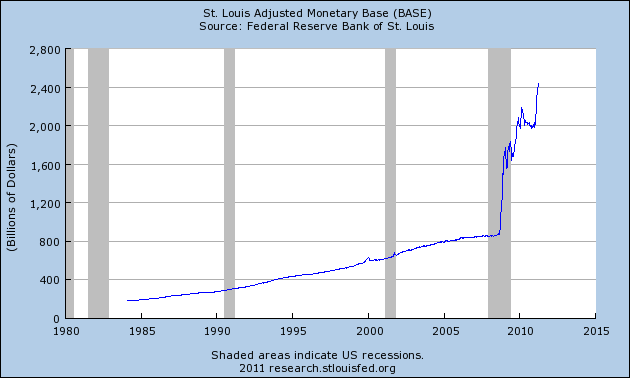
#7 The Federal Reserve has decided to play bizarre games with our money supply. In a desperate attempt to revive the dying U.S. economy, the Federal Reserve has resorted to chucking gigantic quantities of cash into the financial system. Remember how earlier I explained that normally whenever new money is created that more debt is created? Well, lately the Fed has been resorting to a trick called "quantitative easing". What "quantitative easing" means is that the Federal Reserve zaps massive amounts of money into existence out of thin air and starts spending it on anything that it wants to buy. Lately, this has primarily been done to buy up U.S. government debt. But isn't that "monetizing the debt"? Of course it is, and it is a blatant Ponzi scheme. However, what is even more alarming is what this is doing to our money supply. Just look at what has happened to our monetary base since about mid-2008....
Does anyone in their right mind believe that this is not going to cause horrible inflation? Right now most of the new cash is tied up in the financial system, but once it gets out into the regular economy watch out! #8 The Federal Reserve is undemocratic. In a previous article, I asked the following question:
In both cases, a bunch of unelected elitists run the economy and make important economic decisions for the rest of us. So what really is the difference? #9 The Federal Reserve runs the U.S. economy. Most Americans want to blame Obama or Bush or the U.S. Congress for the state of the economy. But the truth is that it is the Federal Reserve that sets interest rates, it is the Federal Reserve that determines the money supply, it is the Federal Reserve that sets the "target rate" of inflation, it is the Federal Reserve that determines if unemployment is too high or too low and it is the Federal Reserve that watches over all of our banks. Yes, Obama, Bush and the U.S. Congress all have things to answer for as well. But none of them have the direct power over the economy that the Federal Reserve does. #10 The Federal Reserve favors the big banks. Not all financial institutions are treated equally by the Fed. The truth is that the big banks (particularly those on Wall Street) are treated with great favor by the Federal Reserve. If the Federal Reserve did not exist, the big Wall Street banks would not have such an overwhelming advantage. Most Americans simply have no idea that over the last several years the Federal Reserve has been giving gigantic piles of nearly interest-free money to the big Wall Street banks which they turned right around and started lending to the federal government at a much higher rate of return. I don't know about you, but if I was allowed to do that I could make a whole bunch of money very quickly. In fact, it has come out that the Federal Reserve made over $9 trillion in overnight loans to major banks, large financial institutions and other "friends" during the financial crisis of 2008 and 2009. Wouldn't you like to be able to zap trillions of dollars into existence and loan it out to your friends at very favorable terms? Sadly, most of the "help" from the Federal Reserve always seems to go to the big boys. When "small enough to fail" banks need assistance, they are usually told to go sell themselves to one of the big banks. #11 The worse the debt problems caused by the Federal Reserve become, the more money the IRS needs to collect from the rest of us. If the U.S. government could issue debt-free money, it is conceivable that we would not even need the IRS. You doubt this? Well, the truth is that the United States did just fine for well over a hundred years without a national income tax. But about the same time the Federal Reserve was created a national income tax was instituted as well. The whole idea was that the wealth of the American people would be transferred to the U.S. government by force and then transferred into the hands of the ultra-wealthy in the form of interest payments. If the Federal Reserve was shut down, it is entirely possible that we would be able to shut down the IRS as well. But the only way that the current system works is if massive amounts of wealth continue to be drained from the American people. #12 The Federal Reserve creates artificial financial bubbles. When you look back over the last several decades, you will find financial bubble after financial bubble. So who created all of those bubbles? It was the Federal Reserve. The ridiculous policies of Greenspan and Bernanke have wrought disaster after disaster and yet most of our politicians still will not even consider major changes to the Federal Reserve. #13 The Federal Reserve is anti-free market. In a true free market system, the marketplace would determine what interest rates are. In a true free market system, the marketplace would determine which financial institutions survive. In a true free market system, artificial financial bubbles would be far less likely. But we don't have a true free market system. #14 The Federal Reserve tells the rest of the our banks what to do. Most Americans don't understand just how much power the Federal Reserve actually has over our local banks. For example, just last year Federal Reserve officials walked into one bank in Oklahoma and demanded that they take down all the Bible verses and all the Christmas buttons that the bank had been displaying. #15 The people currently running the Federal Reserve pretty much have no idea what they are doing. In case anyone has not noticed, Federal Reserve Chairman Ben Bernanke has a very long track record of incompetence. Nearly every major judgment that he has made since taking over that position has been dead wrong. If one of us could go down the street and appoint the manager of the local Dairy Queen as the Chairman of the Federal Reserve, it is very doubtful that person would do a worse job than Bernanke has done. #16 Even though the Federal Reserve has such extraordinary power over the financial system, the American people are not permitted to examine their books. The Federal Reserve claims that they are regularly audited, but when some members of Congress attempted to push through a true comprehensive audit of the Fed last year Federal Reserve officials threw a hissy fit. The truth is that the Federal Reserve has never undergone a true comprehensive audit since it was created back in 1913. Whenever the subject of an audit comes up, Bernanke and others at the Fed keep repeating the mantra of how important "the independence of the Federal Reserve" is. Sadly, Ron Paul's proposal to audit the Federal Reserve last year, which had previously been co-sponsored by 320 members of the U.S. House of Representatives, No Title: Blythe is not worthy of an 'ounce' of respect tonight for a title Posted: 29 Mar 2011 11:56 AM PDT |
| Beware of the Collector's Coach and the Deangelis Brothers Posted: 29 Mar 2011 11:47 AM PDT |
| Gold & Silver Higher as Eurozone Downgrades Posted: 29 Mar 2011 11:00 AM PDT Gold and, particularly, silver are higher in European trading, especially in Japanese yen, which has come under pressure again today. The initial "repatriation funds" yen rally in the days after the natural and nuclear disaster has abated. |


| You are subscribed to email updates from Gold World News Flash 2 To stop receiving these emails, you may unsubscribe now. | Email delivery powered by Google |
| Google Inc., 20 West Kinzie, Chicago IL USA 60610 | |

No comments:
Post a Comment