


saveyourassetsfirst3 |

- Income, Growth and Black Gold: Canada's Trifecta
- J M Smucker: It's a Tasty Investment Idea Now
- Is Kinross a Takeover Target?
- The Contango Report: Wheat's Contango Grows Significantly
- China Imports 245 Tonnes Of Silver In February And Qatar SWF “Interested” In Silver
- Market Report
- Fifteen mining stocks set for a big rebound
- Gold Ownership Now Illegal in Australia!!!!
- Aussie Gold Stocks Surge
- Ag needs a medication review.
- Revisionist View Of The Great Depression
- Shaken: 10 Economic Disasters Which Threaten To Rip World Financial Markets To Shreds
- The Stupid Variable
- Paging Blythe, Silver fiat denominated silver price approaching $36 again, Paging Blythe
- Where There Is Smoke...
- Gold Investment Grows on ‘Forex Volatility’
- Gold Prices still Strong Despite the Earthquake
- When the Oil Price Portends Recession
- COMEX Other Reportable Traders Net Short Gold
- Spot's Getting a Little Frisky Tonight
- North Carolina wants to issue their own gold/silver backed currency...and you thought the bears 4 video was full of shit?
| Income, Growth and Black Gold: Canada's Trifecta Posted: 21 Mar 2011 06:38 AM PDT The Sovereign Society submits: What should you be looking at right now? In my opinion: junior and mid-cap oil and gas stocks. They're poised to blast even higher as oil prices resurge and investors grab the bull by the horns. And in 2011, the biggest, juiciest stocks that fit this description reside in Canada's energy sector. But why Canada? And why now? Why Canada, Why Now Few countries escaped the wrath of the 2008 global financial crisis. Canada was one of them. Sure, the Canadian economy did suffer a major short-term pullback in late 2008 as the financial system quickly came undone. But within months of the March 2009 bottom in world asset prices, Canada became the beneficiary of massive international fund-flows. What worked in its favor? First, its prudent mortgage lending and strong bank capitalization ratios. Second, it suffered only minimal losses from esoteric fixed-income and mortgage-backed securities. And third, foreign investors just Complete Story » | ||||||
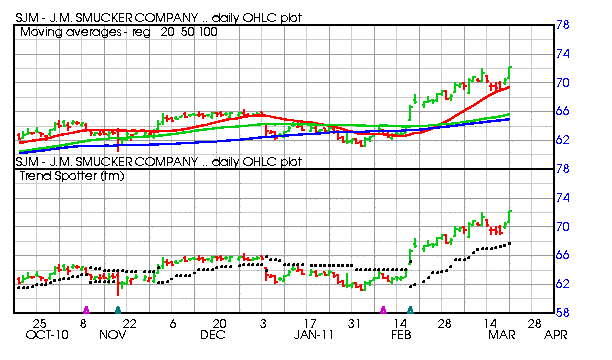
| J M Smucker: It's a Tasty Investment Idea Now Posted: 21 Mar 2011 06:34 AM PDT Jim Van Meerten submits: I've enjoyed the nice homey Norman Rockwell-like commercials about the 2 little Smucker boys walking through the orchard preparing themselves to one day take over Grandpa's jam operations. Well to my surprise the Co-CEOs are the little Smucker boys all grown up - with Little Timmy as Chairman and Richard as President. Grampa's jam operations is J M Smucker (SJM) now a 5 billion dollar operation. (Click to enlarge) The J.M. Smucker Company, with headquarters in Orrville, Ohio, is the leading marketer of jams, jellies, preserves, and other fruit spreads in the U.S. It also is the leader in dessert toppings, natural peanut butter, and health and natural foods juice products, and markets a wide variety of other specialty products throughout the U.S. and in many foreign countries. In the fruit spreads category, it also holds the leadership position in Australia and Canada. The product line-up sounds like my pantry. Complete Story » | ||||||
| Posted: 21 Mar 2011 06:20 AM PDT Streetwise Blog submits: By Boyd Erman Shares of Kinross Gold (KGC) have taken such a beating relative to the company's gold mining peers that there's a buzz on some trading desks that the miner is a ripe takeover target. Shares of Kinross are down almost 23 per cent so far this year, as of Friday. By comparison, Goldcorp Inc. (GG) has gained 2 per cent, Barrick Gold Corp. (ABX) has lost 8 per cent and Newmont Mining Corp (NEM) is down 17 per cent. The result is that in price-to-net-asset value, Kinross looks cheap. According to a recent analyst report from Canaccord Genuity, Kinross is trading at a substantial discount to peers in the senior and intermediate gold group. Kinross was trading at 14.98 at 2:56 p.m. today. There's no sense that anything is imminently going to happen to Kinross. But when traders see a valuation gap like that they can't help but Complete Story » | ||||||
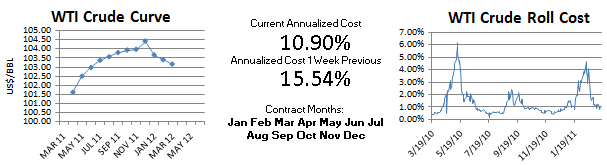
| The Contango Report: Wheat's Contango Grows Significantly Posted: 21 Mar 2011 05:45 AM PDT Hard Assets Investor submits: Has oil moved into backwardation yet? What does corn's roll yield look like? How do you know when it's time to buy—or sell?
EnergyNYMEX WTI Crude Oil CONTANGO WATCH: The one-year WTI Crude Oil forward curve flattened on the front end and moved into backwardation on the back end—a Complete Story » | ||||||
| China Imports 245 Tonnes Of Silver In February And Qatar SWF “Interested” In Silver Posted: 21 Mar 2011 01:43 AM PDT From GoldCore China Imports 245 Tonnes of Silver in February and Qatar SWF "Interested" in Buying Silver Gold and silver rose on the open in Asia and have continued those gains so far in European trading with the Libyan military conflict leading to a safe haven bid and falls in the dollar and yen. The all time and multiyear nominal dollar highs set on March 7th ($1,444.95/oz and $36.75/oz) look set to be challenged as gold is less than 1% from its record high and silver less than 2% from its nominal recent high. see more.... http://www.zerohedge.com/article/chi...-buying-silver That's a lot of SAE's!!! Looks like the petro-dollar is breaking down ....Eh? | ||||||
| Posted: 21 Mar 2011 01:25 AM PDT Market results from latest week ended with comments. Dow Jones Industrial Average: Closed at 11858.52 +83.93 on falling momentum and normal volume. While price closed under the 20-day and 50-day moving averages, the chart is showing a wave one of five waves up in a new rally. The Japan disruptions continue unresolved but positives were the G-7 intervening to keep the Yen down and near 80.00 on the index. With all the government cash flowing in, the Yen was rising creating more expensive exports for Japanese companies. Also the Libyan government called a cease-fire and US big bankers paid back more TARP, bought their own shares and declared larger dividends. This of course was a propping maneuver paid for with taxpayer funds. However it did prop the stock markets and unless the Asian problems worsen considerably, we see new stock rallies moving along with most other markets to the upside. Support is 11850 and resistance 11945 on the 50-day average. Expect buying Monday. S&P 100 Index: Closed at 572.93 +2.21 on normal volume and falling momentum. Support is 550 on the 200-day moving average and previous highs. Resistance is 581.17 on the 50-day average. Price fell under the bull trading range channel but has based and now seems to be recovering with the beginning of a new five wave rally. However, resistance is hard with two moving averages and one channel line above the close. Yet, we know that if the Asian troubles can be solved soon, we expect a very large stock rally, perhaps taking the price to a new double top at 600 or even higher. Expect more buying on Monday to 581-50-day price resistance. S&P 500 Index: Closed at 1279.21 +5.49 on normal volume and falling momentum. Price is beneath four trading signals including two moving averages and two upper price channel lines. Yet, new solid support has been found at 1250; a major number. The new bull wave one up today was weak but it is a start. Resistance is the 50-day average at 1293.26 and support is 1275 on this Friday. Traders should be buyers on Monday but much of the trend depends on Japan news this weekend. If engineers can get the reactor pumps running and things cool down, Monday trading could be a very big up-day. Nasdaq 100 Index: Closed at 2221.07 -4.17 on normal volume and falling momentum. The Nasdaq is the index leader and became more over-sold than the other indexes this week. Price fell below the critical 2250 support and resistance telling us more selling ahead. However, the price did support at 2200, a very hard and important lower support and came back somewhat to resist just under the 2250 number. If the news is better on the weekend and on Monday, look for this index to reverse and plow up through 2250 hard resistance to the 50-day average at 2293 resistance. That would secure new rallies and off we go again. XAU Index: Closed at 204.30 +2.26 on selling momentum but a basing-bottoming metal-to-shares ratio, which is a faster signal and a very accurate one. That ratio is based and moving sideways and it quite falling. New closing price support is above two critical markers; the 200-day moving average with the higher one being lower channel price trading support. Price is being squeezed between those supports and nearby averages at 207.63 on the 20-day and 209.11 on the 50-day. There is very hard underlying support on the 200-day moving average at 199.29; say 200.00. This index has been a laggard of late but with perhaps new stock rallies coming in the broader markets, we think the XAU can break-up and through resistance, stopping first at 210 and then rising to 220. The broader markets still have heavy influence on the XAU shares. 30-Year Bonds: Closed at 121.75 -0.19 on rising momentum and a breakout this week above the top of the selling trading range. We now have four closes above the top of this former selling pattern providing hard bond supports. Yet, just a little higher, we see the 200-day average at 123.61 and further hard price resistance at 122.50. With convergence of all these averages and channel lines, bonds are stuck in a vise for a few days next week, trading sideways until stocks can firmly demonstrate new rallies. When the stock rallies get going, the bonds will fall in price again sliding back to firm support at 120.00. If stocks can rally next week the bonds settle and stick at 120.00 for a few trading sessions. Gold: Closed at 1419.40 +14.60 above all moving averages beginning the next five wave bull rally. The 20-day average at 1407.52 is hard lower support with the price of 1415 providing intermediate softer support. Next week, if gold can keep moving up, 1432.50 is resistance and our first objective. Under these market conditions, we have a promising precious metals cycle until at least April 10th and perhaps a little longer. While negative news can sometimes rally gold, we think Japan news if very bad, can sell-off all markets in unison next week. Watch for positive news from Japan (hopefully) and new rallies in all shares and metals. Silver: Closed at 35.20 -0.69 with after hours May futures continuing to rally with a last price of 35.28. Silver moved up about +3% on the futures today touching a high of 35.43 and having a low of 34.24. This is a new wave one of a five wave rally. With the daily trading ranges going wider, a strong breakout above 35.85 could take us to our next objective of 38.00-38.48 very quickly. After the May futures are expired later next month, silver could take another stronger selling move backwards to lower support on normal cycles. Silver shares and silver futures prices will be more volatile as we trade higher in price. When we touch 48.50-$51.00, the silver price could correct all the way back to $30.00-$35.00 as the highest touch number was the older, higher high. The trend is up but we will have some true price adventures along the way. US Dollar: Closed at 75.61 -0.43 after selling more this week. Our daily dollar chart has formed a very wide double bottom, which is bullish. I have a very hard time calling a bull dollar market but we could see a relief rally after the dollar's recent tumble from 81.50 resistance in January. However, everything on the chart is blocking and resisting the dollar price including all three moving averages, and two price channel lines. The only thing positive on the chart is the oversold price, basing momentum, and the double bottom. If we can see a small dollar pop, it would probably would not be much, taking price to 75.50-76.50 in a stuck sideways trading range for a few days. Crude Oil: Closed at 102.34 -0.01 on a tiny rise in momentum but price continues to pressure the top inside of the trading range channel. Oil had a three day breakout above the top channel but sold back and closed inside it on this Friday. Oil is trading with more volatility just like other commodities. Previously a big oil move was $.50 to $1.50 and now we are seeing $4-$5 and $6 daily moves. This is a very large and expensive market to trade. Those kinds of moves tell us there are many traders earning and losing hundreds of thousands of dollars on just one trading day. Resistance is $103 and support is $100. Price is rising in a larger bull flag. When the channel lines squeeze hard enough, we forecast a major price jump in oil of $10-$20 on a breakout. This would be inflation and Middle Eastern news, we suspect. CRB Index: Closed at 351.15 +2.48 on falling but soon supporting momentum. Price is above all moving averages, which is bullish. The nearest lower support is the 20 day average at 349.31 with resistance on the higher price of 360. We expect the CRB to touch 360 resistance next week, back-up a little and then proceed to go higher touching 365 resistance. -Traderrog         This posting includes an audio/video/photo media file: Download Now | ||||||
| Fifteen mining stocks set for a big rebound Posted: 21 Mar 2011 01:04 AM PDT From The TSI Trader: Gold topped a couple weeks ago, on March 7 to be specific, and closed this past week just 2.1% below the all-time high reached on that day. Silver also topped on March 7th and closed this week just 4.8% below the historic intraday high reached at 36.75 on March 7. That gold and silver have consolidated within literally a few percentage points of their all-time highs, given the news events of the past two weeks, speaks volumes as to their relative strength and ability to withstand tremendous selling pressure. When the selling pressures of forced liquidations, margin calls, and downright emotional panic lift in the very near future, I have no doubt that gold and silver will break out and quickly make new all-time highs. But what about the gold and silver miners? Are they, too, within just a few percentage points of their March 7 high? The answer is that a few are... very few, in fact. And within this fact, lies a wonderful opportunity for an investor to get positioned ahead of the crowd before gold and silver break to new highs. The purpose of this post is simple... Read full article... More on mining stocks: Doug Casey: Get ready for the junior gold mania This silver miner could be starting a monumental rally An incredible development is taking place in gold mining stocks | ||||||
| Gold Ownership Now Illegal in Australia!!!! Posted: 21 Mar 2011 12:19 AM PDT Secretly amended this year!!! http://www.comlaw.gov.au/Details/C2011C00034 Part IV—Gold 40 Operation of Part (1) This Part shall not be in operation except as provided by this section. (2) Where the Governor‑General is satisfied that it is expedient so to do, for the protection of the currency or of the public credit of the Commonwealth, the Governor‑General may, by Proclamation, declare that this Part, or such of the provisions of this Part as are specified in the Proclamation, shall come into operation, and this Part, or the provisions so specified, shall thereupon come into operation. (3) Where the Governor‑General is satisfied that it is no longer expedient, for the protection of the currency or of the public credit of the Commonwealth, that this Part, or any of the provisions of this Part, should remain in operation, the Governor‑General may, by Proclamation, declare that this Part, or such of the provisions of this Part as are specified in the Proclamation, shall cease to be in operation, and thereupon this Part, or the provisions so specified, shall cease to be in operation. 41 Transfer of gold out of Australia (1) A person shall not, except with the consent in writing of the Reserve Bank, take or send any gold out of Australia. (2) A person is guilty of an offence if: (a) the person contravenes subsection (1); and (c) there is no instrument in force under section 48 exempting the person from the application of this subsection. Penalty: 200 penalty units. Note 1: Chapter 2 of the Criminal Code sets out the general principles of criminal responsibility. Note 2: If a body corporate is convicted of an offence against this subsection, subsection 4B(3) of the Crimes Act 1914 allows a court to impose a fine of up to 5 times the penalty stated above. (3) An offence against subsection (2) is an indictable offence. 42 Delivery of gold (1) Subject to this Part, a person who has any gold in the person's possession or under the person's control, not being: (a) gold coins the total value of the gold content of which does not exceed the prescribed amount; or (b) gold lawfully in the possession of that person for the purpose of being worked or used by that person in connexion with the person's profession or trade; shall deliver the gold to the Reserve Bank, or as prescribed, within one month after the gold comes into the person's possession or under the person's control or, if the gold is in the person's possession or under the person's control on any date on which this Part comes into operation, within one month after that date. (1A) A person is guilty of an offence if: (a) the person fails to comply with subsection (1); and (c) there is no instrument in force under section 48 exempting the person from the application of this subsection. Penalty: 50 penalty units. Note 1: Chapter 2 of the Criminal Code sets out the general principles of criminal responsibility. Note 2: If a body corporate is convicted of an offence against this subsection, subsection 4B(3) of the Crimes Act 1914 allows a court to impose a fine of up to 5 times the penalty stated above. (2) Where a person who has gold lawfully in the person's possession for the purpose of being worked or used by the person in connexion with the person's profession or trade ceases to have that purpose in respect of that gold, the person shall deliver the gold to the Reserve Bank, or as prescribed, within one month after the person has ceased to have that purpose in respect of that gold. (3) A person is guilty of an offence if: (a) the person fails to comply with subsection (2); and (c) there is no instrument in force under section 48 exempting the person from the application of this subsection. Penalty: 50 penalty units. Note 1: Chapter 2 of the Criminal Code sets out the general principles of criminal responsibility. Note 2: If a body corporate is convicted of an offence against this subsection, subsection 4B(3) of the Crimes Act 1914 allows a court to impose a fine of up to 5 times the penalty stated above. 43 Vesting of gold delivered All gold delivered in pursuance of section 42 shall thereupon vest in the Reserve Bank absolutely, free from any mortgage, charge, lien, trust or other interest in or affecting the gold, and the Reserve Bank shall pay for the gold, to the person delivering the gold, on behalf of all persons having any interest in the gold, an amount determined in accordance with section 44 and the Reserve Bank shall not be under any liability to any other person claiming any interest in the gold. 44 Payment for gold The amount to be paid for any gold delivered in pursuance of section 42 shall be an amount determined in accordance with such price as is fixed and published by the Reserve Bank or, at the option of the person delivering the gold, such amount as is determined in an action for compensation against the Reserve Bank. 45 Limitation of sale and purchase of gold (1) Subject to this Part: (a) a person shall not sell or otherwise dispose of gold to a person other than the Reserve Bank or a person authorized in writing by the Reserve Bank to purchase gold; and (b) a person, other than the Reserve Bank or a person so authorized, shall not buy or otherwise obtain gold from any person. (1A) A person is guilty of an offence if: (a) the person fails to comply with subsection (1); and (c) there is no instrument in force under section 48 exempting the person from the application of this subsection. Penalty: 200 penalty units. Note 1: Chapter 2 of the Criminal Code sets out the general principles of criminal responsibility. Note 2: If a body corporate is convicted of an offence against this subsection, subsection 4B(3) of the Crimes Act 1914 allows a court to impose a fine of up to 5 times the penalty stated above. (1B) An offence against subsection (1A) is an indictable offence. (2) A person may buy gold from the Reserve Bank or from a person authorized in writing by the Reserve Bank to sell gold, and the Reserve Bank or a person so authorized may sell gold to a person, for the purpose of its being worked or used by the purchaser in connexion with the person's profession or trade. (3) A person authorized by the Reserve Bank under this section shall comply with such directions relating to gold as are given to the person by the Reserve Bank. (4) A person is guilty of an offence if: (a) the person fails to comply with subsection (3); and (c) there is no instrument in force under section 48 exempting the person from the application of this subsection. Penalty: 200 penalty units. Note 1: Chapter 2 of the Criminal Code sets out the general principles of criminal responsibility. Note 2: If a body corporate is convicted of an offence against this subsection, subsection 4B(3) of the Crimes Act 1914 allows a court to impose a fine of up to 5 times the penalty stated above. (5) An offence against subsection (4) is an indictable offence. 46 Limitation on working of gold (1) A person shall not work or use in manufacture any gold, not being gold lawfully in the person's possession for the purpose of being worked or used by the person in connexion with the person's profession or trade. (2) A person is guilty of an offence if: (a) the person fails to comply with subsection (1); and (c) there is no instrument in force under section 48 exempting the person from the application of subsection (1). Penalty: 200 penalty units. Note 1: Chapter 2 of the Criminal Code sets out the general principles of criminal responsibility. Note 2: If a body corporate is convicted of an offence against this subsection, subsection 4B(3) of the Crimes Act 1914 allows a court to impose a fine of up to 5 times the penalty stated above. (3) An offence against subsection (2) is an indictable offence. 47 Application of Part (1) This Part does not apply to wrought gold, not being wrought gold worked or manufactured in contravention of this Part. (2) In this section, wrought gold means gold and gold alloys which on view have apparently been worked or manufactured for professional or trade purposes and includes the waste products arising from the working or manufacturing of gold and gold alloys for professional or trade purposes. 48 Exemptions The Reserve Bank may, by instrument in writing, and either wholly or to the extent specified in the instrument, exempt a person from the application of the whole or any of the provisions of this Part and, so long as the exemption continues, that person is exempt accordingly. | ||||||
| Posted: 20 Mar 2011 10:00 PM PDT | ||||||
| Posted: 20 Mar 2011 09:10 PM PDT JMO, but I believe it time to look at Silver's SRI's (serotonin re-uptake inhibitors) It just keeps pushing toward that spot 36 mark, and then its back to the doldrums, it never stays there for more than a fleeting minute. How many attempts now to push through the 36 and hold? in the last 4 weeks, I recall 3 X. SH And PS. If the Japanese conduct regular Tsunami drills, how come those doors failed on that day? Off on a tangent. | ||||||
| Revisionist View Of The Great Depression Posted: 20 Mar 2011 05:00 PM PDT Gold University | ||||||
| Shaken: 10 Economic Disasters Which Threaten To Rip World Financial Markets To Shreds Posted: 20 Mar 2011 04:23 PM PDT 
Yes, things really are that bad. The mainstream media has been really busy downplaying the economic impact of the disaster in Japan and the chaos in the Middle East, but the truth is that these events have huge implications for the global economy. Today our world is more interconnected than ever, so economic pain in one area of the planet is going to have a significant effect on other areas of the globe. The following are 10 economic disasters which could potentially rip world financial markets to shreds.... #1 War In Libya Do you think that the "international community" would be intervening in Libya if they did not have a lot of oil? If you actually believe that, you might want to review the last few decades of African history. Millions upon millions of Africans have been slaughtered by incredibly repressive regimes and the "international community" did next to nothing about it. But Libya is different. Libya is the largest producer of oil in Africa. Apparently the revolution in Libya was not going the way it was supposed to, so the U.S. and Europe are stepping in. Moammar Gadhafi is vowing that this will be a "long war", but the truth is that his forces don't stand a chance against NATO. Initially we were told that NATO would just be setting up a "no fly zone", but there have already been reports of Libyan tank columns being assaulted and there has even been an air strike on Moammar Gadhafi's personal compound in Tripoli. So since when did a "no fly zone" include an attempt to kill a foreign head of state? Let there be no mistake - the moment that the first Tomahawk cruise missiles were launched the United States declared war on Libya. Already the Arab League, India, China and Russia have all objected to how this operation is being carried out and they are alarmed about the reports of civilian casualties. Tensions around the globe are rising once again, and that is not a good thing for the world economy. On a side note, does anyone recall anyone in the Obama administration even stopping for a moment to consider whether or not they should consult the U.S. Congress before starting another war? The U.S. Constitution specifically requires the approval of the Congress before we go to war. But very few people seem to care too much about what the U.S. Constitution says these days. In any event, the flow of oil out of Libya is likely to be reduced for an extended period of time now, and that is not going to be good for a deeply struggling global economy. #2 Revolutions In The Middle East Protests just seem to keep spreading to more countries in the Middle East. On Friday, five Syrian protesters were killed by government forces in the city of Daraa. Subsequently, over the weekend thousands of protesters reportedly stormed government buildings in that city and set them on fire. Things in the region just seem to get wilder and wilder. Even in countries where the revolutions are supposed to be "over" there is still a lot of chaos. Have you seen what has been going on in Egypt lately? The truth is that all of North Africa and nearly the entire Middle East is aflame with revolutionary fervor. About the only place where revolution has not broken out is in Saudi Arabia. Of course it probably helps that the United States and Europe don't really want a revolution in Saudi Arabia and the Saudis have a brutally effective secret police force. In any event, as long as the chaos in the Middle East continues the price of oil is likely to remain very high, and that is not good news for the world economy. #3 The Japanese Earthquake And Tsunami Japan is the third largest economy in the world. When a major disaster happens in that nation it has global implications. The tsunami that just hit Japan was absolutely unprecedented. Vast stretches of Japan have been more thoroughly destroyed than if they had been bombed by a foreign military power. It really was a nation changing event. The Japanese economy is going to be crippled for an extended period of time. But it is not just Japan's economy that has been deeply affected by this tragedy. According to the Wall Street Journal, the recent disaster in Japan has caused supply chain disruptions all over the globe....
Not only that, GM has also suspended all "nonessential" spending globally as it evaluates the impact of this crisis. The truth is that there are a whole host of industries that rely on parts from Japan. Supply chains all over the world are going to have to be changed as a result of this crisis. There are going to be some shortages of certain classes of products. Japan is a nation that imports and exports tremendous quantities of goods. At least for a while both imports and exports will be significantly down, and that is not good news for a world economy that was already having a really hard time recovering from the recent economic downturn. #4 The Japan Nuclear Crisis Even if the worst case scenario does not play out, the reality is that the crisis at the Fukushima Dai-ichi nuclear plant is going to have a long lasting impact on the global economy. Already, nuclear power projects all over the world are being rethought. The nuclear power industry was really starting to gain some momentum in many areas of the globe, but now that has totally changed. But of much greater concern is the potential effect that all of this radiation will have on the Japanese people. Radiation from the disaster at the Fukushima Dai-ichi nuclear plant is now showing up in food and tap water in Japan as an article on the website of USA Today recently described....
Hopefully the authorities in Japan will be able to get this situation under control before Tokyo is affected too much. The truth is that Tokyo is one of the most economically important cities on the planet. But right now there is a lot of uncertainty surrounding Tokyo. For example, one very large German real estate fund says that their holdings in Tokyo are now "impossible to value" and they have suspended all customer withdrawals from the fund. Once again, let us hope that a worst case scenario does not happen. But if we do get to the point where most of the population had to be evacuated from Tokyo for an extended period of time it would be absolutely devastating for the global economy. #5 The Price Of Oil Most people believe that the U.S. dollar is the currency of the world, but really it is oil. Without oil, the global economy that we have constructed simply could not function. That is why it was so alarming when the price of oil went above $100 a barrel earlier this year for the first time since 2008. Virtually everyone agrees that if the price of oil stays high for an extended period of time it will have a highly negative impact on the world economy. In particular, the U.S. economy is highly, highly dependent on cheap oil. This country is really spread out and we transport goods and services over vast distances. That is why the following facts are so alarming.... *The average price of a gallon of gasoline in the United States is now 75 cents higher than it was a year ago. *In San Francisco, California, the average price of a gallon of gasoline is now $3.97. *According to the Oil Price Information Service, U.S. drivers spent an average of $347 on gasoline during the month of February, which was 30 percent more than a year earlier. *According to the U.S. Energy Department, the average U.S. household will spend approximately $700 more on gasoline in 2011 than it did during 2010. #6 Food Inflation Many people believe that the rapidly rising price of food has been a major factor in sparking the revolutions that we have seen in Africa and the Middle East. When people cannot feed themselves or their families they tend to lose it. According to the United Nations, the global price of food hit a new all-time high earlier this year, and the UN is expecting the price of food to continue to go up throughout the rest of this year. Food supplies were already tight around the globe and this is certainly not going to help things. The price of food has also been going up rapidly inside the United States. Last month the price of food in the United States rose at the fastest rate in 36 years. American families are really starting to feel their budgets stretched. According to the U.S. Labor Department, the cost of living in the United States hit a brand new all-time record high in the month of February. What this means is that U.S. families are going to have less discretionary income to spend at the stores and that is bad news for the world economy. #7 The European Sovereign Debt Crisis Several European governments have had their debt downgraded in the past several months. Portugal, Spain, Greece and Ireland are all in big time trouble. Several other European nations are not far behind them. Right now Germany seems content to bail the "weak sisters" in Europe out, but if that changes at some point it is going to be an absolute nightmare for world financial markets. #8 The Dying U.S. Dollar Right now there is a lot of anxiety about the U.S. dollar. Prior to the tsunami, Japan was one of the primary purchasers of U.S. government debt. In fact, Japan was the second-largest foreign buyer of U.S. Treasuries last year. But now as Japan rebuilds from this nightmare it is not going to have capital to invest overseas. Someone else is going to have to step in and buy up all of the debt that the Japanese were buying. Not only that, but big bond funds such as PIMCO have announced that they are stepping away from U.S. Treasuries at least for now. So if Japan is not buying U.S. Treasuries and bond funds such as PIMCO are not buying U.S. Treasuries, then who is going to be buying them? The U.S. government needs to borrow trillions of dollars this year alone to roll over existing debt and to finance new debt. All of that borrowing has got to come from somewhere. #9 A New Oil Spill In The Gulf Of Mexico? As if everything above was not enough, there are reports of a possible major new oil spill in the Gulf of Mexico. The U.S. Coast Guard is on the scene and is investigating. The following is what a new report in the Wall Street Journal says about it....
#10 The Derivatives Bubble Most Americans do not even understand what derivatives are, but the truth is that they are one of the biggest threats to our financial system. Some experts estimate that the worldwide derivatives bubble is somewhere in the neighborhood of a quadrillion dollars. This bubble could burst at any time. Right now we are watching the greatest financial casino in the history of the globe spin around and around and around and everyone is hoping that at some point it doesn't stop. Today, most money on Wall Street is not made by investing in good business ideas. Rather, most money on Wall Street is now made by making shrewd bets. Unfortunately, at some point the casino is going to come crashing down and the game will be over. Most people simply do not realize how fragile the global economy is at this point. The financial crash of 2008 was a devastating blow. The next wave of the economic crisis could be even worse. So what will the rest of 2011 bring? Well, nobody knows for sure, but a lot of experts are not optimistic. David Rosenberg, the chief economist at Gluskin Sheff and Associates, is warning that the second half of the year could be very rough for the global economy....
Let us hope that the world economy can hold together and that we can get through the rest of 2011 okay. The last thing we need is a repeat of 2008. The world could use some peace and some time to recover. But unfortunately, we live in a world that is becoming increasingly unstable. With the way that the world has been lately, perhaps we should all just start to expect the unexpected. But world financial markets do not respond well to instability and unpredictability. In fact, investors tend to start fleeing to safety at the first signs of danger these days. Most Americans simply have no idea how vulnerable the world financial system is at this point. Nothing really got "fixed" after 2008. If anything, global financial markets are even more fragile than they were back then. So what do all of you think about the state of the global economy? Please feel free to leave a comment with your opinion below.... | ||||||
| Posted: 20 Mar 2011 02:35 PM PDT --Why isn't investing a science? After all, with a modest lesson in securities analysis, it isn't that hard to tell when a stock is cheap or dear relative to its intrinsic value. Once you know how to value a security properly, the only other major variable you have to consider is whether the asset class that security belongs to is rising or falling. --Ahh! If only it were so easy. If investing was strictly a rational exercise, everything would always be perfectly priced and on one would have an advantage over anyone else. There would be brilliant investors and stupid investors still. But the price of security—which represents where buyers and sellers are collectively meeting—wouldn't deviate much from the intrinsic value of the security. --But throw a few variables in the mix—fear, greed, the future—and all of the sudden what you should pay for a security and what you can expect to get in terms of performance are all up in the air. And that's kind of where we are today. --Stock prices are remarkably stable for a world at war and in the midst of a nuclear crisis/natural disaster in the third largest economy on the planet. This means investors are very good at holding their nerve, or they have badly mis-calculated about what's going on. That's understandable. In a fluid situation, you don't always know what's going on. --One step to calm your breathing down and relax your heart rate is to study a few soothing charts. The idea is to strip out all the commentary and just focus on the "price action" and see what, if anything, that tells you. If you missed it last Friday, Slipstream Trader Murray Dawes took readers through five of the charts that he follows and shows you what they're telling him at the moment. You can watch on Murray's YouTube channel here. --Speaking of price action, we had a look the latest continuous copper futures chart this morning. Why? Copper is a good sentiment indicator. When it can rise in the face of end-of-the-world news, it tells you that investors are focused on the economy, not the headlines. Of course investors could be generally wrong about the impact of geopolitical events. But let's look at the chart anyway. Copper stays on target
--The three-year chart shows you how copper, like most stock market indexes, has surfed the global liquidity wave higher. But what if that wave crashes? The 200-day moving average for copper is at $3.76 per pound. The more immediate bearish target would be the 10-day MA at $4.24/lb. --But in the Grand Narrative of Everything that informs our understanding of the market, the short-term copper price only tells us that most asset prices will fall without more money pumping from central banks. In fact, it suits the bankster agenda quite nicely to allow prices to fall even more, including commodities. --Weaker commodity prices remove the sting from the accusation that quantitative easing is causing food and fuel inflation. And weaker stock prices create demand from the Fed's Wall Street constituency for more money and asset buying. In the interim, the Fed and other central banks will sit tight and let the anxiety build the backdrop for the next big round of Quantitative Easing. --It's hard to trade a market like that. It's even harder to invest in it. If you're daring, you can try to sell into the rallies that anticipate QE and then buy during the periods of acute anxiety, like now. But you'd have to be playing with someone else's money to employ that strategy AND sleep at night. --Incidentally, most fund managers are playing with someone else's money when they make these decisions, which is why they probably sleep well at night. If they're wrong, it's not their money and they can blame the market. If they're right, they look smart. --Nothing is certain in the Middle East and North Africa. It could "blow over" and stabilise with new regimes that pump what's left of the regions oil to global security patrons China and the U.S. Or, it could be a long-term crisis in the legitimacy of the regimes that rose to power on the Petro-dollar standard. --We wish there were a simple strategy you could take to hedge all your risks. But if you're in the financial markets, there is no such strategy. This is why the best strategy is to migrate your wealth out of financial assets and into tangible assets. We'll keep saying it until stocks look like a screaming bargain. Dan Denning | ||||||
| Paging Blythe, Silver fiat denominated silver price approaching $36 again, Paging Blythe Posted: 20 Mar 2011 12:41 PM PDT Well if you bought the fuckin dip under $34, I guess you are up a few fiats or two three's. Time to get your shorts on again, pun intended, every time we get near $36-$36.50, we hit a wall. See picture below for reason why this could be. | ||||||
| Posted: 20 Mar 2011 11:00 AM PDT Monday morning's New York trading sessions opened with robust gains both in black and yellow gold as speculators continued to add a healthy dose of fear-based premium to both commodities, and as they sold the US dollar off some more. | ||||||
| Gold Investment Grows on ‘Forex Volatility’ Posted: 20 Mar 2011 11:00 AM PDT Gold investment prices jumped vs. a falling dollar at the start of Asian trade on Monday, hitting near-two-week highs for US investors as crude oil also leapt following the weekend's joint UN air strikes on Libya. | ||||||
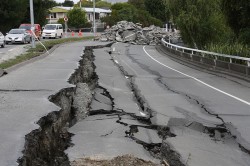
| Gold Prices still Strong Despite the Earthquake Posted: 20 Mar 2011 11:00 AM PDT Japanese investors will realize that investing their money in Japanese government bonds is not only a low-yielding strategy, but a dangerous one. Although Japan has been mired in deflation, inflation may return sooner than most think. | ||||||
| When the Oil Price Portends Recession Posted: 20 Mar 2011 10:46 AM PDT What a nuisance! Our laptop computer collapsed this morning. Hours were wasted trying to revive it. We were like a carpenter without a hammer...a clown without a red nose...an idiot without a village. Meanwhile, the financial world seemed to be on the verge of collapse too. Stocks rose 161 points on the Dow yesterday...after a big drop the day before. Gold rose a bit too. This is the kind of market nervousness that usually resolves itself - in a big drop. Yes, our "Crash Alert" flag - tattered, faded, and frayed - is out. Ignore it at your peril! The Fed is still pumping $4 billion of new money into the system every day. And the federal government is putting in another $5 billion of deficit spending every day. With this kind of support, you wouldn't expect asset prices to fall. Instead, they should be soaring. "Don't fight the Fed," the old timers warn. But watch out. The Fed might have lost control. The Great Correction isn't going away. It's intensifying. As you know, it's been war out there. The feds against the market. The market wants change. The feds fight to protect the status quo. It's an ancient struggle. But this phase of it has been going on for more than 10 years. The markets try to go down...to correct their mistakes...to reduce the amount of debt in the system. And the feds fight back with overwhelming firepower - forcing prices back up...adding more debt...preventing bankruptcies. And now the battle is heating up. What to make of it? First, the feds can destroy wealth. They can prevent it. They can move it around. But it's only the private sector - and market forces - that create it. Second, the more the feds meddle in the markets, the more distorted and grotesque the outcome becomes. Regulation, rigged credit markets, bailouts and subsidies - all pervert the natural outcome of market forces. Third, the feds' current use of overwhelming force to block a market correction is creating overwhelming unforeseen and pernicious problems. They put money into the system to try to encourage spending and investment. The money pushes up stocks - giving investors more "wealth" to spend. But it also tempts speculators into risky trades...and pushes up oil prices...giving business and consumers higher energy prices...and less money to spend on other things. Let's look at what happens next. No, the feds didn't cause earthquakes in Japan or revolutions and civil wars in North Africa. But they created such a rickety financial structure...so top-heavy with debt...that almost any calamity can bring it down. As it happens, political troubles in the Arab states...and Japan's nuclear problems...both grip the world's single most important market - oil - like the jaws of a vise. The Arab world produces the stuff. Japan consumes it. Without its nuclear reactors, Japan will rely even more heavily on other forms of energy...leaving more people standing in line with gas cans in their hands. And here's where the feds come in - their funny money had already sent the price of oil from a low near $30 at the bottom of the '09 crisis...to a high over $100 before the first coffee cup started to rattle in Japan. Where the price will go next, we don't know. But it's being squeezed on both sides - supply and demand - simultaneously. And here's something you should know: According to Nomura Securities, every time there is a big increase in the price of oil - 170% or more - there is also a recession. We mean every time in the last 40 years - '74, '79, '90, and '00. And don't forget, it wasn't just subprime debt in the US that spelled doom for the economy in '08. It was also skyrocketing oil prices...that pinched household budgets all over the world. And guess what? The price of oil has already risen more than 170%. It had hit the critical point even before the revolutions in North Africa or the earthquakes off the coast of Japan. Now, under even more pressure, we can expect a higher price of oil...until the bottom falls out again... And more thoughts Whoa...this looks bad too. In the housing sector, the fed's ultra-low interest rates are supposed to make it easier to refinance...which is supposed to help firm up prices. But prices haven't firmed. They're still giving way. The latest numbers show prices falling, hitting post-bubble lows in 11 cities. Of the 20 major cities in the survey, only two of them had positive price movements last year. No surprise, only one - Zombietown itself, Washington, DC, home of the feds - showed an increase of more than 2%. Worst hit were the sunshine states - California, Florida, Nevada, Arizona and Georgia. Along with Michigan, more than a third of homeowners in these states have negative equity in their houses...with 70% of them underwater in Nevada. Wealth effect? Not in housing. According to the Case/Shiller numbers, homeowners saw their net housing wealth decline by $650 billion in the last quarter of 2010. And since many more households own houses than stocks - 66% are homeowners - falling housing prices has a much bigger effect on the economy than rising stock prices. And it gets worse. The big wave of resetting (and recasting) ARM loans begins to crash into the housing market next month. There are about $700 billion worth of loans in this group. Many will not be successfully rewritten. Falling housing prices will make it impossible. Homeowners will prefer to walk away, rather than be shackled to a long- term mortgage 30% to 50% higher than the value of the house. Says housing expert Robert M. Campbell: "I continue to believe that the second downward leg in house prices that began in 2010 will likely take US housing prices to a point that is 15% to 20% below current levels." *** And what's this... "This is great...it's down 35% since we bought it." This is not the kind of message you usually get from your financial advisor. But this was no ordinary advisor...and no ordinary advice. Rob Marstrand advises our Family Office on what to do with money for really good, really long-term returns. He was speaking about a Chinese food producer; he thinks this is one of the greatest opportunities to come along in many years. "Doesn't sound so great to me," we responded. "We've lost a third of our money." "You don't understand Bill, this is not the same sort of investing most people do. We let time work for us. The average guy would be petrified. He'd be looking at his retirement account...and wondering how he would make up for a 35% loss. He'll need more than a 50% gain to get back to even. "But we're not concerned about retirement. The key to family office investing success is to find the right positions...get in them at the best prices possible...and stay in until they go where they ought to go. This is a stock that is debt free...and it is trading at less than 3 times this year's earnings. "This is an almost unbelievable gift...but only if you've got the time to take advantage of it. If China blows up...or the world sinks into another big slump...this could stay down for years. But over the long run, this is likely to produce huge gains. If it just went to a 'normal' P/E of 10...you'd quadruple your money. But this is a company whose revenues are growing at 20% per year...so you might expect a P/E more like 20 - which would be about a 700% gain." Will Rob be right about this? We don't know. But our family office investing strategy is a little like the advice we gave to Edward. In the short run, you can't know what will be a big winner and what won't. So, you invest in the things that deserve to be winners in the long run. Regards, Bill Bonner | ||||||
| COMEX Other Reportable Traders Net Short Gold Posted: 20 Mar 2011 09:54 AM PDT One class of traders net short gold for first time in our records. HOUSTON – On this "off weekend" for the Got Gold Report, we have spent much of the time studying the news, data, charts, ratios getting ready for the upcoming trading week. We have also been preparing full-sized linkable charts of all of our Vulture Bargain companies (for subscribers). We are pleased to report that all of the linkable charts (18 of them to start) have been posted to the password-protected subscriber pages. Just below is a sample of what one of the charts looks like. ... | ||||||
| Spot's Getting a Little Frisky Tonight Posted: 20 Mar 2011 09:05 AM PDT ....................................... | ||||||
| Posted: 20 Mar 2011 07:16 AM PDT RALEIGH -- Cautioning that the federal dollars in your wallet could soon be little more than green paper backed by broken promises, state Rep. Glen Bradley wants North Carolina to issue its own legal tender backed by silver and gold. The Republican from Youngsville has introduced a bill that would establish a legislative commission to study his plan for a state currency. He is also drafting a |

| You are subscribed to email updates from Gold World News Flash 2 To stop receiving these emails, you may unsubscribe now. | Email delivery powered by Google |
| Google Inc., 20 West Kinzie, Chicago IL USA 60610 | |

No comments:
Post a Comment