


Gold World News Flash |

- The Canada Bubble?
- Dollar crashing and . . .
- Yen Intervention Friendly Towards The Yen Carry Trade
- Gold Seeker Closing Report: Gold Gains While Silver Slumps Slightly
- Eric Sprott: The Government Lied…There is No More Silver!
- The World’s Best Gold Experts: “Buy and Hold!”
- Price Gouging: Why I Sold Potassium Iodide Nuke Pills For A 1500% Gain
- Odds Favor More Downside for the Gold Price
- Western central banks join Japan's in rigging yen market
- Hourly Action In Gold From Trader Dan
- A Monetary Policy that Encourages Malinvestment
- Eric Sprott: The Government Lied… There is No More Silver!
- The World’s Best Gold Experts: “Buy and Hold!”
- Japanese Nuclear Crisis: If it bleeds it Leads
- Guest Post: Currency Wars: RIP Shadow Banking System, Long Live QEx!
- Money & Markets Charts ~ 03.17.11
- Why Markets are Rebounding Despite Continued Crisis
- Grandich Client Sunridge Gold
- Grandich Client Spanish Mountain Gold
- Gold Daily and Silver Weekly Charts
- Worse than Zimbabwe
- In The News Today
- Japanese Fallout May Hit Treasuries
- Gold futures settle above $1,400 an ounce
- Gold Resistance at 1410
- Some Commentary On The Metals And Coffee With Jesse
- Update: A 2011/12 Silver Keiser?
- update 17/03/2011
- A new gold rush
| Posted: 17 Mar 2011 05:19 PM PDT
Jason Kirby with Erica Alini of Macleans report on The Canada Bubble:
You can read the rest of this long article by clicking here. So is this time different? Is Canada going to coast right through the next decade unscathed? Of course not. I have already referred to a Canadian bubble back in October 2009 when I stated another bubble sooner than you think. It was a very wise senior pension fund manager who opened my eyes to the one bubble that escaped me because I live in Canada and never thought that a major bubble is brewing right in our own backyard. Of course I never bought into the real estate hype and totally missed the boat on the spectacular runup in housing prices. My firends were all laughing at me because I preferred renting and waiting for a major correction in housing, which has yet to materialize. but it will and when housing corrects, the Canadian economic miracle will be exposed for what it truly is, lots of hot air driven mostly by speculative flows, not by solid fundamentals. Bank of Montreal economist Sal Guateri recently wrote a report stating that Canada’s housing prices nearing bubble territory:
No major correction if incomes increase faster than home prices in the future? Come on, who are we kidding here? Australia's Business Spectator posted an excellent article, Is Canadian housing the next domino?:
Yes, it's only a matter of time before the Cana |
| Posted: 17 Mar 2011 04:44 PM PDT US Cost of Living Hits Record, Passing Pre-Crisis High Share this:
|
| Yen Intervention Friendly Towards The Yen Carry Trade Posted: 17 Mar 2011 04:18 PM PDT For further market analysis and commentary, please see Trader Dan's website at www.traderdan.net Dear CIGAs, One of the reasons that leveraged carry trade positions explode is a rally in the underlying currency which has financed the trade. In this case, it is the Japanese Yen which has been the funding currency. Those who put on this sort of trade are effectively short the Yen because when they exit the trade, they have to close out the positions that they financed and then buy Yen to pay back the original loan in Yen terms. As the funding currency rallies, they begin losing money because they are forced to pay a higher price for the Yen when they do the foreign currency exchange. When we saw the Yen begin rallying sharply this past week it set off a cascade of unwinding of the carry trade as hedge funds dumped both stocks and commodities that had been purchased and then leveraged up as risk trades were quickly going underwater. It now appears that the Bank of Japan has secured the cooperation of the entire G7 in knocking down the Yen which most agree had soared to levels that were nowhere near commensurate with an accurate valuation of the currency given the fiscal condition of the nation. If it now appears that the G7 agrees to keep the Yen at bay then it could well be that the same hedge funds that were blowing out of their carry trades will be eager to reinstate them since they will feel that they have an effective upside cap on the Yen thus eliminating an element of risk in the trade. If the nuclear plant situation in Japan can indeed get stabilized, that, combined with the cap on the Yen, could be the signal for the hedgies to pile back into the carry trade. It would not surprise me to learn that the BOJ would actually welcome such an event because it would keep a lid on the Yen and would thus serve their purposes of preventing the Yen from strengthening. I would therefore view this as setting in place the factors necessary for keeping gold and silver well supported in price again. We will see how the market is interpreting these events in the trading that takes place over the next few trading sessions.
|
| Gold Seeker Closing Report: Gold Gains While Silver Slumps Slightly Posted: 17 Mar 2011 04:00 PM PDT Gold fell almost $10 to $1386.44 in Asia, but it then rallied back higher in London and New York and ended near its late morning high of $1404.90 with a gain of 0.58%. Silver fell over 2% to $33.67 in Asia before it also rallied back higher and saw a decent gain at $34.635 by late morning in New York, but it then fell back off in the last couple of hours of trade and ended with a loss of 0.46%.
|
| Eric Sprott: The Government Lied…There is No More Silver! Posted: 17 Mar 2011 02:23 PM PDT http://www.caseyresearch.com/editorial.php?page=articles/eric-sprott-government&ppref=TBP202ED0311B Speaking at the Casey Research Gold and Resource Summit, Eric Sprott told investors that there is no more silver left to go around, "There's $22 billion of silver available in the world, of which the ETFs already own half, and between you guys and us we probably own the other half… Which means there's [...]
|
| The World’s Best Gold Experts: “Buy and Hold!” Posted: 17 Mar 2011 02:21 PM PDT http://www.caseyresearch.com/editorial.php?page=articles/worlds_best_gold_experts_buy_and_hold&ppref=TBP209ED0311B BG: How volatile do you expect gold to be? What's your low price that would present a good buying opportunity? Rick Rule: Volatile on steroids! If we have a replay of the liquidity crisis of 2007-2008, gold could crack $1,000 on the downside. I don't time these things; I build cash when values in [...]
|
| Price Gouging: Why I Sold Potassium Iodide Nuke Pills For A 1500% Gain Posted: 17 Mar 2011 01:16 PM PDT Tweet
Reading time: 8 – 12 minutes [Disclaimer: The follow article is a fictional account of a persuasive argument and should not be construed as an assertion of facts although written in the first person.] My nuke pills, commonly known as potassium iodide, have been languishing unloved in my emergency supplies for years since I bought them for about $5.99 each. They expire next month. I would like to have donated them to a charity that would get them to people in Japan who so badly need them But potassium iodide is only available by prescription in Japan and I am not interested in engaging in the international smuggling of controlled substances. So I did the next best thing: I just sold them for $99.99 apiece representing a net realized gain of approximately 1,500%. One of my best investments yet. But with the nuke pill market's backwardation more severe than the silver backwardation why would I sell them?
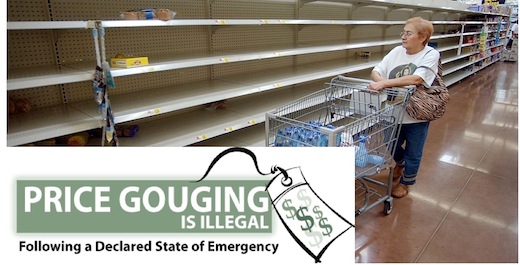
Price gouging has a nasty connotation. This is mostly due to the true cause of shortages, governments, attempting to spread disinformation about how markets work. For example, the Florida Division of Consumer Services asserts: In the wake of natural disaster, essentials — such as food, ice generators, lanterns, lumber, etc. — may be in short supply. Charging exorbitant or excessive prices for these and other necessities following a disaster is not only unethical, it's illegal. Under Sections 501.160 and 501.205 Florida Statutes, it is illegal to charge unconscionable prices for goods or services following a declared state of emergency. Individuals or businesses found guilty of price-gouging could face fines up to $1,000 per violation.
HOW AND WHY VOLUNTARY TRADE WORKS If I own potassium iodide pills there are two mutually exclusive ways for you to acquire them. One option is for me to voluntarily sell or gift you the pills. The other option is for you to steal or rob the pills from me. Trade works because everyone has different preferences, talents, abilities, competitive advantages, knowledge and desires. For example, Mozart had different talents than Einstein. The baker and the painter are each able to perform work the other values and when they engage in a voluntary trade then it implies that the baker derives more value from what the painter offers than from his bread. Because the baker is better at baking than the painter and because the painter is better at painting than the baker therefore when a trade is voluntarily concluded then both the painter and baker are better off which raises the standard of living for both. Even nations have comparative advantages. However, when property is either stolen or robbed then only one party benefits to the detriment of another party. This type of parasitic behavior does not encourage additional productive activities. In fact, it decreases wealth by requiring the aggrieved party to expend additional resources on protection which ultimately gets passed on to legitimate moral consumers in the form of higher prices. It should be noted that since governments are force and force is violence they are by nature parasitic in this stealing and robbing way. And they have the nerve to call a party to a purely voluntary transaction unethical. Thus, the Florida division should probably be named something a little more accurate like the Florida Division of Victimizer Services. THE VALUABLE NATURE OF THE PRICE The price, where a producer and consumer meet in negotiations, is an extremely valuable, even vital, tool. It helps the baker know whether he should produce 5 loaves or 500. Because the baker is also a consumer therefore a price is communicated by the baker to the farmer about whether he should plant one acre or 100 acres of wheat. And so on through the increasingly complex economy with people being able to build up considerable comparative advantages by learning such disciplines as xenotransplantation, mechanical engineering, robotics, proctology, hematology or biomedical gerontology. It is through the price that individuals, all acting according to their own dictates, decide how to allocate their time, talents and capital to meet the needs and desires of each other. When the pricing mechanism is immorally interfered with by the use of aggression then individuals are hindered in their ability to know how much demand exists for a particular good or service. Misallocation of wealth happens which results in its destruction and a lowering of living standards for society. When a price control is implemented through the use of force then it leads to shortages which are often used as an excuse to implement rationing. In the modern world with such technological advances there is a sole cause for all the starvation and shortages: governments.
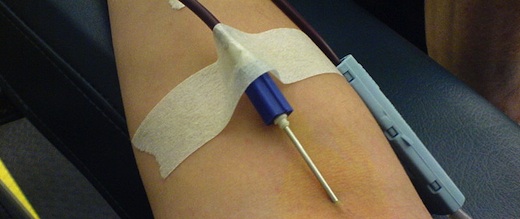
For example, there always seems to be a shortage of blood, particularly the rarer kinds, for transfusions. But there are billions of able-bodied adults who could voluntarily agree to sell their blood. Theoretically there should never be a shortage of blood as it should merely be a function of price. But instead many governments have implemented price controls. In exchange for about an hour of one's time and getting stuck with a needle, sometimes multiple times, the most you can receive is a cookie. Sometimes a T-shirt and some warm fuzzies are thrown in. The reasoning is that if people were able to legally sell their own blood, oh the irony to think one is free, then there would be a higher probability of contaimination in the blood supply. But that does not make any sense because the medical companies already perform extensive screenings of the blood supply. The real issue is that a pint of blood goes for a couple hundred dollars. The government imposed price control serves at least two functions for those who make a profit selling blood: (1) reduction of raw material costs to zero and (2) decrease in supply. But these types of violent interferences are not limited to necessities like food, water, potassium iodide or blood but are extended through licenses for hair cuts to medical services, are found in regulations limiting the type of light bulb or toilet you can buy and of particular interest to the bureaucrats is healthy food and why raw food recipes are going underground. With potassium iodide pills available in Japan by prescription only; thus, even though many may have rationally prepared for this emergency the costumed criminal gangs made it illegal and threatened to violate offenders with fines or jail. As Rand Paul teased out during his Senatorial questioning; these bureaucrats found throughout the world are not pro-choice or pro-consumer but violent aggressors against freedom of choice and a primary cause for lower standards of living. PRICE GOUGING ECONOMICS How are producers supposed to know what consumers demand? Without the ability to charge what the market will bear it is impossible to find out. When that knowledge is buried or price discovery prevented then entreprnuers are unable to make calculated risks in hopes of profit. When entreprenuers fail to perform thier vital service of bringing goods and services to market then price gouging is not an issue. As the old saying from communist Russia goes, "Sausage is one ruble per link. But there is no sausage." Pretty soon the only noble profession left will be that of a smuggler. As David Brown observed in Price Gouging Saves Lives: "Price gouging" is nothing more than charging what the market will bear. If that's immoral, then all market adjustment to changing circumstances is "immoral," and markets per se are immoral. But that is not the case. And I don't think a store owner who makes money by satisfying the urgent needs of his customers is immoral either. It is called making a living. And, in the wake of Hurricane Charley, surviving.
The jet streams show it is possible that the Japanese nuclear meltdowns could deliver nuclear fallout to California, Oregon, Washington and other states. At the end of the day, governments and bureaucrats do not care about your personal safety. They will lie, deceive, cover-up and exacerbate problems if they find it politically expedient. No one cares as much about your health and well-being as you do. Therefore, you must take whatever precautions and actions you deem necessary and prudent.
CONCLUSION So why did I sell my nuke pills? Sure, the 1500% gain was nice. But the real reason was because I wanted to make sure that particular good went to its highest and best use at this particular moment in time. How else would I know what that use was without a price signal? In my opinion the probability of someone in California or Oregon needing the nuke pills within a month for a life saving purpose is extremely low; less than 1%. Thus, I derive more value with the FRN$s than the counter-party to the trade. Plus, if needed I will just get on a plane and head down to La Estancia de Cafayate, which has a very favorable geographic location for nuclear fallout concerns, for their two events this month. I sure hope the counter-party to my nuke pill trade derives sufficient value from being prepared and I hope even more they never have to actually use the potassium iodide. But even if they never do use them I bet having them in the hand relieves a lot of anxiety that comes from being unprepared! And if you are ever in a situation where there is a shortage of something know who to blame: governments. DISCLOSURES: Long physical gold, silver, platinum, palladium and potassium iodide. Copyright © 2008. This article was published on http://www.RunToGold.com by Trace Mayer, J.D. on March 17, 2011. This feed is for personal and non-commercial use only. Applicable legal information and disclosures are available. The use of this feed on other websites may breach copyright. If this content is not in your news reader then it may make the page you are viewing an infringement of the copyright. Please inform us at legal@runtogold.com so we can determine what action, if any, to take. If you are interested in how to buy gold or silver then you may consider GoldMoney.(Digital Fingerprint: 1122aabbLittleBrotherIsWatching3344ccdd) Copyright © 2011 RunToGold.com. This Feed is for personal non-commercial use only. If you are not reading this material in your news aggregator then the site you are looking at may be guilty of copyright infringement. Please contact legal@runtogold.com so we can take legal action immediately. Plugin by Taragana Tweet RELATED POSTS:
|
| Odds Favor More Downside for the Gold Price Posted: 17 Mar 2011 01:08 PM PDT Gold Price Close Today : 1404.00 Change : 8.00 or 0.6% Silver Price Close Today : 34.260 Change : (21.1) cents or -0.6% Gold Silver Ratio Today : 40.98 Change : 0.483 or 1.2% Silver Gold Ratio Today : 0.02440 Change : -0.000291 or -1.2% Platinum Price Close Today : 1701.00 Change : 5.00 or 0.3% Palladium Price Close Today : 708.65 Change : 11.75 or 1.7% S&P 500 : 1,273.72 Change : 16.84 or 1.3% Dow In GOLD$ : $173.36 Change : $ 1.41 or 0.8% Dow in GOLD oz : 8.386 Change : 0.068 or 0.8% Dow in SILVER oz : 343.68 Change : 4.73 or 1.4% Dow Industrial : 11,774.59 Change : 161.29 or 1.4% US Dollar Index : 75.99 Change : -0.691 or -0.9% The GOLD PRICE bounced off its 50 DMA day before yesterday and poked thru $1,400 resistance today. By Comex closing it had climbed $8.00 to $1,404. Ladies and gentlemen, I love gold. I want everybody to shuck that paper that Wall Street and Washington fleece them with and buy some gold. But today merely constituted a countertrend rally in a downtrend. To gainsay that, the gold price would have to pierce its 20 DMA ($1,412.80) for starters, then clear $1,425, and keep right on climbing. I NEVER say "never," so won't say it this time, either, but I will say "right unlikely." Odds favor more downside for the gold price. 'Tain't the end of the world, it's just a correction. The SILVER PRICE extended a sideways move today, but eroding. Comex lost 21.21c to close at 3426c. Low was 33.83, no lower than Tuesday or Wednesday, and that fell early in the day. But the silver price couldn't clear 3450c, although 3400c held up well. I asked the Oracle of Dogwood Mudhole about silver, but he only said, "Make sure you finish one thing before you start another, and keep your fingers away from the business end of that mowing machine." It's always chancy business translating for an Oracle, but the way I read that he's saying, the silver trend shows no sign of reversal yet, so just wait until it does, or you may feed your wallet into a garbage disposal. Or some such. Underneath silver needs to remain above 3350c. It has no strong support before 3120c. 50 DMA stands around 3105c. Rest easy, silver and gold prices are merely undergoing a correction, and no market shoots straight for the sky. Every now and then markets have to pause to digest the gains they've gobbled down. The Japanese yen has jumped 8% in the last week and today hit an all time high against the dollar. The soaring yen has created trouble for them clever Harvard MBAs who were borrowing low-interest yen to invest elsewhere -- the yen carry trade. Suddenly the yen costs a lot more, and as they unwind those trades and scurry to cover those yen shorts, more fuel is added to the yen's fire. Will the Bank of Japan intervene to keep its currency from rising more? Can a duck swim? Is a pig's rear pork? Do crack- heads break and enter? Of course they will. By the way, I confused y'all by quoting the yen two different ways. It is quoted as "yen per 100 cents" or "cents per 100 yen." If the "yen per 100 cents" rate is 79.26, then the "cents per 100 yen" rate is 100/.7926 = 126.2 yen. I'll try to restrain myself in the future. The euro rose 0.7% today while the dollar got busy with a claw hammer and nails nailing shut the lid on its own coffin. Today it fell 69.1 basis points to 75.99, that is, below the March low. One must conclude that the moonstruck dollar has decided to visit 75.60, then 70.70. The earthquake did not do this, the Federal Reserve did. My-o-my-dee-my! US stocks rallied today, and y'all can expect the Wall Street cheerleaders to be crowing and preening tomorrow, doing their best to lure more victims to their financial destruction. The Dow continues its Speedy-Slinky descent to Avernus. Today the Dow gained 161.29 to 11,774.59 (up 1.39%) while the S&P500 bent over, grabbed its bootstraps, and pulled itself up 16.84 points (1.34%) to 1,273.72. For years and years I was an unteachable fool and kept on drawing to inside straits and making bets that could not possibly pay off. I bought my learning dear. Now I'm not so much proud that I've learned a little something as I am sorry for all those folks who are constantly deceived by "gurus" and kept away from catching on. Institutions and media work together to keep them victimized, so they can feed on them. Take well known radio Financial guru A. A has done a fine job getting people out of debt, and if he'd just stick to that, he'd bless folks. But, no, he discovered stocks in the early 1990s -- without discovering the principle of the primary trend -- made money, and confounded a bull market with investing genius. Hence 11 years into a bear market he's still sending his victims into stocks and bad-mouthing gold, because nobody ever taught him the first principle of investing, "always align your investments with the primary trend." Stocks remain the industrial-strength ipecac in the Investment Medicine Cabinet. A kind Greek wrote to clean my plow over the astonishing mistake I made yesterday. Cretan Knossos was not part of the Mycenaean civilization, but a precursor perhaps brought down by the Mycenaeans. The culture on ancient Crete is properly called "Minoan" after the legendary king. It flourished in the Bronze Age from about the 27th century B.C. to the 15th century B.C. It may have met its final end thanks to a gigantic volcanic eruption. Or to invasion by the Mycenaeans from the Greek mainland. The Mycenaean period in Greece was also in the Bronze Age, lasting from 1600 B.C. to 1100 B.C., and is probably the setting of Homer's epics. To confound the Minoan with the Mycenaean is to make just a tiny mistake of, Oh, a millennium. What's a thousand years among friends? But don't let my ignorant mistake scare you. If you EVER get a chance to visit Greece or Crete, go! It's worth the trip for the Kalamata olives alone, but when you add all the history and ruins and artifacts and the kind people, it becomes the trip of a lifetime. This day in 1905 Eleanor Roosevelt married Franklin D. Roosevelt. Now here's a question that would stump a log: which one got the worst deal? On this day in 1921 Comrade Lenin declared the New Economic Policy. The zealous Reds had installed communism in Russia successfully, with only one drawback: the economy collapsed. To gain breathing room Lenin lifted the controls long enough for the Russians' naturally enterprising natures to supply markets again thru small businesses, farms, etc. Agricultural production soared and the economy briefly recovered, but the policy was abandoned in 1928 by Comrade Stalin. Once again, history proves that socialism/communism can only produce two things in abundance: shortages and executions. Hey, wait a minute! Isn't a national central bank like the Federal Reserve one plank in the Communist Manifesto? And wouldn't that mean that we have a, well, you-know-what kind of economy? SHHHHHH. Someone may be listening in Homeland Security. Argentums et aurum comparanda sunt -- -- Silver and gold must be bought. - Franklin Sanders, The Moneychanger © 2011, The Moneychanger. May not be republished in any form, including electronically, without our express permission. To avoid confusion, please remember that the comments above have a very short time horizon. Always invest with the primary trend. Gold's primary trend is up, targeting at least $3,130.00; silver's primary is up targeting 16:1 gold/silver ratio or $195.66; stocks' primary trend is down, targeting Dow under 2,900 and worth only one ounce of gold or 18 ounces of silver. or 18 ounces of silver. US $ and US$-denominated assets, primary trend down; real estate bubble has burst, primary trend down. Argentum et aurum comparenda sunt -- -- Gold and silver must be bought. - Franklin Sanders, The Moneychanger The-MoneyChanger.com © 2011, The Moneychanger. May not be republished in any form, including electronically, without our express permission. To avoid confusion, please remember that the comments above have a very short time horizon. Always invest with the primary trend. Gold's primary trend is up, targeting at least $3,130.00; silver's primary is up targeting 16:1 gold/silver ratio or $195.66; stocks' primary trend is down, targeting Dow under 2,900 and worth only one ounce of gold; US$ or US$-denominated assets, primary trend down; real estate in a bubble, primary trend way down. Whenever I write "Stay out of stocks" readers inevitably ask, "Do you mean precious metals mining stocks, too?" No, I don't. 
|
| Western central banks join Japan's in rigging yen market Posted: 17 Mar 2011 12:59 PM PDT Central Banks Intervene to Weaken Yen After Post-Quake Surge By Keith Jenkins and Yoshiaki Nohara http://www.bloomberg.com/news/2011-03-18/g-7-intervenes-to-weaken-yen-as... Central banks intervened in currency markets to weaken the yen after it soared to the strongest against the dollar since World War II, threatening Japan's recovery from its worst earthquake on record. "In response to recent movements in the exchange rate of the yen associated with the tragic events in Japan, and at the request of the Japanese authorities, the authorities of the U.S., the U.K., Canada, and the European Central Bank will join with Japan, on March 18, 2011, in concerted intervention in exchange markets," the Group of Seven said today in a statement. The yen depreciated 2.9 percent to 81.32 per dollar as of 9:25 a.m. in Tokyo from 78.89 yesterday in New York, when it reached a record 76.25 as increased risk of radiation leaks from a crippled nuclear power station boosted speculation Japanese investors will bring home overseas assets. ... Dispatch continues below ... ADVERTISEMENT Sona Drills 85.4g Gold/Ton Over 4 Metres at Elizabeth Gold Deposit, Extending the Mineralization of the Southwest Vein on the Property Company Press Release, October 27, 2010 VANCOUVER, British Columbia -- Sona Resources Corp. reports on five drillling holes in the third round of assay results from the recently completed drill program at its 100 percent-owned Elizabeth Gold Deposit Property in the Lillooet Mining District of southern British Columbia. Highlights from the diamond drilling include: -- Hole E10-66 intersected 17.4g gold/ton over 1.54 metres. -- Hole E10-67 intersected 96.4g gold/ton over 2.5 metres, including one assay interval of 383g of gold/ton over 0.5 metres. -- Hole E10-69 intersected 85.4g gold/ton over 4.03 metres, including one assay interval of 230g gold/ton over 1 metre. Four drill holes, E10-66 to E10-69, targeted the southwestern end of the Southwest Vein, and three of the holes have expanded the mineralized zone in that direction. The Southwest Vein gold mineralization has now been intersected over a strike length of 325 metres, with the deepest hole drilled less than 200 metres from surface. "The assay results from the Southwest Zone quartz vein continue to be extremely positive," says John P. Thompson, Sona's president and CEO. "We are expanding the Southwest Vein, and this high-grade gold mineralization remains wide open down dip and along strike to the southwest." For the company's full press release, please visit: http://sonaresources.com/_resources/news/SONA_NR19_2010.pdf The combined sales are an attempt to limit the damage a strong Japanese currency will have on the nation's economy in the aftermath of the magnitude 9 earthquake that struck on March 11. Japan unilaterally sold more than 2 trillion yen ($26 billion) in foreign-exchange markets in September to stem gains, its first intervention since 2004. The intervention started at 9 a.m. Tokyo time and followed a Group of Seven industrialized nations conference call to discuss the impact of the March 11 earthquake in Japan, Finance Minister Yoshihiko Noda told reporters after the call. Each country will intervene when its markets open, Noda said. "Foreign-exchange markets are convinced that when the main central banks act together, that has to be taken very seriously," said Paul Robson, a senior foreign-exchange strategist at Royal Bank of Scotland Group Plc in London. "The last thing Japan needs is a sharply stronger exchange rate. They don't want the global financial system to be weakened by sharp moves in the yen exchange rate." The yen typically climbs during crises because Japan's current-account surplus means it doesn't need foreign funding and because of the likelihood Japanese investors will repatriate assets. Japan holds $885.9 billion of Treasuries, the highest tally after China, according to the U.S. Treasury. The currency reached its previous postwar high of 79.75 per dollar three months after Japan's magnitude 6.9 Kobe earthquake in January 1995, which killed about 6,400 people, on speculation that bilateral talks to open up Japan's auto market to U.S. exports would fail. Japan sold a total of 1.8 trillion yen in February and March that year as the yen rose 10 percent. There have been more than 530 aftershocks since the March 11 temblor near the city of Sendai that left at least 5,457 people dead, with more than 9,500 missing and hundreds of thousands stranded and without power. Prime Minister Naoto Kan called for calm as he dispatched 100,000 troops to the northeastern region. The tsunami and concern of a meltdown at Tokyo Electric Power Co.'s Fukushima Dai-Ichi nuclear plant has forced more than 450,000 people from their homes. Japan's success in reversing the yen's gains on its own last year proved transitory. While it slumped 3.3 percent to 85.75 against the dollar on Sept. 15, the day of the intervention, the currency had strengthened to 80.22 by Nov. 1 as the Fed announced a second round of so-called quantitative easing to purchase $600 billion of Treasuries. The U.S. is Japan's second-biggest trading partner. "Japan had come in for some heat from overseas authorities for intervening before, but it's becoming more acceptable to take action now, given that the move is designed to limit the damage a strong yen will have on the economy in the wake of the earthquake," Takahide Kiuchi, chief economist at Nomura Securities Co. in Tokyo, said before the announcement. Japan's success in reversing the yen's gains on its own last year proved transitory. While it slumped 3.3 percent to 85.75 against the dollar on Sept. 15, the day of the intervention, the currency had strengthened to 80.22 by Nov. 1, before the Fed announced a second round of so-called quantitative easing to purchase $600 billion of Treasuries. Support GATA by purchasing a colorful GATA T-shirt: Or a colorful poster of GATA's full-page ad in The Wall Street Journal on January 31, 2009: http://gata.org/node/wallstreetjournal Or a video disc of GATA's 2005 Gold Rush 21 conference in the Yukon: Help keep GATA going GATA is a civil rights and educational organization based in the United States and tax-exempt under the U.S. Internal Revenue Code. Its e-mail dispatches are free, and you can subscribe at: To contribute to GATA, please visit: http://www.gata.org/node/16 ADVERTISEMENT Prophecy Resource Spins Off Platinum/Palladium Venture: Company Press Release, January 18, 2011 VANCOUVER, British Columbia -- Prophecy Resource Corp. (TSX-V:PCY)and Pacific Coast Nickel Corp. announce that they have agreed that PCNC will acquire Prophecy's Nickel PGM projects by issuing common shares to Prophecy. PCNC will acquire the Wellgreen PGM Ni-Cu and Lynn Lake nickel projects in the Yukon Territory and Manitoba respectively by issuing up to 550 million common shares of PCNC to Prophecy. PCNC has 55.7 million shares outstanding. Following the transaction: -- Prophecy will own approximately 90 percent of PCNC. -- PCNC will consolidate its share capital on a 10 old for one new basis. -- Prophecy will change its name to Prophecy Coal Corp. and PCNC will be renamed Prophecy Platinum Corp. -- Prophecy intends to distribute half of its PCNC shares to shareholders pro-rata in accordance with their holdings. Based on the closing price of the common shares of PCNC on January 17, $0.195 per share, the gross value of the transaction is $107,250,000. For the complete announcement, please visit: http://prophecyresource.com/news_2011_jan18.php
|
| Hourly Action In Gold From Trader Dan Posted: 17 Mar 2011 11:43 AM PDT Dear CIGAs, Click chart to enlarge in PDF format with commentary from Trader Dan Norcini For further market analysis and commentary, please see Trader Dan's website at www.traderdan.net
|
| A Monetary Policy that Encourages Malinvestment Posted: 17 Mar 2011 11:00 AM PDT Thorsten Polleit, of the Frankfurt School of Finance & Management, penned an article in The Free Market newsletter of the Ludwig von Mises Institute titled "The Many Names for Money Creation." It starts off almost humorous, reading more like an interesting, mood-lightening sidebar to a banner article titled "We're Freaking Doomed (WFD)!" as he notes that the dire economic conditions are such that "euphemisms have risen to great prominence. This holds true in particular for monetary policy experts, who are at great pains to advertise a variety of policy measures as being in the interest of the greater good, because they are supposed to 'fight' the credit crisis." He then illustrates how the term "unconventional monetary policy" is meant to convey the happy virtues of "courageous and innovative", as opposed to the bad old "conventional" monetary policy, which is now "outdated." In a similar vein, he notes that "Aggressive monetary policy" is meant to signify "bold and daring action for the greater good," and "quantitative easing" is just a confusing term used to make it difficult for people to see "what such a monetary policy really is – namely, a policy of increasing the money supply (out of thin air), which, in turn, is equal to a monetary policy of inflation." A policy of inflation! Yikes! What was in that article "We're Freaking Doomed (WFD)!"? From the perspective of the Austrian school of economics (the only true economic theory!), this is not going to be the ordinary kind of inflation, either, but the really nasty, evil kind, where "monetary policy pushes the market rate of interest below the natural rate of interest (the societal time-preference rate), thereby necessarily causing malinvestment rather than ushering in an economic recovery." In other words, the Fed and the government are making it worse. And if you want to know about malinvestment, then ask my boss, who never tires of telling me that I am the only employee, alone, apparently in the whole freaking history of employees, that has a consistent negative value to the company, meaning that the bottom-line of the company would be immediately improved if I was, to coin a rhyme, removed. So I asked her, "What's with that 'improved if I was removed' stuff?" to which she asked, "What are you talking about? You are the one that said that in the previous paragraph, you moron!" to which I asked, "What?" and then she asked, "What?" and then we just looked at each other, confused as hell. There was an awkward silence, as I struggled as if I was in some weird parallel universe, since her point was that she is, only now, realizing that I am, as an employee, a huge mal-investment, but I can't be fired since I am too old and too savvy not to sue the hell out of all of them for my termination, even though their case is air-tight and I should have been fired long ago. And, as I never cease saying, some other, much worse mal-investments, such as the stock market bubbles, and the bond market bubbles, and the derivatives bubbles, and the debt bubbles, and the housing bubbles, and the bubbles in the sheer, staggering size of governments, were NOT my fault, but are all the fault of the Federal Reserve creating the money that made it all possible Now, as if playing right into my hands, Mr. Polleit writes, "Sooner or later the dependence of the people on government handouts reaches, and then surpasses, a critical level," which I assume we have reached. The worse news is that he figures that "People will then view a monetary policy of ever-greater increases in the money supply as being more favorable than government defaulting on its debt, which would wipe out any hope of receiving benefits from government in the future." The terrifying point of all of this is when he writes, ominously, "In other words, a policy of inflation, even hyperinflation, will be seen as the policy of lesser evil." Hyperinflation! Gaaahhh! Hyperinflation! Immediately, I go into We're Freaking Doomed (WFD) mode, which usually involves a lot of hyperventilating and a feeling of panic until I realize that all I have to do is buy gold and silver to keep what is going to happen to everyone else from happening to me, and make a lot of dollars in the process, which always makes me feel better, leading to euphoria, as in, "Whee! This investing stuff is easy!" The Mogambo Guru A Monetary Policy that Encourages Malinvestment originally appeared in the Daily Reckoning. The Daily Reckoning now provides over half a million subscribers with literary economic perspective, global market analysis, and contrarian investment ideas.
|
| Eric Sprott: The Government Lied… There is No More Silver! Posted: 17 Mar 2011 10:18 AM PDT Speaking at the Casey Research Gold and Resource Summit, Eric Sprott told investors that there is no more silver left to go around, "There's $22 billion of silver available in the world, of which the ETFs already own half, and between you guys and us we probably own the other half… Which means there's nothing left." We've got the highlights of his speech in the video below. Listen as the CEO of Sprott Asset Management discusses the availability of precious metals, the price of gold, the GDP, national debt, and more. [ame=http://www.youtube.com/watch?v=T2w7wGwUZ9Y]YouTube - Eric Sprott: The Government Lied... There is No More Silver![/ame] Ed Steer, editor of the free Gold & Silver Daily newsletter and longtime GATA member, believes that silver will go to the moon, and soon. Read his explanation why that's the case and how you can profit from this enourmous upswing by reading his report, The Case for $60 Silver....
|
| The World’s Best Gold Experts: “Buy and Hold!” Posted: 17 Mar 2011 10:14 AM PDT Jeff Clark, BIG GOLD In January, Jeff Clark of Casey Research’s BIG GOLD advisory set out to get opinions from some of the smartest, most accomplished investors in the gold industry – where is the gold price going to go, how volatile will the markets be, what’s the outlook for precious metals stocks? Read on for some of the most insightful answers you’ll see anywhere… Rick Rule is the founder of Global Resource Investments (Natural Resource Investments, Natural Resource Investment), now part of Sprott, one of the most acclaimed and sought-after brokers in the natural resource industry. Rick has spent 30 years in the sector and is a regular speaker at investment conferences in the U.S. and Canada. He and his staff have an extraordinary record of success in resource stock investing. James Turkis the founder and chairman of GoldMoney.com. He’s authored two books on economic topics, published numerous articles on money and banking, and is...
|
| Japanese Nuclear Crisis: If it bleeds it Leads Posted: 17 Mar 2011 10:00 AM PDT Richard (Rick) Mills Ahead of the Herd As a general rule, the most successful man in life is the man who has the best information What is happening in Japan is a humanitarian disaster, but not because of what primetime pundits and talking heads would have you believe. “Nuclear Nightmare: A radioactive death cloud from one or more of the Japanese reactors experience core meltdown and catastrophic release of radiation could ...” Japan Does Not Face Another Chernobyl The containment structures appear to be working, and the latest reactor designs aren't vulnerable to the coolant problem at issue here. -William Tucker, Terrestrial Energy by William Tucker Even while thousands of people are reported dead or missing, whole neighborhoods lie in ruins, and gas and oil fires rage out of control, press coverage of the Japanese earthquake has quickly settled on the troubles at two nuclear reactors as the center of the catastrophe. Rep. Ed Markey (D., Mass.), a lon...
|
| Guest Post: Currency Wars: RIP Shadow Banking System, Long Live QEx! Posted: 17 Mar 2011 09:50 AM PDT
Submitted by Gordon T. Long of Tipping Points RIP Shadow Banking System - Long Live QEX We have unwittingly become trapped in the snarled net of years of bad Public Policy. Like corpor
To ensure all our readers truly appreciate what this decision meant and where we stand today, we need to revisit some basics. First, in a the fractional reserve banking system which we currently operate under, money can only be borrowed into Secondly, Inflation is first and always a result of Monetary policy. If more money is put into the economy we will have more money chasing the same number of goods and it results in price inflation. Thirdly, for an economy measured by GDP to grow, the money supply must grow faster than GDP or the economy will be starved of liquidity. If more money is created for economic growth and it consequentially produces inflation, then the money supply must maintain its growth at a faster pace than inflation. This is one of the reasons why when the inflation genie is released it is so hard to get 'back into the bottle' and to contain it. We learned this difficult lesson in the 1970's for those old enough to remember. In theory therefore: Money Supply Growth must be > Growth of the Economy Since Money can only be loaned into existence and inflation is a Monetary phenomena Money Supply must be larger > Inflation Inflation must be larger > Real Growth (NOMINAL GROWTH MINUS INFLATION) In a theoretical CLOSED economy there must always be a level of money growth which is slightly larger than inflation which is slightly larger than REAL economic growth. Healthy Economy - Examples Unhealthy Economy - Examples 2% GDP Growth with 3% Inflation means Money Growth is larger than 3% with a -1% Real Growth Broken Economy - Examples 2% GDP Growth with 3% DEFLATION means Money Growth is larger than 1% with a +1% Real Growth Therefore you can see Real Growth is always positive To appreciate this fact you must remember that interest on outstanding debt STILL compounds every year. The economy may stop growing but the carrying cost of outstanding debt doesn't. The Federal Reserve in essence must make sure that DEFLATION is absorbed by adding money or the debt payments will shrink the economy (Note: It is argued that it is actually the first derivative or rate of change of the increases/ decreases above, not the actual rate, that must be maintained. Even if this is true, the sign doesn't change which is the important point here.) The major issue arises when even by increasing debt (somehow) it no longer generates growth. This happens when we arrive at the consequential point of Debt Saturation relative to economic growth. THIS IS THE PROBLEM WE NOW FACE, BUT KNOW ONE WANTS TO TELL YOU!
SITUATIONAL ANALYSIS 2- Since the US is not a CLOSED economy and in fact is the world's reserve currency, money created by the Fed does not necessarily stay in the US. In fact Quantitative Easing has presently ignited a massive global US dollar carry trade. To put the above into perspective we need to understand that Money or more specifically Credit prior to 2008 had been growing not just through the banking system regulated by bank regulators but rather through what is referred to as the Shadow Banking System. The Shadow Banking System as the prime pusher of toxic debt instruments collapsed in the 2008 financial crisis and so far it simply has not re-emerged in some sort of hybrid fashion. The Federal Reserve desperately needs this to happen and this has been another reason for the Fed's "Extend & Pretend" policy. Extend & Pretend was not only to give the economy time to rebound and push asset prices up (helping book collateral values), but also to allow asset appreciate to re-ignite a new and improved Shadow Banking System. It simply is not happening fast enough. Here is the latest figures from the Federal Reserve's Flow of Funds report for Q4 2010. The report was startling since Q3 2010 was even worse than thought after final adjustments were made. We had aQ4 2010 decline of $206.4 Billion in Shadow Banking liabilities with $440 Billion in combined Shadow and Conventional Banking System Liabilities. This almost guarantees that the Federal Reserve must continue QEX. THE SHADOW BANKING SYSTEM IS NOT RETURNING
THEY CAN'T STOP THE CRUMPLING BAD DEBT It will take too much printed money by the Fed, created so fast, that the collateral fallout damage would be economically fatal.
Even the TRADITIONAL Banking System is shrinking on a M3 basis (it is no longer reported)
CONCLUSION
|
| Money & Markets Charts ~ 03.17.11 Posted: 17 Mar 2011 09:47 AM PDT View this week's chart comparisons of gold against fiat currencies, oil and the Dow. Stay tuned for our next Money & Markets segment of The Solari Report tonight, Thursday, March 17, 2011. Click here to view all charts as a pdf file. See previous Money & Markets Charts blog posts here. Currency charts are from StockCharts.com. Gold vs Oil Gold [...]
|
| Why Markets are Rebounding Despite Continued Crisis Posted: 17 Mar 2011 09:30 AM PDT During the last 24 hours, fear evaporated from the global financial markets as completely as water from a Fukushima reactor. The Nikkei recovered from a 5% plunge to end the day down about 1.4%. Most European markets have rebounded about 2% and the Dow Jones Industrial Average is busy attempting a similar feat. Today's gains probably have more to do with mere "selling fatigue" than they do with a genuine conviction that stocks are a "buy." But, selectively, folks are trying to capitalize on what they perceive to be "oversold" situations. One group of astute investors known to your editor reached the following conclusions yesterday: 1) Japanese stocks may well represent a solid contrarian opportunity after the recent panic-driven selling. The problem is that any gains for American investors will likely be offset by an appreciation in the yen versus the dollar over the short term. 2) It's too early to tell, but uranium-linked stocks may also be a "buy" following their recent rout. Nuclear power produces about 13% of the world's energy. That's not easy to replace. Depending on the outcome at Fukushima Daiichi, uranium producers could recover to their pre-Japan quake highs. 3) The world faces an energy crunch as nuclear and oil become problems. Natural gas will be a big winner. It is a relatively clean way of producing electricity. 4) Gold should do well when the margin selling ends. Japan's rebuilding efforts will increase its already yawning deficits, pile on more public debt and lead to a new flood of paper money from the Bank of Japan. "Rare earths" are also back in vogue. But the hottest "rare earth" investment of the moment has nothing to do with iridium, scandium, yttrium or any of the other "-ium" metals. The hottest rare earth investment today is element #53: Iodine. Iodine is not particularly rare from a geological standpoint. But that doesn't mean it's easy to find on a pharmacy shelf. Geologically, iodine represents 450 parts per billion of the earth's crust, which means its about ten times more abundant than gold. Based on parts per billion, therefore, Iodine is not so rare. But based on pills per pharmacy, good luck. Never mind that Japan's nuclear crisis is more than 5,000 miles away from California, the crisis is close enough to trigger an "iodine rush" in the Golden State. Yesterday morning, your editor strolled into the Laguna Beach CVS store and asked to buy iodine tablets. The pharmacist laughed, "Can't get it." "Really?" "Yep," the pharmacist replied. "It's impossible to get." This anecdote provides context for a little game we'll call, "Who's holding the bag?" Eric Fry Why Markets are Rebounding Despite Continued Crisis originally appeared in the Daily Reckoning. The Daily Reckoning now provides over half a million subscribers with literary economic perspective, global market analysis, and contrarian investment ideas.
|
| Posted: 17 Mar 2011 09:01 AM PDT The following is automatically syndicated from Grandich's blog. You can view the original post here. Stay up to date on his model portfolio! March 17, 2011 11:40 AM Article on SGC from Resource Clips [url]http://www.grandich.com/[/url] grandich.com...
|
| Grandich Client Spanish Mountain Gold Posted: 17 Mar 2011 09:01 AM PDT The following is automatically syndicated from Grandich's blog. You can view the original post here. Stay up to date on his model portfolio! March 17, 2011 11:36 AM Spanish Mountain Gold has just announced the signing of a Protocol Agreement or Memorandum of Understanding with a First Nations group.* This is a critical step in formalizing the support from the Williams Lake Indian Band (WLIB) for SPA's flagship Spanish Mountain project. This should set out a framework for future discussions and negotiations with the band as the project moves hopefully towards eventual production. It's the culmination of more than 12 months of community meetings, site visits and workshops planned by Spanish Mountain in concert with the Williams Lake Indian Band. So what is the significance of this agreement?* It shows that SPA has chosen to engage the First Nations communities and has successfully obtained support for the project from the communities very early on.* I believe this is the right approa...
|
| Gold Daily and Silver Weekly Charts Posted: 17 Mar 2011 08:55 AM PDT |
| Posted: 17 Mar 2011 08:54 AM PDT by Addison Wiggin - March 17, 2011
 Yes, Zimbabwe... the country where at its worst $100 trillion was worth about 30 of the U.S. variety... and good for four loaves of bread. Yesterday, the Zimbabwe National Statistical Agency announced that consumer prices slowed last month to an annualized 3%. But this morning, here in the good ol' USA, the Bureau of Labor Statistics (BLS) announced the U.S. consumer price index (CPI) rose 0.5% last month — which works out to a 6% annual clip. Congratulations.
Food and energy costs are "volatile" and not reflective of "underlying trends" as detected by such farseeing folk:
Thus the "core" CPI, for people who only eat iPads, rose a scant 0.2%. That's an annualized 1.2%, on the low end of the Fed's inflationary sweet spot. Print away.
We knew having our friend chair this subcommittee was going to provide ample entertainment for readers of The 5, but we didn't know how aptly... or how soon. Today you'll find kismet in action for several reasons... let's press on. "Since the expansive Federal Reserve program of quantitative easing began in late 2008," testified investment banker Lewis Lehrman, "oil prices have almost tripled, gasoline prices have almost doubled." "Basic world food prices, such as sugar, corn, soybean and wheat, have almost doubled," he added. Other expert testimony today will come from Pace University professor Joe Salerno and the prickly James Grant, editor of Grant's Interest Rate Observer. But it's Lehrman whose presence carries the most significance, as you'll see.
On a chart, that $2 trillion looks something like this:  Oops...
Actually, the commission's real task was to go through the motions of investigating a return to the gold standard. Of that, Treasury Secretary Donald Regan made sure. Fifteen of the 17 members, including Regan and a young Sen. Chris Dodd, concluded a gold standard was a barbarous relic. Ron Paul was one of the two dissenters. He wrote up a "minority report" that was published in book form under the title The Case for Gold. The other dissenter gave his full-throated endorsement to Paul's manifesto. That was Lew Lehrman. History rhymes, they say. But this time, the stakes are higher. By ironic circumstance, we were approached earlier this year with a proposal to republish The Case for Gold — a joint project of Laissez Faire Books and the Ludwig von Mises Institute. Later today, you'll have the opportunity to secure a copy of this "lost" gold bible for yourself… at no charge. Watch your inbox for details on this exclusive offer.
Yesterday, the Dow started plunging shortly before 11 a.m. EDT when news hit the wires that the European Union's energy commissioner, speaking to a parliamentary committee, described the situation in Japan as "effectively out of control." How, sitting in a leather chair in Brussels, he was better equipped to make that assessment than anyone else, no one paused to consider. "Hit the bid!" traders cried. Later, the functionary admitted his assessment was based in part on the same media reports you and I and everyone else have been bombarded with since Friday. But programmed sell orders that kick in when prices dip to one level or another don't take such things into account. By day's end, the S&P was down 2%, and its year-to-date performance had ventured into the red.
 The last time the VIX approached anything this high was June 29, 2010. On that day, the S&P 500 fell 3%. There was no single factor driving it that time, rather a pastiche of bad news — Chinese leading economic indicators, eurozone banks, U.S. consumer confidence. You know, the good old days. This morning, the VIX has pulled back below 27. Fear is no longer cheap. There's not much to act on here. Before this week, the VIX spent most of this year below 20 — a pretty reliable sell signal, as our friend Karim Rahemtulla remarked last year in Vancouver. But between 20 and 30, the VIX offers few cues about whether to buy or sell stocks.
This is the last thing Japan's government wants right now; a stronger yen will slam exports at least as hard as the tsunami. The finance ministry will likely instruct the Bank of Japan to start selling yen. Or buy dollars. Officially, there's been no comment. Unofficially, we're sure the finance ministry is in as desperate a rush to cool the yen as the defense ministry is to cool the reactors at Fukushima.
Yesterday, Standard and Poor's upgraded Colombia on level to BBB-. S&P's report said it was impressed — as we were — with the country's resilience in the face of the Panic of 2008, along with the government's effort to reduce its budget deficit. It's now under 4% of GDP... compared to the homespun U.S. figure of 10% plus. "Colombia is now an investment-grade country," declared S&P's Joydeep Mukherji, thereby bestowing the credentials many institutional investors still blindly regard as useful. "That sends a signal to the world and also makes it very clear to anyone who has restrictions on their investment choices." Colombia's IGBC stock index is up over 3% this morning. But there remains another catalyst for growth — the stock exchange's planned merger with the exchanges of Peru and Chile. We're still culling through the many choices Colombia presents for investors. Some are suited for the risk-averse who want to stick to major U.S. exchanges, while others are better suited for the more speculative minded. Watch this space.
One day last year, Hart Main, a 13-year-old from Marysville, Ohio, started poking fun at his sister for selling scented candles as part of a school fundraiser. "They were really girly scents," he said. And then it hit him: "There weren't any man-scented candles."  So he started filling up empty soup cans with candle wax and developed "manly" scents — like bacon, sawdust and a fresh leather baseball mitt. So far, he's sold 500 of his "Man Cans" for $5 apiece. His costs per unit: $2.50. The soup inside the cans, he donates to a local food bank. With his profits, he, so far... bought a new bicycle. Awesome.
"We all have access to 10 channels of misinformed speculation 24 hours/day if we want this 'white noise.'" The 5: Exactly why we've reserved our comments to the likely impacts on the financial markets. If you've got a beef with the science of it all, or the way it's getting reported, your beef is not with us. Thanks for reading carefully, though.
"Long term, the 250 reactors left in the world will still be producing electricity daily. As the industry learned/improved from Three Mile Island and Chernobyl, they will review this, likely make improvements to deal with hydrogen production during a calamity and implement reactor designs with thermosyphoning and continue. "I will hold onto my uranium stocks." The 5: That's your choice. The debate among our analysts has been fairly strident. Of the two with uranium plays, one has elected to hold... the other to sell.
"I am not trying to be crass. This is an unfathomable tragedy in Japan they will endure. The other side of the coin, sound thinking now for the future as the world works through this will provide huge opportunities for the young." "Do you think maybe, just maybe, there is opportunity for another service that reaches out to the young investor? One of these days, they will have a bit of money to invest, and they could use a sound plan that you folks could develop." The 5: When we launched Outstanding Investments a decade ago, we concluded a 20-year bear market in natural resources had come to an end. That decision was vindicated recently when the independent Hulbert Financial Digest crunched its numbers and found Outstanding Investments was the best-performing letter among those they tracked over the previous 10 years. Thing is, we believe the best is yet to come in this space — the "blowoff" rally that propels every bull market to unimaginable heights. That's when natural resources will be like tech stocks in 1999 and you'll want to sell. But in the meantime, it's not too late to climb on board — especially if you're in your 30s. Here's where to start.
The 5: "Your risk is strictly limited. You can't lose more than you put in," says Abe, "And you don't need to guess how far the underlying move is going, just which direction it's headed. You don't need to keep track of more than two possible results — yes or no." Nothing is guaranteed, except the quality of the service. And how many services cover a market in which you can rack up gains of 162%… 545%… even 1,329%… in a maximum time frame of five days? All right, you got us, that was a trick question. No other North American advisory service covers this market. Let Abe walk you through how it works step by step, right here.
"There is a large concentrated short position that traces back to JPM and HSBC for the silver and gold market shorts, respectively. There are currently 25 class action lawsuits now pending and being consolidated." "Pure and simple, the banks that have the monopoly of the control of currency of the world's reserve currency know that gold and silver are the only viable alternatives to the very flawed fiat currency system. The futures market is the price discovery mechanism that can be perverted by massive short selling by these banks." "Do your due diligence on this issue. It goes without saying that you will, but I am admitting that my opinion is not the only one out there. Ted Butler and GATA (Gold Anti-Trust Action Committee) have been writing about this for years and are only now finally gaining the recognition they deserve." "What say you on the 'precious metals suppression issue,' 5?" The 5: "If you have manipulation to keep the price down," our friend Marc Faber puts it best, "it eventually goes ballistic. All the people bitching about the manipulation of silver and gold should be happy that it is manipulated, because it still gives them an opportunity to buy it at a depressed price." Top o' the morning to ya, Addison Wiggin P.S. Way back in December, Alan Knuckman called a rise in the yen, and laid on a trade accordingly. Yesterday, he told readers to close half the position for a gain of 108%. He'll let the other half ride. We haven't formally offered Alan's Resource Trader Alert to new readers for some time now. But in this year alone, his readers have bagged a 95% gain on soybean meal and 217% on wheat. They're sitting on open gains of 157% on cocoa and 287% on heating oil. As an acknowledgement of his stellar performance, we'd like to extend you an invitation to check out Resource Trader Alert for half off the annual membership fee. Today and tomorrow only. And only over the phone. Call John Wilkinson at (866) 361-7662. He can answer any questions you have about how the service works. Just know that this offer comes off the table tomorrow at 5 p.m. EDT.  On your behalf, Byron King has been in London this week, meeting with executives from five mining and four oil companies. He'll render insights gained in good time. In the interim, he made time last night to take in "a real treat and honor" at which he was in attendance by exclusive invitation. Amid the changing tides of fortune, it's comforting for some to witness tradition and ceremony: I just returned from the Tower of London, where I witnessed the Ceremony of the Keys. It's a private function witnessed by invitation only — an inside-the-British-army thing. I felt it quite a coup to be there, having accepted a personal invitation from a Household Guard. We were met by (name withheld by request), a retired army officer and now a civilian Beefeater guard at the Tower. He gave us the overview, describing the ceremony in detail before it occurred. Precisely at 21:53, the guards emerged, marched down the cobblestone walk to the first gate of the Tower and locked it up. Then they marched to the second gate and locked it up. Then as they returned to parade area in front of the barracks, they were challenged by a sentry, asking "Who Comes There?" They answered the hail "Queen Elizabeth's Keys!" and were allowed to pass, with rifle salute rendered by the sentry — tonight, a Scots Guard. Then precisely at 22:00, there was the retirement bugle, sounding its refrain, marking the end of another day in the life of the British monarchy. This ceremony has taken place every night, of every week, of every year... for over 750 years of recorded history. As the story goes, the ceremony has started late only once... on Dec. 29, 1941. During a German bombing raid, a bomb hit the Tower and knocked the guards down. They got up, dusted themselves off and proceeded... six minutes late. The next day, King George ("The King's Speech" George) telegraphed the guards, congratulating them on their drive to carry on in the face of adversity and reminding them that the Tower ceremony must never be late again. The ceremony is rich with tradition... every movement of the soldiers has a heritage. There is lots of fine marching and precision drill with rifles and such. I was honored to see such a rich and historic ceremony. It's good that some things last a long time. Some things should last a long time... especially those with real meaning. I'm pleased to report all's well in the Tower of London — Byron King |
| Posted: 17 Mar 2011 08:30 AM PDT View the original post at jsmineset.com... March 17, 2011 09:51 AM Dear CIGAs, Back in the 1980s I had a business in Luxembourg, James Sinclair Financial Research SARL, with a satellite office in Johannesburg. During the Chernobyl disaster my office requested a Geiger Counter for use at the various food stores they frequented. They were grateful as they got significant readings on some produce, milk and meats. There now has been a run on Geiger Counters on the Web. Jim Sinclair’s Commentary Talk about gouging people in times of need. "The potassium iodide bubble is growing. The list price of a 14-tablet pack: $5.99. Asking price $300-$400!" Click here to view the listings… Jim Sinclair’s Commentary Your must have subscription service. - Economy Slumps Anew as Inflation Soars - Fed's Dollar Debasement Efforts Begin to Yield Their Poisoned Fruit - February Annual Consumer Inflation: 2.1% (CPI-U), 2.3% (CPI-W), 9.6% (SGS) - H...
|
| Japanese Fallout May Hit Treasuries Posted: 17 Mar 2011 08:30 AM PDT By: John Browne Thursday, March 17, 2011 Japan is facing two meltdowns in the wake of its devastating earthquake. The first, and more critical, is the meltdown at the Fukushima I Nuclear Plant, 150 miles north of Tokyo. Surely, this is the greater near-term threat. But long-term, another threat looms, having to do with the Japanese government’s response to the former. As the fourth largest economy in the world, behind the EU, US, and China, any major setback in Japan likely will have widespread repercussions. Japan is also the third largest holder of US Treasuries, behind the United States and China. While it is too early even to assess the Japanese damage accurately – let alone to forecast the full implications – it is possible to see the potential for a meltdown of the US Treasury market and international monetary system. Current estimates hold that the Japanese disaste...
|
| Gold futures settle above $1,400 an ounce Posted: 17 Mar 2011 08:10 AM PDT By Claudia Assis and Deborah Levine Gold for April delivery added $8.10, or 0.6%, to $1,404.20 an ounce on the Comex division of the New York Mercantile Exchange. That was the first time it settled above $1,400 since Monday. … "You are seeing a bit of relaxing in the pressure to sell whatever you had to make your portfolio whole," said Bart Melek, head of commodities at TD Securities in Toronto. Japanese authorities continued to deal with the world's worst nuclear disaster since Chernobyl nearly 25 years ago. … Support for gold also came from a weaker dollar and data showing a pickup in U.S. inflation, Melek added. Consumer prices rose 0.5% in February, and the core rate, which excludes the more volatile food and energy categories, increased 0.2%, slightly more than expected. Read more about the CPI. [source]
|
| Posted: 17 Mar 2011 07:50 AM PDT courtesy of DailyFX.com March 17, 2011 05:04 AM Daily Bars Prepared by Jamie Saettele “Gold made an outside week last week which (along with divergence with RSI on the weekly) warns of distribution and a potential top.” Price has reached its 50 day average but a break of long term trendline support is needed in order to suggest that an important top has formed. The trendline is at 1353 this week. 1410 is resistance....
|
| Some Commentary On The Metals And Coffee With Jesse Posted: 17 Mar 2011 07:42 AM PDT I am sensing a lot of "nervousness" in the precious metals and mining stock investing community which is connected with the recent volatility in the metals. I must say that some type of correction/pullback should be expected given the run in gold and silver since early August (silver was on a double since August 1, at one point). It's only natural that traders and investors will take some profits after a run like that and preserve some profits with the hope of reloading positions at a lower level. To an extent, that action makes price correction a self-fulfilling prophesy. Having said that, the geopolitical, economic and natural disasters ("disaster" is pluralized because I consider the growing food shortages globally to be a natural disaster) are serving to make the arguments for owning gold and silver even more compelling. We have yet to see large institutions and the public pile into this sector, which means some of the most thrilling gains are yet to happen. Of course, none of us will be thrilled with the associated systemic problems that will accompany the move in the metals... I wanted to highlight some brief comments by John Embry posted on Eric King's blog. Here is the LINK I'll add to that my view that the fact that the banks who are manipulating the metals can't engineer a more substantial sell-off in the metals given the technical condition is testament to the voracious demand for physical gold and silver globally. In the past, a big move in silver has always been followed with 20-40% price correction (even bigger in July 2008). As I watch the metals trade all day, every day, it is becoming apparent to me that the entities manipulating the market - CFTC be damned - are losing their ability to do so. Currently there are 1054 open silver contracts for this March delivery period. This is a very large number of open contracts at this point in the month. What's even more remarkable is the fact that the aggressive attempts to push the metals lower have not caused the liquidation of a large portion of the open March contracts. I'm sure JP Morgan is stunned by this unexpected development. I do not believe that the Comex will default on deliveries this month. In fact, I have a big bet with a colleague who does think the Comex will default on silver this month. While I'm not worried that I will lose the bet, the inability of JPM to force liquidation - plus the fact that those contracts have not been closed out by deliveries - is raising my eyebrows. Finally, for anyone reading this who does not stop Jesse's Cafe Americain on a regular basis, I highly recommend reading this interview with Jesse: LINK "Jesse" offers some very well-articulated insight into why our system is, well, screwed. LATE ADDITION: HSBC makes it more difficult to take delivery and remove the silver from their Comex vault. Our fund is taking delivery of silver from Comex, with HSBC as the counterparty. In the past, we were always able to make arrangements to have our depository representative swing by the HSBC vault and pick up the metal on our behalf after we received notice. NOW, my partner has to fill out some forms and send those plus a copy of his driver's license to HSBC's compliance department and, best case, we will be approved in 5 days to make arrangements for pick-up. This will cost us time and money. My view is that the Comex counterparties are making every attempt to discourage investors from not only standing for delivery of silver but removing those bars from Comex depositories..."Houston, we have a problem in the silver pits at the Comex." 
|
| Update: A 2011/12 Silver Keiser? Posted: 17 Mar 2011 07:33 AM PDT The response for the 2010/11 Silver Keiser “Crash Banksters Buy Silver” has been fantastic. Time now to start thinking about the 2011/12 edition. The text on the coin that I am pushing for is; “Goldman Sachs are Scum.” This is an historic phrase that captured the mood of the SLA back in 2008 and has [...]
|
| Posted: 17 Mar 2011 07:28 AM PDT I'm back. What a world we live in. An earthquake followed by a tsunami and a nuclear nightmare! And that all in one week....  Back to Gold: Gold needs to stay above 1404 now. Thank you Chris from the US for your 14 USD donation. Someone has suggested me to use google adds to fund the model, others have suggested making it a paying membership site... I'm not the commercial guy.... For the moment I'm thinking about only publishing once a week or just quiting. After all, there are more important things in life. Just look at Japan.... Don't let the markets rule your life. Don't forget to live! 
|
| Posted: 17 Mar 2011 07:14 AM PDT by Kent Bernhard, Jr.
And it seems there's still plenty of gold to be found around the sites of the rush that led thousands to seek their fortune in the Golden State more than a century ago. Witness the sale Wednesday of one of the biggest chunks of gold yet to be found in the region. The gold nugget, weighing in at 8.2 pounds, sold at auction in Sacramento for $460,000, and was discovered last year by a prospector using a metal detector, reportedly in his own backyard. Both the name of the prospector and that of the buyer are secret, and the price of the intact nugget was higher than the roughly $137,000 the gold would have fetched had it been melted down. The San Francisco Chronicle reports that the nugget was found on land in Washington, California, in Nevada County, in the heart of the old gold-mining country. The prospector was out in the yard with his metal detector when he pinged on the monster nugget back in March 2010. After digging it up with a pick, he proceeded to find two smaller nuggets, weighing four ounces and eight ounces respectively. Those nuggets sold for $7,000 and $17,000, respectively… [source]
|




 If you live in the United States, your cost of living — even by official stats — is rising twice as fast as in Zimbabwe.
 Of course, most of the increase in CPI was driven by higher energy costs and, to a lesser extent, higher food costs. So for Washington policy wonks and central bank honchos alike, the rise in prices doesn't count.
 "The Relationship of Monetary Policy and Rising Prices" is the timely subject of a hearing this morning by the House Domestic Monetary Policy Subcommittee, now chaired by Rep. Ron Paul.
 "The Fed credit expansion," Lehrman continued, "from late 2008 through March 2011 — creating almost 2 trillion new dollars on the Fed balance sheet — triggered the commodity and stock boom, because the new credit could not at first be fully absorbed by the U.S. economy in recession."
 In 1981, President Reagan formed the U.S. Gold Commission, at the behest of the late Sen. Jesse Helms. The commission's task: to investigate a return to the gold standard.
 Stocks are recovering some of yesterday's Japan-driven losses. No, the situation in Japan isn't appreciably improved over yesterday. Consider it Wall Street's way of compensating for mass histrionics.
 Meanwhile, volatility perked up in a big way, as measured by the "fear gauge." The VIX popped 21% yesterday, briefly eclipsing the 30 mark.
 Meanwhile, the yen touched an all-time high against the dollar in overnight trading. It takes less than 79 yen to buy one U.S. dollar. A year ago, it took more than 90.
 When we were in Colombia last week, we were emboldened enough to suggest it would be another six months before the major rating agencies upgraded the government's debt to investment grade. Some forecasters we are, eh? It turned out to be six days.
 Amid all the turgid news this week — rising prices, Japan, the Middle East — we find comfort that the spirit of entrepreneurship remains alive and well.
 "Please keep a lid on the stridency and hype," a reader implores about our coverage of Japan this week. "The world turns. If you can obtain factual estimates from specialists in their field of worse-case and likely-case scenarios for the various incidents, please filter and present those."
 "You are not keeping up with events at the Japanese failed reactor," chides another, likewise failing to cite any specifics.
 "I am not interested in uranium," writes another, even if "it is going to suffer a big blow." But if you are, say, in your 30s and can find the companies that will be around for the next generation, do you not think that investing for the future, and years of dollar cost averaging, and a solid energy portfolio put together now might just pay pretty well in, say, 30 or 40 years.
 "How is Abe Cofnas doing with revealing the actual loss potential involved with his system? Some information there would certainly help me decide whether or not to buy in!"
 "The reason that gold and silver have not rallied," writes a reader seeking to amplify our remarks yesterday, "is because the member banks of the Federal Reserve suppress the price. Evidence of this is in the COT (Commitments of Traders reports) put out by the CFTC."
| You are subscribed to email updates from Save Your ASSets First To stop receiving these emails, you may unsubscribe now. | Email delivery powered by Google |
| Google Inc., 20 West Kinzie, Chicago IL USA 60610 | |


No comments:
Post a Comment