


saveyourassetsfirst3 |

- Wall Street Playing ‘Chicken’ With U.S. Government
- Gold Rises with Dollar as Korean Conflict Flares, Worsening Euro Crisis Blamed on "Weak Dollar
- When Money Dies
- All paper money actually sucks!
- IMF Proposing New World Currency to Replace U.S. Dollar and Other National Currencies!
- The Unraveling QE Trade
- Should You Buy SLV The Silver ETF?
- Markets Rebound in Late Trade, End Mixed; Futures Point Lower
- Silver, Gold to Surge on Wednesday?
- Latvia’s Third Option
- It'll all end in tears
- Gold drops, then pops...
- Giordano Bruno – Silver: The Investment Of A Lifetime
- There's an unusual divergence developing in the precious metals
- Why an island of people with no freedom is important to YOUR financial security
- Suppressing Gold
- Scapegoated Merrill Lynch Banker And Practical Hawala Privacy Tips
- Soros Gold Bubble Expanding as ETP Holdings Increase
- Ted Butler is interviewed about silver by Chris Martenson
- Global Gold Hedge Book Falls 2 Million Ounces in Q3
- Consuelo Mack interview with David Einhorn
- Silver Sales to Jump as Demand Gains, Perth Mint Says
- A cautionary tale for gold and silver buyers
- U.S. Politics, Economic Policy and the Future Price of Gold
- Gold Bar Hoarding vs. the ETFs
- Wall Street Moves In for ...
- 2010-11-22 CIBC gold price forecast $1,600 in 2011 and $1,700 in 2012
- 2010-11-18 Bank of America gold price forecast $1,500 in 2011
- 2010-11-18 Scotia Capital gold price forecast $1,700 peaks within 2 years
- 2010-10-22 Barclays Capital gold price forecast $1,850 in 2011
- Gold Bars Weights and Purities
- 2010-10-19 UBS gold price forecast $1,400 in 2011 and $1,250 in 2012
- 2010-10-11 Citigroup gold price forecast $1,450
- 2010-10-11 Natixis gold price forecast $1,050 in 2011
- Gold Traders "Torn" as Ireland Takes Bail-Out But Euro Falls, Futures Positions "Enormous"
- Dollar Hegemony and the R...
- Stick a Fork In It
- China: Bull Market or Bubble? The Story Continues…
- Gold vs. The Fed: The Record Is Clear
- Positive COT Structure for Gold and Silver
- Cartel Raid on gold and silver failed; December open interest remains extremely high
- Why You Should Have Silver in Your Portfolio
- Gold Bullion Hits 1-Week High as North Korea Shells South
- How High Could Silver Go in December?
| Wall Street Playing ‘Chicken’ With U.S. Government Posted: 23 Nov 2010 05:17 AM PST Most readers are familiar with recent revelations concerning the epidemic of U.S. foreclosure-fraud, perpetrated almost entirely by the "too big to fail" Wall Street fraud-factories. All of the big banks which actually "service" these mortgages were caught attempting to ram-through 100's of thousands of fraudulent foreclosures. The ramifications are gigantic. Even if we accept the euphemism used by the mainstream media that these mortgages (and foreclosures) were merely "defective", this alone creates the legal mandate that the Wall Street banks who "securitized" these mortgages must buy back $100's of billions in these fraud-ridden securities – and perhaps as much as $2 trillion. So what were Wall Street banks also busy doing in the 3rd quarter? They slashed their "loan-loss reserves" to their lowest level since before the assassination of Lehman Brothers, the collapse of the U.S. financial sector, and the $15 trillion (or so) in U.S. government hand-outs, guarantees, 0% "loans" (i.e. more hand-outs), and tax-breaks (i.e. even more hand-outs). Like the true "deadbeats" that they are, Wall Street banks have made their strategy for dealing with the exposure of their mortgage/foreclosure fraud very clear. When the holders of this $2 trillion in mortgage-securitization feces assert their contractual rights – and demand that Wall Street take back their scam-products – these "leaders" of the U.S. financial sector will go running to their government sugar-daddies and whine that "we don't have any money". They will then suggest two "solutions" to the U.S. government: either the U.S. government simply pass laws voiding the terms of these contracts which required Wall Street to buy back their fraud-filled securities or the U.S. government can simply give these Oligarchs yet more $trillions in corporate welfare (to literally pay for their crimes). Understand that this is only half of the problem which Wall Street created for itself with its foreclosure/mortgage fraud. Having created millions of defective land-titles (and perhaps more than 60 million in total), none of the properties where these title-defects exist can legally be foreclosed. And there simply aren't enough corrupt U.S. judges and rubber-stamps to sneak millions of blatantly fraudulent foreclosures through the U.S.'s Third World "justice" system. Even if the U.S. government interferes in the sanctity of these contracts, and prohibits investors from asserting their buy-back rights, that still doesn't preclude these bank creditors from simply suing the Oligarchs for any and all losses they suffered – since the deliberately reckless/fraudulent manner in which Wall Street processed and packaged these mortgages makes their legal liability automatic. Meanwhile, the U.S. housing sector had already begun a second, inevitable collapse, even before revelations of massive foreclosure-fraud caused Wall Street to put a temporary halt on their foreclosure-mills. And this next leg down in the U.S. housing market has commenced even before the next, massive wave of U.S. job-losses and loss of unemployment benefits kicks-in. Given that Republicans made several attempts to cut-off extended unemployment benefits while being the "minority", now that they have taken control of the U.S. Congress we must presume that (having been elected to "fight the deficit") they will finally follow through on this threat. On top of that, they have also pledged to cut-off the federal "gravy train" to the states. U.S. states have already borrowed over $41 billion during this extended "crisis" from the federal government – almost all of it being used to pay unemployment benefits, since most U.S. states totally exhausted their own unemployment "insurance" funds long ago. Now, not only are any more loans almost certainly out of the question, but U.S. states must (at least) begin paying the interest on this $41 billion of new debt (on top of the trillions of dollars of debt the states are already paying interest on). | ||
| Gold Rises with Dollar as Korean Conflict Flares, Worsening Euro Crisis Blamed on "Weak Dollar Posted: 23 Nov 2010 05:00 AM PST
| ||
| Posted: 23 Nov 2010 04:42 AM PST Link to a 5 page article by Adam Fergusson, based on his classic book. http://www.monadnocktaxpayers.org/pd...money_dies.pdf Excellent read about the Weimar currency destruction. | ||
| All paper money actually sucks! Posted: 23 Nov 2010 04:23 AM PST Well here is another reason to hate paper money. It turns out that back in the early 90s my girlfriend took a trip to Europe. She just recently discovered in a suitcase some Swiss francs and some French francs. I said the Swiss francs should still be convertible to US$ but the French francs no long exist but may still have a value. So I went to my bank and they do purchase Swiss franc, so when I handed the notes to the teller she said that these are old Swiss franc and they will not exchange them, WTF? Since my girl friends visit, the Swiss National Back has issued a new stlye bill, just like our new FRNs. I did find out that these older notes are redeemable till 2020 but where in Switzerland? I called Credit Swiss bank in NY but they cannot help me, so I've emailed the Swiss National bank who was the issuer of this paper money scam, and asked how can I redeem this wall paper? I can imagine that there are other cases similiar to this out there, so I hope the Swiss bankers respond to my email. Any input from you guys will be appreciated.:vollkommenauf: | ||
| IMF Proposing New World Currency to Replace U.S. Dollar and Other National Currencies! Posted: 23 Nov 2010 04:17 AM PST Over the past few years, there have been many rumors about a coming global currency, but at times it has been difficult to pin down evidence that plans for such a currency are actually in the works but not anymore. A shocking new report by the IMF is proposing just that - a global currency beyong national control! Words: 820 | ||
| Posted: 23 Nov 2010 04:09 AM PST Cullen Roche submits: The QE trade continues to unravel as investors recognize that QE doesn’t really have any inflationary impact at all. As I mentioned repeatedly in recent weeks, the run-up in most commodity prices was entirely irrational and based on the false belief that QE was “money printing” and therefore inflationary. This truly was the irrational and inefficient market in real-time. Markets have reversed course in recent weeks and in some cases the moves have been spectacular. Most markets have reversed to their pre-QE2 levels including the dollar, bonds, and many commodities. China is off 14%, cotton futures have crashed 41%, the CRB index is off 9% and the dollar has rallied over 5% from its lows. The rampant misinformation and inaccurate reporting with regards to QE was truly astounding, but made for some easy money for those who were able to understand the real-time inefficiency at work. Complete Story » | ||
| Should You Buy SLV The Silver ETF? Posted: 23 Nov 2010 04:01 AM PST In summary, and despite the fact that other investment vehicles are outperforming SLV, in the event that price breaks out at the blue arrow in the SLV chart above, on increased volume, then those who own shares in SLV will continue to profit, but those who invest in the alternatives can expect to do even better, and without having to worry about the JPMorgan influence at SLV. | ||
| Markets Rebound in Late Trade, End Mixed; Futures Point Lower Posted: 23 Nov 2010 03:01 AM PST Gary Townsend submits: This morning. After yesterday’s mixed trade (the NASDAQ closed 13.9 points higher) on lower volume, markets remain in correction. Equity futures are lower this morning, despite yesterday’s late but impressive rebound, positive market breadth, and better-than-expected HPQ earnings after the close. Today’s weakness is likely in response to a military skirmish between the Koreas. Also, the Irish bailout has achieved little so far, as eurozone contagion fears have shifted to Portugal and Spain. On flight-to-quality, the dollar is stronger in early trading. Commodities are generally lower, but mixed. December SPX futures are below initial support at 1184.10, down -11.99 points after fair value adjustment. Next resistance is at 1202.99; next support is at 1188.63. Technical indicators are mixed, but trending toward the negative. All major indexes are higher on the year, but closed below their April highs. The NYSE closed below its 200-week moving average. After yesterday’s mixed trade, only the NASDAQ closed above its 20-day moving average. Directional movement indicators are negative, with weak trend strength. On the other hand, all major indexes closed above their 50-, 100-, and 200-day moving averages. Also, their respective 50-day moving averages are above 200-day moving averages. Relative strength indicators suggest that markets are back in a neutral range. Complete Story » | ||
| Silver, Gold to Surge on Wednesday? Posted: 23 Nov 2010 02:01 AM PST Silver, Gold to Surge on Wednesday?
In the United States, some people might not feel like counting their blessings this Thanksgiving. With unemployment and underemployment running above 20 percent (see http://www.shadowstats.com), surging bankruptcies, massive numbers of home foreclosures, a record number of people eligible to collect food stamps, a plummeting U.S. dollar, the U.S. military fighting in two countries and stationed in more than 100 other countries, it is easy to be overwhelmed with bad news. However, those with the foresight to own physical gold and silver have at least some blessings to count for Thanksgiving. Since the end of 2009 through Monday, Nov. 22, the spot prices of gold and silver are up more than 24 percent and 64 percent, respectively. Beyond that, those who have acquired and still hold physical gold and silver can appreciate the blessing of the price suppression tactics used by the U.S. government, its trading partners and allies. The manipulation has enabled people to acquire precious metals at lower prices, though the current trend makes it look highly likely that far higher non-suppressed prices could be achieved within the next year or two. The weekend edition of the Wall Street Journal featured a front page headline story titled, "U.S. in Vast Insider Trading Probe." The story details a U.S. government investigation into insider trading activities by investment consultants, investment bankers, hedge fund traders and analysts, and mutual fund traders and analysts. As part of this investigation, the Federal Bureau of Investigation raided the offices of three hedge funds on Nov, 22: Diamondback Capital Management LLC, Level Global Investors LP, and Loch Capital Management LLC. The article only cites an investigation into the manipulation of paper assets. It doesn't mention the Commodity Futures Trading Commission's two-year investigation into the manipulation of the COMEX silver market, for which a report has yet to be issued. Last month, CFTC Commissioner Bart Chilton issued a statement that he believed that criminal violations of the Commodity Exchange Act have been perpetrated in the silver market and should be prosecuted. There are now at least 25 lawsuits pending against JPMorgan Chase and HSBC alleging illegal market manipulation. As just one example of what I consider to be blatant market manipulation, the COMEX last Tuesday raised the gold and silver margin requirements for the second consecutive Tuesday. There was substantial selling of gold and silver the previous afternoon by entities that could be classified as "insiders." Did the word get around to these insiders in advance of the announcement so that they could sell before prices fell last Tuesday? This is just one of more than a decade-long string of blatant signs of insider trading and rigged gold and silver markets. At the close of the COMEX on Tuesday, Nov. 23, the latest round of gold and silver options will expire. I expect to see prices surge shortly after that. The would result in even more blessings to count this Thanksgiving – as long as you already own your physical gold and silver. Source >> http://www.numismaster.com/ta/numis/...rticleId=15745 | ||
| Posted: 23 Nov 2010 01:12 AM PST | ||
| Posted: 23 Nov 2010 12:59 AM PST The Chinese blame Ben Bernanke for increasing the supply of dollars and causing inflation in emerging markets and commodities. Bernanke points his finger at the Chinese. Replying to charges of reckless endangerment, 'they made me do it,' he says. The Chinese wouldn't raise the yuan... so he has to lower the dollar. | ||
| Posted: 23 Nov 2010 12:15 AM PST Sure seems like every sell-off lately is short-lived. Somebody, or maybe you might say, everybody is buying the dips.  | ||
| Giordano Bruno – Silver: The Investment Of A Lifetime Posted: 22 Nov 2010 11:21 PM PST Silver: Still The Investment Of A Lifetime Gold's unprecedented upsurge in price the past year alone is now becoming the stuff of legend, and it is also something we at Neithercorp have been predicting for a while now: The mainstream media attacks on precious metals were so extreme last year that they began to border on the bizarre. The "cult of fiat" was relentless in their attempts to slander gold investors and it seemed as though no matter how well the yellow stuff did, or how dismal the dollar's performance was, they would never get tired of the disinformation game. Fast forward a year later, however, and they have been utterly silenced. What a difference twelve short months can make… As I write this, gold is holding after a spectacular drive at around $1390, which is in line with my prediction of $1350 to $1450 by winter 2010, and on track to meet my prediction of $1500 by the beginning of next year. We'll have to wait and see, but what seemed absolutely out of reach during this summer is now looking rather simple to achieve today. Of course, silver has been a bit harder to put a finger on, and there are many unfortunate reasons for this. The silver market was wholly dominated for at least two decades by only a few corporate banks, but primarily through the infamous JP Morgan and the HSBC. Using coordinated naked short selling and massive amounts of capital, they have been able to knock silver down every time its value fell below a certain ratio to gold; usually 60:1. Only recently has that ratio moved slightly closer to the true wealth of silver. The historical average ranges between 16-33 ounces of silver for every ounce of gold. These banks have also been issuing paper silver securities, usually in the form of ETF's, which have no REAL silver backing them. These securities give investors the illusion that there is too much silver on the market, and not enough buyers. This causes devaluation in the metal. Gold has suffered from the same manipulation in the past, but the silver market is even more tightly controlled, at least, until this year… In November of 2009, a metals trader in London by the name of Andrew Maguire contacted the CFTC with inside information that JP Morgan Chase Bank was deliberately interfering with the silver market on an enormous scale. He not only told the CFTC how the bankers were doing it, he PREDICTED when they would do it again! Maguire gave two days advanced warning that JP Morgan would attack silver on Feb 5, 2010. The market played out exactly as he said it would: The bankers were now caught red handed. Indeed, silver is now holding at around $27 an ounce, up from less than $10 an ounce two years ago, closing in on a 300% gain. If you bought silver in 2008 as I did, then you've made out incredibly well in a very minimal time span. But what about people who were afraid to dive into the market back then, or who just weren't aware of silver as an investment at all? Have they missed out? Is the $30 mark as good as it gets? I believe that silver still has a long way to go before it peaks, and room yet for millions of new buyers who are in need of a safe haven against the imploding dollar but don't have the finances to purchase gold. Here's why… Bank Fraud Exposure Hitting Mainstream CFTC Commissioner Bart Chilton has announced his belief that there is, in fact, manipulation of the silver market. In his statement he said: http://www.cftc.gov/PressRoom/SpeechesTestimony This is an extremely rare admission by the CFTC, which has for many years ignored all complaints and evidence pointing to bank interference in precious metals. The Department of Justice has also launched a parallel probe into criminal wrongdoing on the part of JP Morgan (though I doubt much good will come out of the DOJ): The bottom line is that the corruption in silver trade has been brought into the light of day, which means banks will have to, at the very least, back away from their activities to a point, which will allow PM's to grow according to free market fundamentals, instead of global banking whims. This explains why silver has jumped to $27 an ounce so quickly, but it also signals the possibility of even greater gains in the near future, especially in light of QE2 and the weakening dollar. Silver Supply Declining In June, the U.S. Mint announced it had run out of silver bullion blanks for the production of coins like the American Eagle: While COMEX silver inventories continue to decline because of constant customer withdrawals of physical bullion: Mining in many areas is also beginning to fall, including in Peru, a major source of metals like copper, gold, and, of course, silver: On top of all this, silver is used in the making of many industrial and consumer products, including electronics, photography, batteries, and engine components. This puts an extra strain on silver supplies that is not felt as prominently with gold. Meaning, the ability of silver to outperform gold in terms of demand and investment potential is very high. Dollar On Its Last Leg http://www.commodityonline.com/news/Why-Central-Banks The announcement of QE2 has compounded the precious metals issue (not because the Fed is creating more fiat, they were already doing that unhindered). No, it is because the Fed signaled to the world OPENLY that they were about to deliberately devalue the Greenback, instead of just doing it under the radar. They erased any delusions left in the investment world had that they would try to protect the stability of our currency. As a result, the dollar index has dropped like a rock into the recesses of some distant Grand Canyon, while PM's have spiked. As gold climbs into the $1500 range, the effect on silver will be evident. Gold will be less and less attainable by average people with lower incomes, but these same people will still be exposed to dollar devaluation, and the need for a hedge against inflation; enter silver. I believe silver will become the single most important investment of our age, filling the void in the wage gap gold leaves behind. As gold shoots into the stratosphere, it will be silver that people turn to most for smaller investment needs, which means much higher demand and much greater returns for those who are smart enough to buy now. $27 an ounce is incredibly affordable, especially when considering that the metal has the potential to reach $75-$100 an ounce in the next two years (and that is a conservative estimate). There is little doubt that the dollar plunge will continue to drive people towards PM's. While Ben Bernanke and Timothy Geithner have both made claims pre-G20 that QE2 is not a move to devalue, the rest of the world is unconvinced. Reuters recently called the meeting in Seoul, Korea "G19 plus 1", as foreign nations become infuriated with the Federal Reserve's actions: Even Alan Greenspan has come out in opposition to QE2, saying it is a dangerous act of devaluation: Now, why is Greenspan of all people suddenly coming out against blasting the financial system with fiat? It's hard to say. We have written here often at Neithercorp about the deliberate destabilization of the American economy in order to remove the dollar as the world reserve currency and replace it with the IMF's Special Drawing Rights (the SDR). We have also written about the possibility that the IMF will attempt to insinuate itself into the U.S. system as a "savior", implementing supranational control over our fiscal infrastructure, just as it is trying to do in Ireland today: It is perhaps possible that the Fed itself (the institution, not the people who run it) may one day be offered up to Americans as a sacrificial proxy to be torn down as the lone culprit of global collapse, only to then be replaced with the IMF (which is worse, because they don't even live in this country). In any case, the dollar is going for a ride into the backwaters of historical infamy, and it will take us all with it if we do not protect ourselves from its demise. Gold, and most especially silver, give us the power to do this. The Return Of Real Money ~Giordano Bruno Of Neithercorp Press | ||
| There's an unusual divergence developing in the precious metals Posted: 22 Nov 2010 10:56 PM PST From Bespoke Investment Group: Gold and silver both saw declines from overbought levels in recent weeks, but they have taken divergent paths over the past few days. Below are price charts of the iShares gold (GLD) and silver (SLV) trusts. Last Tuesday, both GLD and SLV traded down to support at the bottom of their long-term uptrend channels. While SLV held its uptrend that day, GLD broke below support. SLV has... Read full article (with chart)... More on precious metals: Why silver could make another big move next month Precious metals expert: Outlook for silver still "very bullish" Casey Research: Four big signs that it's time to sell your gold | ||
| Why an island of people with no freedom is important to YOUR financial security Posted: 22 Nov 2010 10:46 PM PST From Sovereign Man: The ferry ride from Labuan to Brunei is a quick hour and fifteen minutes… and I have to be brutally honest with you about something: I'm not exactly what you would call "sea-worthy." I've traveled by ferry just a handful of times in the last few years, once from Helsinki to Tallinn, Estonia and another time from Spain into Tangiers, Morocco. Both times were white-knuckle rides for me. Fortunately, the South China Sea was very friendly today. The first class ferry ticket (purchased in Malaysia) set me back an incomprehensible $12.50, for which I got a front-row seat to Borneo’s gorgeous coastline. Borneo is huge… country-sized huge. It's the third-largest island in the world that's not a continent (Greenland and New Guinea being the top two). To give you an idea, Borneo is twice the size of Germany and much larger than Texas. The island is also split among three nations – Malaysia, Indonesia, and Brunei; Brunei is the smallest, yet by far the richest (on a per-capita basis). In a pure geological accident, Brunei's waters are filled with oil and gas reserves, and the country has prospered as a result… sort of. Brunei is technically a constitutional sultanate (like a quasi-religious monarchy), yet everyone here knows that the Sultan has absolute authority. There are no elections in Brunei, and the people have no power whatsoever... Read full article... More from Sovereign Man: How to handle a societal collapse Must read: Why a Hong Kong stockbroker is terrified of the IRS... Tax outrage: Gov't jobs and entitlements are taking over the economy | ||
| Posted: 22 Nov 2010 10:35 PM PST Many believe that there is a conspiracy to hold down the price of gold. This alternate money is said to reflect the true deterioration in the value of the dollar. It is presumed that the Federal Government has an interest in hiding the theft of citizen purchasing power. Gold markets [...] | ||
| Scapegoated Merrill Lynch Banker And Practical Hawala Privacy Tips Posted: 22 Nov 2010 09:00 PM PST Run to Gold | ||
| Soros Gold Bubble Expanding as ETP Holdings Increase Posted: 22 Nov 2010 08:55 PM PST Image:  Here's another Bloomberg story... and the first person through the door with this one was Russian reader Alex Lvov in the wee hours of Monday morning. It showed up as a GATA release later in the day bearing Chris Powell's headline of "Bloomberg can't note gold's rise without disparaging it". The actual headline reads "Soros Gold Bubble Expanding as ETP Holdings Increase". As you read the story, you can decide which headline is more applicable... | ||
| Ted Butler is interviewed about silver by Chris Martenson Posted: 22 Nov 2010 08:55 PM PST Image:  Lastly today, I want to re-post a story that I ran on Saturday. I should have posted it with the rest of the day's stories, but didn't. This time it's imbedded in a GATA release headlined "Ted Butler is interviewed about silver by Chris Martenson". The interview runs about 33 minutes... and with that kind of time, Ted has the opportunity to lay out how his 25 years of work getting to the bottom of the silver price suppression scheme... | ||
| Global Gold Hedge Book Falls 2 Million Ounces in Q3 Posted: 22 Nov 2010 08:55 PM PST An interview with silver analyst Ted Butler. SLV takes in another 879,910 ounces of silver. Can the euro still be saved? Perth Mint says silver sales to jump as demand gains. Buy all the metal that you can... and much, much more. ¤ Yesterday in Gold and SilverGold was up five bucks right at the Far East open on Monday morning, but ran into stiff opposition within a few minutes. An interim top was set at 2:30 p.m. Hong Kong time... and from there it was all down hill until minutes after the London close. This was gold's low price of the day which Kitco reported as $1,347.60 spot. From that point, the strong selling virtually disappeared... and a rally [not unopposed] began that ran gold up to its high price of the day at $1,368.90 spot shortly before 4:00 p.m. in electronic trading in New York.
Silver went ballistic the moment trading began in the Far East on Monday morning... but it, too, ran into the same not-for-profit seller. At one point, I saw silver up 53 cents from its Friday close of $27.35 spot... with that point occurring the same time as gold's interim peak in Far East trading... shortly after 3:00 p.m. Hong Kong time. All in all, the silver graph is almost a carbon copy of gold's graph... with the New York low [$27.10 spot] occurring at the same moment as gold's low. The subsequent rally took silver up to its high of the day [$27.90 spot]... and it closed close to that.
One can only imagine what the prices of both metals would have done if they'd been left to their own devices yesterday. The world's reserve currency gapped down about 25 points right at the open of Monday trading... with its absolute low occurring shortly at 2:30 a.m. New York time. This was also gold's high tick of the day at 3:30 p.m. in Hong Kong. Then the dollar didn't do much until 5:00 a.m. Eastern, when a rally [that could justify the name] got under way. The top of the rally was in around 1:30 p.m. Eastern. From the absolute bottom to the absolute top... the dollar was up about 85 basis points. From that high... and right into the close... the dollar lost another 25 basis points. It would be naïve to believe that there was any connection between the dollar rally and the gold price action on Monday... but we are meant to think there was. I believe that the dollar rally was contrived to hide the sell-down in the gold and silver prices earlier in the day. If one believes that there was a solid connection between the dollar and the precious metals prices yesterday, please explain [relative to the dollar price action] the gold rally between 11:00 a.m. and 5:00 p.m. New York time yesterday.
The gold stocks mirrored the gold price action almost to the tick yesterday. As I write this paragraph, I'm looking at the HUI and the New York Spot Gold chart... and it's almost impossible to tell them apart. The HUI finished up 1.54% on the day.
Once again, it was the silver stocks that put on the show on Monday... as the silver price continued to outperform its more expensive cousin... and the gold/silver ratio continues to narrow. The CME Delivery report on Monday showed that there were no gold deliveries posted for tomorrow, but JPMorgan issued 41 silver contracts from their client accounts. The link to that 'action' is here. A lot of action in the two ETFs yesterday. GLD showed a withdrawal of 136,711 ounces of gold... and SLV received 879,910 ounces of silver. For the week that was, Switzerland's Zürcher Kantonalbank reported an increase of 21,571 ounces of gold in their gold ETF... and a withdrawal of 197,760 ounces of silver from their silver ETF. I thank Carl Loeb for those numbers. The U.S. Mint had no sales report yesterday. Over at the Comex-approved depositories, they reported that a net 500,936 ounces of silver were withdrawn from their warehouses on Friday... and the link to that action is here.
¤ Critical ReadsSubscribeDebt Delenda EstIt was a pretty busy weekend for stories... and I have quite a few for you to pick and chose from. Today's first offering is from reader Robert Bentley. One of the best writers on the Internet by far is Bill Bonner. Here's a short piece he wrote on the subject of debt... all kinds of debt. I've seen few people that can cut to the chase in such few words on such a big subject as Bonner can. This 3-minute read, posted over at lewrockwell.com, is very much worth your time... and is headlined "Debt Delenda Est"... and the link is here.  Walker's World: The Price of IrelandMy next item is from reader Roy Stephens... and the first paragraph reads as follows: "It cannot be reported as fact, but rumor and logic suggest that a highly secret group of German officials is secluded in a discreet Frankfurt office suite and trying to draft a contingency plan for a return to the deutsche mark." The story is from UPI's Editor Emeritus, Martin Walker... and was filed from Brussels yesterday. The headline reads "Walker's World: The Price of Ireland"... and the link is here.  Europe's Never-ending Crisis: Can the Euro Still Be Saved?Here's Roy Stephens second offering of the day... and it's a bit of a read. It was posted yesterday over at the German website spiegel.de... and is headlined "Europe's Never-ending Crisis: Can the Euro Still Be Saved?" The link is here.  China Allows Yuan to Start Trading Against RubleThis next piece was a GATA release last night. It's a Bloomberg article headlined "China Allows Yuan to Start Trading Against Ruble". The link is here.  Top banks face $100 billion Basel shortfall: reportThe following story comes courtesy of reader Scott Pluschau. It's a piece that was posted on Sunday over at finance.yahoo.com. The first paragraph reads as follows: "The new Basel III banking rules will leave the biggest U.S. banks short of between $100 billion and $150 billion in equity capital, with 90 per cent of the shortfall concentrated in the top six banks. Without even checking the last OCC derivatives report, the six banks in question hold more than 90% of all derivatives held by U.S. banks. The headline reads "Top banks face $100 billion Basel shortfall: report"... and it's a handful of short paragraphs. The link is here.  Consuelo Mack interview with David EinhornReader Charlie Orr sent me a rather longish Consuelo Mack interview with David Einhorn of Greenlight Capital that's posted over at pragcap.com. This was the first time I'd laid eyes on this guy... or heard him speak... and he's a real sharp cookie. I've listened to most of the interview... and he talks about gold quite a bit... but other things as well. The interview runs about half a hour... and is well worth your time. The link is here.  A cautionary tale for gold and silver buyersPretty much all of the remaining stories are gold or silver related and... like the stories above... you can pick and choose. The first story is from the Saturday edition of the Los Angeles Times... and bears the headline "A cautionary tale for gold and silver buyers". Some Monex customers allege that they were misled and even lied to by the Newport Beach firm and lost thousands of dollars on their precious metal investments, despite the bull market in gold and silver. The paragraph about Monex's margin account agreement is a real eye-opener. The link to this story, which is definitely worth your time, is here.  Silver Sales to Jump as Demand Gains, Perth Mint SaysThe next story is a Bloomberg piece that was sent to me by reader Donna Badach. Silver-coin sales will climb as investors seek to protect their wealth from weakening currencies, according to the Perth Mint, producer of about 6 percent of the world's gold bullion. The headline reads "Silver Sales to Jump as Demand Gains, Perth Mint Says"... and the link is here.  Soros Gold Bubble Expanding as ETP Holdings IncreaseHere's another Bloomberg story... and the first person through the door with this one was Russian reader Alex Lvov in the wee hours of Monday morning. It showed up as a GATA release later in the day bearing Chris Powell's headline of "Bloomberg can't note gold's rise without disparaging it". The actual headline reads "Soros Gold Bubble Expanding as ETP Holdings Increase". As you read the story, you can decide which headline is more applicable... and the link is here.  Gold, Silver to Beat Farm Commodities, SocGen SaysReader 'David in California' has another Bloomberg& | ||
| Consuelo Mack interview with David Einhorn Posted: 22 Nov 2010 08:55 PM PST Image:  Reader Charlie Orr sent me a rather longish Consuelo Mack interview with David Einhorn of Greenlight Capital that's posted over at pragcap.com. This was the first time I'd laid eyes on this guy... or heard him speak... and he's a real sharp cookie. I've listened to most of the interview... and he talks about gold quite a bit... but other things as well. The interview runs about half a hour... and is well worth your time. The link is here. | ||
| Silver Sales to Jump as Demand Gains, Perth Mint Says Posted: 22 Nov 2010 08:55 PM PST Image:  The next story is a Bloomberg piece that was sent to me by reader Donna Badach. Silver-coin sales will climb as investors seek to protect their wealth from weakening currencies, according to the Perth Mint, producer of about 6 percent of the world's gold bullion. The headline reads "Silver Sales to Jump as Demand Gains, Perth Mint Says"... and the link is here. | ||
| A cautionary tale for gold and silver buyers Posted: 22 Nov 2010 08:55 PM PST Image:  Pretty much all of the remaining stories are gold or silver related and... like the stories above... you can pick and choose. | ||
| U.S. Politics, Economic Policy and the Future Price of Gold Posted: 22 Nov 2010 06:53 PM PST
| ||
| Gold Bar Hoarding vs. the ETFs Posted: 22 Nov 2010 06:00 PM PST | ||
| Posted: 22 Nov 2010 04:46 PM PST | ||
| 2010-11-22 CIBC gold price forecast $1,600 in 2011 and $1,700 in 2012 Posted: 22 Nov 2010 04:43 PM PST According to GoldAlert, the Canadian Imperial Bank of Commerce (CIBC) increased its gold price forecast: 2011: $1,600 (from $1,400) Predictions for silver were | ||
| 2010-11-18 Bank of America gold price forecast $1,500 in 2011 Posted: 22 Nov 2010 04:39 PM PST Bank of America forecasts gold to reach $1,500 by the end of 2011 due to strong investor and central bank demand. Full article: http://www.goldalert.com/2010/11/bofa-targeting-1500-gold/< | ||
| 2010-11-18 Scotia Capital gold price forecast $1,700 peaks within 2 years Posted: 22 Nov 2010 04:38 PM PST Scotia Capital increased its targets for gold and silver: Gold Si | ||
| 2010-10-22 Barclays Capital gold price forecast $1,850 in 2011 Posted: 22 Nov 2010 04:30 PM PST Barclays Capital's MD Paul Horsnell predicts that the gold price is likely to reach $1,850 by the end of 2011 due to strong demand from emerging markets and limited supply. (Barclays Capital is a British investment bank. | ||
| Gold Bars Weights and Purities Posted: 22 Nov 2010 04:30 PM PST GoldbarsWorldwide | ||
| 2010-10-19 UBS gold price forecast $1,400 in 2011 and $1,250 in 2012 Posted: 22 Nov 2010 04:27 PM PST | ||
| 2010-10-11 Citigroup gold price forecast $1,450 Posted: 22 Nov 2010 04:24 PM PST Citigroup lifted its short and medium-term gold price $1,450 due to „ongoing sovereign crisis in Europe and deflationary risks in the U.S. | ||
| 2010-10-11 Natixis gold price forecast $1,050 in 2011 Posted: 22 Nov 2010 04:16 PM PST Natixis predicts an average gold price of $1,050 per ounce in 2011 due to global economic recovery. (Natixis is a French corporate and investment bank.) Full article: Gold Traders "Torn" as Ireland Takes Bail-Out But Euro Falls, Futures Positions "Enormous" Posted: 22 Nov 2010 04:06 PM PST | ||
| Posted: 22 Nov 2010 12:44 PM PST | ||
| Posted: 22 Nov 2010 12:10 PM PST --Well this should be interesting. The EU/IMF bailout of Ireland is not going off without a hitch. The UK's Telegraph reports that Green party, which currently supports Ireland's government, might withdraw that support and call for new elections in January. This would call into doubt the ability of the current government not only to execute a deal with the EU and the IMF but also to pursue its four-year austerity program. --What a mess. We'll get to how Ireland and Australia are similar in a moment. But first, please recall the words of the great philosopher of the New York Yankees, Yogi Berra. He once said, "When you come to a fork in the road, take it." --Today's fork in the financial road leads down two different paths. One path is continued U.S. dollar devaluation and a strategic migration to emerging market assets (under the assumption that the BRIICS nations will eventually have to allow for currency appreciation...or face rampant food and fuel inflation). This trade favours gold, commodities, and tangible assets in general. --But remember what happened in 2008? The Global Financial Crisis actually led to a massive rally in the U.S. dollar. Emerging markets got hammered. The "risk" trades financed with cheap greenbacks were reversed and commodities took a shellacking as well. --Could that happen again? The boys at Knight Research think it's going to happen again, but even bigger and badder this time around. In a recent research note, they wrote, "We believe the structural and cyclical terms of global trade have finally reached their tipping point. This will catalyse a wholesale change in sentiment and a historic repositioning of risk assets. The emerging market global growth story is over." --This is the fork Murray has been preparing for in the Slipstream trader. It would mean falling indexes in Australia which would of course mean falling components of those indexes. Knight Research elaborates on this fork: The game is over. Presently, we believe that the broad-based resurgence of investor confidence in the emerging market and secular bull market in commodities will end badly; proving that the rally which commenced in Q2 2009, was in fact an "echo bubble" facilitated by massive-and unsustainable-stimuli from the Chinese Government. We believe that the end of the Great Consumer Credit Cycle and the vast structural differences in the terms of trade between the United States, the EU, and China, have finally caught up with the secular bull thesis on Emerging Market and Commodities. Quite ironically, the Fed's aggressive policies will likely prove to be the catalyst which breaks China's unbridled expansion of credit and non-economic growth, ushering in a wholesale rebalancing of risk assets. --This is not a lukewarm prediction. It would quite obviously be mega bearish for the Aussie dollar and for commodities. And thus far, there's not much evidence to support that giant reversal is afoot that is more bearish for emerging markets than it is for the U.S. dollar. It's a fork in the road, though. So we have to take it and see where it leads. --There ARE a few factors supporting the "Game Over" theme. One is that Ireland's woes are not the last of the Eurozone's problems. There is Greece. There is Spain. And really, Ireland is not even done and dusted yet. To some extent, Euro weakness is dollar bullish and contributes to the "Game Over" theme. --But the bigger factor is Chinese tightening, or just your basic traditional popping massive credit bubble. There are early signs of that. Last week China raised reserve requirements on banks again. And Citigroup agrees with our assessment that rising food prices in China could be bearish for metals. --By the way, if this scenario is right, it's going to make Ken Henry look like a fool for believing that mining is in a secular rather cyclical bull market. He's planning on the boom to end all booms. But it could be the same old bust that comes at the end of every credit cycle. Why doesn't Henry see that? He's not exactly a miner is he...or a geologist...or an entrepreneur...or an investor...or an Austrian economist. --China's State Council is talking a big game on controlling inflation. Does it mean China is quickly shifting away from a bias toward export growth toward an inflation fighting bias? That's the big question. If it does mean that, you can expect lower commodity prices. --For example, three-month copper on the London Metals Exchange fell overnight. The news preceding the drop was that refined copper imports to China fell by a third last month. Comex December copper traded lower too, near $3.75/lb. --We're going to have Dr. Alex what he thinks about this. But we can guess. He probably loves it. He just got back from another site visit in Africa to a copper project. If you're a Diggers and Drillers reader don't worry. You've already read about this company. It's not a new recommendation. --Alex has done his homework on the companies he's recommended. Weakness in the copper price invariably follows through to the shares. If you're a secular metals bull, you believe this lowers your average purchase price on the shares most likely to benefit from rising prices. If you're a bear, well...you're a bear. Go dance. --Alex, of course, has taken the other fork in the road. This fork is for those who've realised the end of the dollar standard in the global money system is likely to be bullish for real assets, despite your reflexive dollar rallies. Europe's chronic and structural problems add an element of dollar support. But the long term story on this fork is to favour "real assets" over paper money. --Which brings us back to Ireland and Australia. Irelands bank's went all in on the Irish property market. When the bubble burst, the banks were left holding the back (a huge mortgage book). The bag was so heavy, in fact, it broke their back. So the government had to pick them up. And the bag was too big for the government to pick up too, especially given rising borrowing costs for countries at Europe's periphery. --Could that ever happen in Australia? Could banks with massive over-exposure to domestic property be caught out by losses and unable to borrow from overseas except at much higher rates? And could the government be forced to step in and cover the bank at the cost of its own good credit? | ||
| China: Bull Market or Bubble? The Story Continues… Posted: 22 Nov 2010 12:10 PM PST The news last week followed the sun. It began with doubts about Ireland's solvency...then moved to fears that California would default...and ended on Friday with doubts about China. Word on the street was that the Middle Kingdom wanted to dampen down inflation. They were going to raise rates and tighten credit. The Chinese blame Ben Bernanke for increasing the supply of dollars and causing inflation in emerging markets and commodities. Bernanke points his finger at the Chinese. Replying to charges of reckless endangerment, "they made me do it," he says. The Chinese wouldn't raise the yuan...so he has to lower the dollar. That's what's nice about paper currencies – you can manipulate them. Which is exactly what the US is doing...trying to manipulate its dollar downward...while simultaneously charging China with being a "currency manipulator." Which just goes to show how little honor there is among central bankers. Maybe it was the China story. Maybe not. But for one reason or another there was no bullish follow-through on Friday. The Dow barely ended the day in positive territory. Gold stood stock still. So, what is going on in China? We decided to get to the bottom of it. Friday, we had a Chinese businessman in our office. He had come to see us about starting up a venture together in China. "Nobody...nobody...knows for sure what it going on," said he. "On the one hand, there are plenty of excesses and bad investments in China. There must be. We've been growing so fast. And there must be a lot of bad debt hidden in the banking system, for example. "But on the other hand, China is booming. There have never, ever been so many people working so hard to make money. It's a bit like the US probably was a hundred years ago. Only bigger. Faster. And with more government involvement. "There might be plenty of problems...business failures...bankruptcies...and financial blow-ups. But I doubt that the China story will end any time soon." We don't think the story will end. We think it will become more and more fascinating...and more exciting. You can't grow at such a breakneck speed without breaking someone's neck. And any time the government is heavily involved in planning an economy, you can be sure the plans will be bad ones. They will control too much...and then they will lose control. Our friend Dylan Grice, analyst at Société Générale, has more on this story:
Tears. Did you hear that, dear reader? Tears. Let's be sure they're not our own. And more thoughts... Our brother-in-law is a Baptist minister. At a recent wedding, he had this comment. "I don't like doing weddings. Statistically, half of all marriages fail. I always worry that my work will be undone. "I prefer funerals. I've never had one of them fail. They put a man underground; he stays there." *** For further reading on why America is doomed to bankruptcy, here is our new friend Laurence Kotlikoff, writing on Bloomberg Opinion:
Regards, Bill Bonner,
| ||
| Gold vs. The Fed: The Record Is Clear Posted: 22 Nov 2010 12:06 PM PST There were no worldwide financial crises of major magnitude during the Bretton Woods era from 1947 to 1971. Lesson: Gold is a more efficient governor of monetary policy that the Federal Reserve. When it last met, the Federal Open Market Committee (FOMC) signaled its desire to increase the rate of inflation by providing additional monetary stimulus. This policy is based on a false-and dangerous-premise: that manipulating the dollar's buying power will lead to higher employment and economic growth. But the experience of the past 40 years points to the opposite conclusion: that guaranteeing a stable value for the dollar by restoring dollar-gold convertibility would be the surest way for the Federal Reserve to achieve its dual mandate of maximum employment and price stability. From 1947 through 1967, the year before the US began to weasel out of its commitment to dollar-gold convertibility, unemployment averaged only 4.7% and never rose above 7%. Real growth averaged 4% a year. Low unemployment and high growth coincided with low inflation. During the 21 years ending in 1967, consumer-price inflation averaged just 1.9% a year. Interest rates, too, were low and stable-the yield on triple-A corporate bonds averaged less than 4% and never rose above 6%. What's happened since 1971, when President Nixon formally broke the link between the dollar and gold? Higher average unemployment, slower growth, greater instability and a decline in the economy's resilience. For the period 1971 through 2009, unemployment averaged 6.2%, a full 1.5 percentage points above the 1947-67 average, and real growth rates averaged less than 3%. We have since experienced the three worst recessions since the end of World War II, with the unemployment rate averaging 8.5% in 1975, 9.7% in 1982, and above 9.5% for the past 14 months. During these 39 years in which the Fed was free to manipulate the value of the dollar, the consumer-price index rose, on average, 4.4% a year. That means that a dollar today buys only about one-sixth of the consumer goods it purchased in 1971. Interest rates, too, have been high and highly volatile, with the yield on triple-A corporate bonds averaging more than 8% and, until 2003, never falling below 6%. High and highly volatile interest rates are symptomatic of the monetary uncertainty that has reduced the economy's ability to recover from external shocks and led directly to one financial crisis after another. During these four decades of discretionary monetary policies, the world suffered no fewer than 10 major financial crises, beginning with the oil crisis of 1973 and culminating in the financial crisis of 2008-09, and now the sovereign debt crisis and potential currency war of 2010. There were no world-wide financial crises of similar magnitude between 1947 and 1971. At the center of each of these crises were gyrating currency values-either on foreign-exchange markets or in terms of real goods and services. As the dollar's value gyrates it produces windfall profits and losses, feeding speculation and poor judgment. The housing bubble was fed in part by 40 years of experience with a dollar that lost purchasing power every year. Today, individual investors are piling into gold and other commodities in hopes of finding a safe haven from the FOMC's intention to decrease the buying power of the dollar and reduce the value of our savings. And what of the seductive promise that a floating dollar would make American labor more competitive and improve the nation's trade balance? In 1967, one dollar could buy the equivalent of approximately 2.4 euros (based on the pre-euro German mark) and 362 yen. Over the succeeding 42 years, the dollar has been devalued by 72% against the euro and 75% against the yen. Yet net exports have fallen from a modest surplus in 1967 to a $390 billion deficit equivalent to 2.7% of GDP today. The members of the FOMC, like their predecessors, are trying to do the best they can, but they are not really sure what it is that needs to be done. They have kept the federal-funds rate near zero for almost two years, but small businesses find it difficult to get loans and savers suffer from the lost income brought by artificially low interest rates. Now they're about to advocate higher inflation-i.e., less price stability-in hopes of spurring economic growth. Economists and pundits may disagree on why the gold standard delivered such superior results compared to the recurrent crises, instability and overall inferior economic performance delivered by the current system. But the data are clear: A gold-based system delivers higher employment and more price stability. The time has come to begin the serious work of building a 21st-century gold standard for the benefit of American workers, investors and businesses. Regards, Charles W. Kadlek, Editor's Notes: Mr. Kadlec is a member of the Economic Advisory Board of the American Principles Project, an author and founder of the Community of Liberty. Similar Posts: | ||
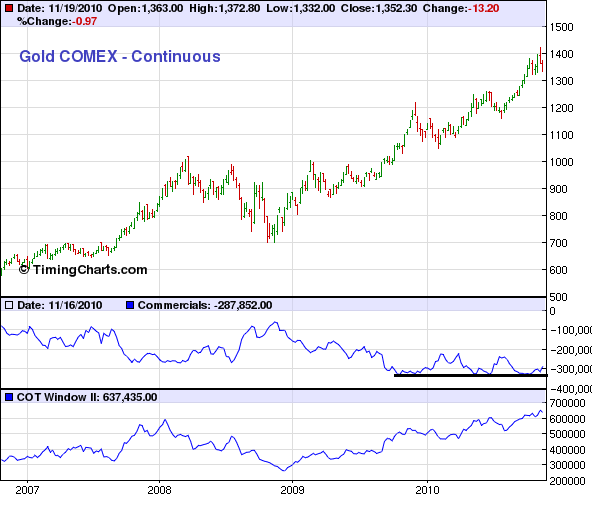
| Positive COT Structure for Gold and Silver Posted: 22 Nov 2010 10:43 AM PST The Commitment of Traders report (COT) comes out every Friday. The data is as of Tuesday so there is a lag. The COT data provides important data about the construct of the market. It tells important information such as who is holding long positions (commercials or speculators) and the total open interest. The commercials are the traders who are the producers and/or users of the commodity. They tend to be more conservative in their approach and will hold positions far longer than your average speculator. As such, it is generally more bullish when commercials are heavily long and not the speculators. The larger the long positions of speculators, the more "weak hands" are in the market. Even though Gold and Silver have had very strong runs, we don't see a negative setup in the COT. At one time, the commercial short position in Gold was 326K contracts. As of last Tuesday, it was 288K contracts. That means that since the May top, Gold has gained about $100 and speculative long positions have declined by 12%.
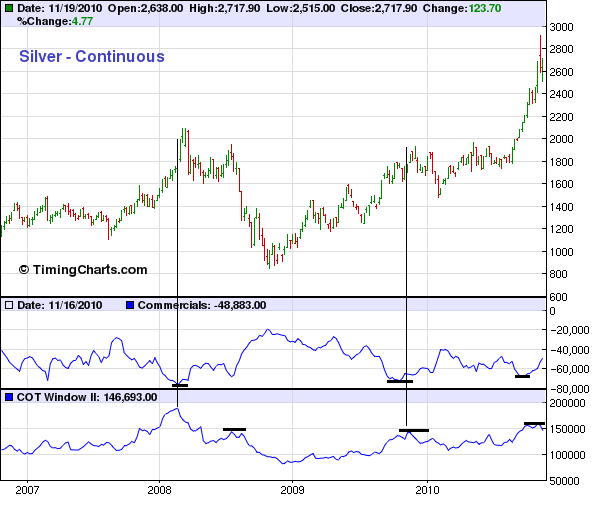
The Silver COT is even more bullish. At the start of October, commercial traders were short roughly 68K contracts. As of last Tuesday, they were short ~49K contracts. That is about a 27% decline in speculative long positions. Open interest is only marginally higher than the last two peeks but also well below the peak in 2008.
The COT is just one of several things we use to gauge the sentiment in the precious metals market. Sentiment indicators, along with technical analysis is a powerful combination that helps us assess the probabilities and manage risk in this burgeoning bull market. If you like this kind of analysis, then consider a free 14-day trial to our premium service. Good Luck! Jordan Roy-Byrne, COT Jordan@TheDailyGold.com
| ||
| Cartel Raid on gold and silver failed; December open interest remains extremely high Posted: 22 Nov 2010 10:08 AM PST | ||
| Why You Should Have Silver in Your Portfolio Posted: 22 Nov 2010 10:00 AM PST Silver has had quite a run the last couple months so it's no surprise that it has gained much attention and interest from investors – possibly even more than gold. | ||
| Gold Bullion Hits 1-Week High as North Korea Shells South Posted: 22 Nov 2010 10:00 AM PST Asian stock markets dropped up to 2%, crude oil fell hard towards $80 per barrel and silver prices unwound Monday's 2.3% rally. | ||
| How High Could Silver Go in December? Posted: 22 Nov 2010 10:00 AM PST There is no other way to describe silver's price movement of the past 13 weeks other than to call it parabolic. |
%7Cutmcsr%3Dhttp%3A%2F%2Fmichael%2Dhudson%2Ecom%2F%7Cutmcmd%3Drss%3B%2B)


%7Cutmcsr%3Dhttp%3A%2F%2Fmichael%2Dhudson%2Ecom%2F%7Cutmcmd%3Drss%3B%2B)

%7Cutmcsr%3Dhttp%3A%2F%2Fmichael%2Dhudson%2Ecom%2F%7Cutmcmd%3Drss%3B%2B)

| You are subscribed to email updates from Gold World News Flash 2 To stop receiving these emails, you may unsubscribe now. | Email delivery powered by Google |
| Google Inc., 20 West Kinzie, Chicago IL USA 60610 | |

No comments:
Post a Comment