


Gold World News Flash |

- Gold vs Treasuries - Which Do You Believe?: Michael Pento
- Nothing Like Uncertainty to Boost Gold & Silver Prices
- Oil Rallies along with Risk Appetite, Gold with Stimulus
- Crude Oil Surges with Risk Appetite, Gold Soars on Momentum and Dollar
- Mid-Week Market Report on Equities and Metals - Oct 14
- The Contrarian Call on Gold
- Tony Parry: Take Away the Crisis Mentality and Gold Looks Precarious
- Gold Vs Treasuries - Which Do You Believe?
- Fear, Desperation and Doom Describe the Housing Market
- Hourly Action In Gold From Trader Dan
- In The News Today
- America Should Open Its Vaults and Sell Gold
- LGMR: Gold Nears USD and Sterling Highs as Washington Denies "Global Currency War"
- Gold Threatening Channel Resistance-1405 Remains an Objective
- Mining News Review: Week of September 27th
- The Overvalued Euro
- Investing in Gold & Silver is a ‘No Brainer’ – Here’s Why!
- Check Out These 5 Hard Asset Investment Alternatives to Gold
- GoldSeek.com Radio Gold Nugget: Peter Schiff & Chris Waltzek
- How to Short Gold - If You Dare
- Can the G-20 and the I.M.F. Burst the “Gold Bubble?”
- Gold Nears USD and Sterling Highs as Washington Denies "Global Currency War"…
- Gold Nears USD and Sterling Highs as Washington Denies "Global Currency War"…
- Should the U.S. Government Sell Its Gold?
- GLD – Gold ETF Daily Chart
- Gold “the Most Important Reserve Asset”?
- GLD – Gold ETF Trading Signals
- Showered By the Sweat of the Sun
- Gold Non-Believers: You Can "Eat It"
- The Illusion of Modern Money
- The Daily Gold Podcast #9
- Gold Seeker Closing Report: Gold and Silver Jump To New Highs
- A Currency Devaluation War: When Will The Next Crisis Start?
- RealtyTrac Reports Q3 Foreclosures Hit All Time Record... Just In Time For The Plunge
- Monetary Policy, Competitive Devaluation, Inflation Targeting . . . and the Future Price of Gold
- Foreclosure Fraud: 6 Things You Need To Know About The Crisis That Could Potentially Rip The U.S. Economy To Shreds
- Researching Gold/Silver Mining Companies III
| Gold vs Treasuries - Which Do You Believe?: Michael Pento Posted: 14 Oct 2010 03:18 AM PDT Many currently believe that 'Helicopter Ben' has yet to ignite inflation on the ground because the money he dropped from the sky is still stuck in the trees. In other words, the funds are caught in the banking system and not spreading among the populace. Yet, M1 is up 6.2% YoY; and, in the last two months, the compounded annual rate of change in M2 is 7.4%. Although these single-digit increases do not yet indicate runaway inflation, a program of relentless quantitative easing has a conclusion as predictable as driving 100mph around an icy mountain turn. Since the Chairman has shown no will to hit the brakes, you'd have to be mad to ride the yield curve alongside him.
|
| Nothing Like Uncertainty to Boost Gold & Silver Prices Posted: 14 Oct 2010 02:06 AM PDT
|
| Oil Rallies along with Risk Appetite, Gold with Stimulus Posted: 13 Oct 2010 08:09 PM PDT courtesy of DailyFX.com October 13, 2010 04:16 PM It seems there is something for everyone in the commodity market. For those that are in risk-sensitive markets like oil, the promising start of the 3Q earnings season was a good booster; while long-term financial concerns keep gold bid. North American Commodity Update Commodities - Energy Chinese Demand and a Rally in Risk Appetite Carries Crude Towards Fresh 5 Month Highs Crude Oil (LS Nymex) - $83.68 // $1.34 // 1.64% It was a strong return to form for crude Wednesday. The commodity started its climb at the turnover of the day; and it would continue to climb throughout the Asian, European and US sessions. This climb wouldn’t lead to a new-five month high close for the US oil market; but the rally has the level of momentum that is usually attributable to trend generation. The question of progress from here rests with fundamental support. Wednesday, there was a combination of factors that would encourage a rally,...
|
| Crude Oil Surges with Risk Appetite, Gold Soars on Momentum and Dollar Posted: 13 Oct 2010 08:09 PM PDT courtesy of DailyFX.com October 13, 2010 10:51 PM A strong start to the third quarter U.S. earnings season led to a surge in risk appetite and commodity prices on Wednesday. Crude will look to the inventory report on Thursday for confirmation. Commodities – Energy Crude Oil Surges with Risk Appetite Crude Oil (WTI) - $83.75 // $0.74 // 0.89% Commentary: A surge in risk appetite sent crude oil higher on Wednesday, with the commodity adding $1.34, or 1.64%, on the session. We have been pointing out that the correlation between crude oil and equities has been extremely strong recently. Thus, when equities rose on the back of robust earnings from bellwether corporations such as JP Morgan Chase and Intel, oil tagged along for the ride. All risk assets in general continue to benefit from a brightening global economic outlook. Granted, there still remains concern with regard to the U.S. economic outlook in particular, but even that has improved after the Fed stated in clear t...
|
| Mid-Week Market Report on Equities and Metals - Oct 14 Posted: 13 Oct 2010 08:09 PM PDT Its been an interesting week with stocks, commodities and currencies having a knee jerk reaction to the FOMC minutes released Tuesday afternoon. In short the Fed clearly said there must be more quantitative easing before things will get better. It was this news which triggered a rally in both stocks and commodities. Quantitative easing is a fast way to devalue the dollar and the Fed is doing a great job at that. As long as the dollar continues to decline the stock market will keep rising. This week kicked off earning season with INTC and JPM beating analyst estimates. We usually see the market trade up the first week of earnings and then start to sell off by the end of earnings season. Both INTC and JPM sold off on strong volume today despite the good earnings and today’s broad market rally. This just goes to show the market has not forgot about buy on rumor sell on news… The big/smart money sold into the morning gaps exiting at a premium price. Is this foresh...
|
| Posted: 13 Oct 2010 08:09 PM PDT Numerous recent busts (technology, banks, internet, oil, stocks, etc) have given rise to the principle of contrarian investing. Contrarians seek to buy when sentiment is bearish or when a market is completely ignored. They seek to sell when a market is overpriced or overvalued. The problem nowadays is that everyone has bubble fatigue. The herd seems to think that whatever rises is a bubble and will automatically go bust. However, there is much more to contrarian investing than simply going against the herd or prevailing trend. First, the herd is actually right most of the time. As a bull market develops, more and more people come on board. Sentiment will inevitably become more bullish as time goes on. Furthermore, an investor should also consider technicals, fundamentals and value in their contrarian approach. Fake, fraudulent and imposter contrarians (who neglect true contrarian analysis) think Gold is a bubble and will soon decline. They see this simply because Gold ...
|
| Tony Parry: Take Away the Crisis Mentality and Gold Looks Precarious Posted: 13 Oct 2010 08:09 PM PDT Source: Brian Sylvester of The Gold Report 10/13/2010 When Tony Parry, a senior analyst with Sydney, Australia–based Resource Capital Research, builds his long-term models for Australian junior gold companies, he's using a long term gold price of $900 per ounce. Tony thinks gold's fundamentals are weak and that fear is artificially propping up the price. In this exclusive interview with The Gold Report, Tony makes the case for a lower gold price and tells us about some small gold companies Down Under with exceptional prospects for growth even at $900 gold. The Gold Report: Tony, you joined Resource Capital Research as a senior analyst in 2008. Tell us about your coverage sector. Tony Parry: At Resource Capital Research, we cover exploration and development companies, typically those with emerging production profiles that have not been picked up by the market or major brokerage firms and need further research coverage. We cover three sectors—gold, urani...
|
| Gold Vs Treasuries - Which Do You Believe? Posted: 13 Oct 2010 08:08 PM PDT Any psychoanalyst looking at the behavior of investors today would see clear strains of schizophrenia in a comparison between the markets for gold and US Treasuries. Currently, the 10-year Treasury yield is setting new lows on a daily basis. In the financial models all economists were taught at school, this would be an indication of an economy with low inflation expectations and a strong currency. But the dollar has fallen over 12% since June, and the price of gold continues to hit all-time highs. These results are completely antithetical. Bonds are flashing a warning sign of deflation, while gold and the dollar presage hyperinflation. During the last period in which the US experienced significant economic stress, the late 70's and early 80's, the markets in gold and Treasuries showed a much higher degree of harmony. At that time, the Fed's extreme depression of interest rates led to rapidly rising inflation, a weakening dollar, and a massive spike in the pri...
|
| Fear, Desperation and Doom Describe the Housing Market Posted: 13 Oct 2010 08:08 PM PDT View the original post at jsmineset.com... October 13, 2010 04:17 AM (Courtesy of Greg Hunter of www.USAWatchdog.com) Dear CIGAs, It has been called foreclosure gate, robo signing, foreclosure fraud or just sloppy paperwork; but no matter what you call it, it's signaling a new financial meltdown for the U.S. economy. The securitized mortgage debt created in the real estate bubble is being called the "largest fraud in the history of capital markets" by people like renowned gold expert Jim Sinclair. The big banks packaged mortgages into securities (mortgage backed security) and then sold them to pension funds and investors. The mortgages in these securities had to meet what is called "contractual representation and warranties." That basically means the bank had to legally be able to prove it owned the property it was selling in the security. Once more, the mortgage applications and appraisals were required to be free of fraud. The "robo sign...
|
| Hourly Action In Gold From Trader Dan Posted: 13 Oct 2010 08:08 PM PDT View the original post at jsmineset.com... October 13, 2010 09:47 AM Dear CIGAs, Gold rallied sharply today on news that the US would sell its entire stock of gold to China….. whoops, wait a minute – it wasn't the US, it was England trying to sell all their gold to China. Oh drat – I forgot – they don't have any gold left to sell to anyone because Gordon Brown sold it all back when it was $250 thinking that it would be a great way to reduce Britain indebtedness and get some assets that really do pay something. After all, gold doesn't throw off any yield; it just sits there gathering gold rust. Great idea Truman. That turned out really well for the Brits. Got any more nuggets of wisdom for us to swallow? Please enlighten us mere mortals and pray lead us from darkness into the light where we may bask in the glory of your countenance. I can see copious amounts of incense ascending right now in the lands of China and India imploring the gold gods to sway the minds of the US officials ...
|
| Posted: 13 Oct 2010 08:08 PM PDT View the original post at jsmineset.com... October 13, 2010 12:20 PM Jim Sinclair's Commentary Sure gold can hit $2000. I think you read that gold is the ultimate currency here 8 years ago. Gold is the final refuge against universal currency debasement States accounting for two-thirds of the global economy are either holding down their exchange rates by direct intervention or steering currencies lower in an attempt to shift problems on to somebody else, each with their own plausible justification. Nothing like this has been seen since the 1930s. By Ambrose Evans-Pritchard Published: 6:01PM BST 26 Sep 2010 "We live in an amazing world. Everybody has big budget deficits and big easy money but somehow the world as a whole cannot fully employ itself," said former Fed chair Paul Volcker in Chris Whalen's new book Inflated: How Money and Debt Built the American Dream. "It is a serious question. We are no longer talking about a single country having a big depression...
|
| America Should Open Its Vaults and Sell Gold Posted: 13 Oct 2010 08:08 PM PDT "Last Gasp of the Fiat Money Regime. What's happening with silver? Where's the note? Bank of America: Too big to fail? The Violence of the Storm, the Destruction of the Middle Class and the Coming Gold Standard: Doug Casey... and much more. " Yesterday in Gold and Silver Despite the wild looking Kitco gold chart below, not much happened in the gold world on Tuesday. The low [around $1,340 spot] occurred around 10:00 a.m. in London. The gold price then struggled back to finish about three dollars lower than its Monday close. Gold's high of the day [around $1,355 spot] was about thirty minutes after trading began in the Far East on Tuesday morning. In New York, gold got hit for eight bucks the moment that the equity markets opened for the day at 9:30 a.m... with the New York low coming 20 minutes later at the London p.m. gold fix about 9:50 a.m. Eastern time. Silver's price path was similar to gold's... with the low [around $22.95 spot] occurring i...
|
| LGMR: Gold Nears USD and Sterling Highs as Washington Denies "Global Currency War" Posted: 13 Oct 2010 08:08 PM PDT London Gold Market Report from Adrian Ash BullionVault 08:55 ET, Weds 13 Oct. Gold Nears USD and Sterling Highs as Washington Denies "Global Currency War", But QEII "Priced In" Say Analysts THE PRICE OF GOLD stalled $3 shy of last week's all-time Dollar record in London trade on Wednesday morning, peaking above $1361 an ounce as the US currency fell and global stock markets rose sharply. Gold priced in Sterling rose within 1.3% of June's record peak at £870 per ounce. Eurozone investors wanting to buy gold saw it hold in the upper-end of the last nine weeks' trading range at €31,300 per kilo. Over in Asia, Tuesday's lack of Indian and Chinese demand had been reversed according to wholesale dealers, with speculative buying noted on the electronic Globex platform after Beijing said China's crude oil imports rose 35% last month from Sept. 2009, hitting a new record of 5.67 million barrels per day. US crude oil futures jumped back towards $83 per barrel. European equit...
|
| Gold Threatening Channel Resistance-1405 Remains an Objective Posted: 13 Oct 2010 08:08 PM PDT courtesy of DailyFX.com October 13, 2010 06:29 AM Daily Bars Prepared by Jamie Saettele Daily RSI has tested the November 2009 extreme and gold has also failed at its multi month channel line. An objective going forward remains 1405, which is the 100% extension of the 1048-1270 advance. Only a drop below 1335 would suggest a trend change....
|
| Mining News Review: Week of September 27th Posted: 13 Oct 2010 08:08 PM PDT Fire River Gold (TSX-V: FAU; Pink Sheets: FVGCF) Results of Preliminary Economic Assessment for Leaching Historic Tailings at Nixon Fork Gold Mine, Alaska - September 29, 2010 A $7.7 million net present value at $1,200 gold isn’t going to win you many friends when your market capitalization is over $30 million. To be fair, the leaching of historic tailings is not the main attraction of the Nixon Fork Gold Mine. As we have noted in the growing Company Index area of our website, the company expects to define a 150,000+ ounce high grade underground resource in 2010 to be followed by a preliminary economic assessment. This would be incremental to the leaching of tailings, and would hopefully have a much more substantial net present value attached. [Zurbo] St. Eugene Mining (TSX-V: SEM) Announces Private Placement Offering at C$0.12 Per Unit for Gross Proceeds of up to $750,000 - September 29, 2010 This explains why the price rose as much as 50% the past few days...
|
| Posted: 13 Oct 2010 07:08 PM PDT Surly Trader submits: The U.S. dollar has been declining and gold has been rallying. This makes a good amount of sense considering the investor public is pricing in a second round of quantitative easing. 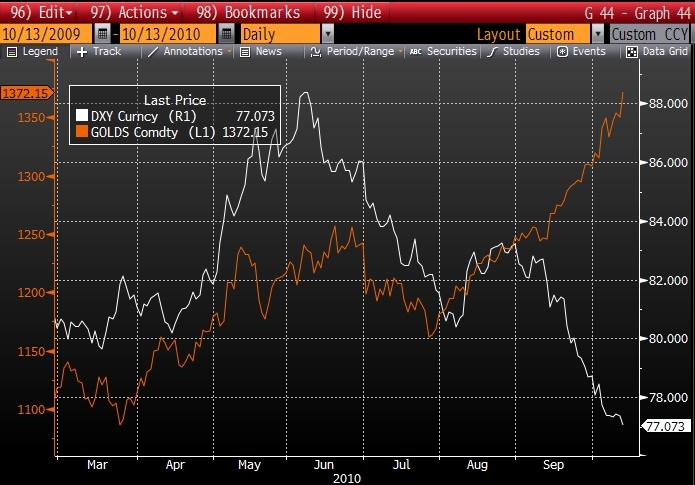 The Dollar Falls and Gold Rallies - The world seems right again... Complete Story »
|
| Investing in Gold & Silver is a ‘No Brainer’ – Here’s Why! Posted: 13 Oct 2010 07:05 PM PDT It is a "no brainer" to stock up on precious metals and other tangibles given that our governments are working overtime to make our paper money worthless. Public economic policy direction is very clear. US Fed Chairman Bernanke continues to issue strong signals that massive money creation resulting in price inflation and a devalued dollar, is the favourite wrench in his toolkit. Words: 1465
|
| Check Out These 5 Hard Asset Investment Alternatives to Gold Posted: 13 Oct 2010 07:05 PM PDT While the 2010 gold rush is making a lot of headlines, it's important to not overlook other hard assets [such as silver, copper, platinum, palladium and rare earth metals] that are good investment alternatives to gold and have all rallied to fresh highs recently as well. While each of these offers its own strengths and weaknesses they are ways to diversify your holdings away from gold if you are worried about a crash. Words: 1561
|
| GoldSeek.com Radio Gold Nugget: Peter Schiff & Chris Waltzek Posted: 13 Oct 2010 07:00 PM PDT GoldSeek.com Radio Gold Nugget: Peter Schiff & Chris Waltzek
|
| How to Short Gold - If You Dare Posted: 13 Oct 2010 06:41 PM PDT Dan Pritch submits: With the price of gold hitting new highs seemingly daily, one would have to be rather daring to swim against the tide. But if you’re looking to take up a contrarian position against continued gold price increases, there are a few ways you could do so. First, let’s look at what’s driving the current price action. What’s Driving Gold Prices?
Why Gold Prices Could Fall
How to Short Gold
Bear in mind that most options expire worthless, leveraged ETFs lose value over time and opening yourself up to unlimited risk can be catastrophic. Additionally, different methods have different tax liabilities (see gold taxes for differentiation). But these are some available tools nonetheless. I make no predictions on where gold is headed from here but I do own a small portion of my trading portfolio (full portfolio holdings/performance) due to the trend, hedging, and belief the we may see further currency devaluations for years to come. Should you decide to go with the drain and go all-in on the gold trend, there are actually some ETFs beating gold worth a look – silver, platinum and others that have industrial utility as well. Complete Story »
|
| Can the G-20 and the I.M.F. Burst the “Gold Bubble?” Posted: 13 Oct 2010 05:45 PM PDT
|
| Gold Nears USD and Sterling Highs as Washington Denies "Global Currency War"… Posted: 13 Oct 2010 05:37 PM PDT
|
| Gold Nears USD and Sterling Highs as Washington Denies "Global Currency War"… Posted: 13 Oct 2010 05:37 PM PDT
|
| Should the U.S. Government Sell Its Gold? Posted: 13 Oct 2010 05:35 PM PDT Tim Iacono More evidence that there is a fundamental lack of understanding about what gold is and why people are paying so much for it these days (and, incidentally, another reason to think that the gold bull market has a very long way yet to go) comes via this op-ed($) in the Financial [...]
|
| Posted: 13 Oct 2010 05:35 PM PDT Prices continue to churn as traders and investors try to figure if they want their hard earned dollar in cash or investments. The market is very jittery simply because no one wants to get caught on the wrong side of the market if it makes another 30-40% move, which is why we [...]
|
| Gold “the Most Important Reserve Asset”? Posted: 13 Oct 2010 05:35 PM PDT Tim Iacono Apparently, after what's happened to the global financial system over the last few years, the world's central bankers have had a dramatic change in thinking about gold bullion, formerly known as the "barbarous relic". A metal once considered to be a remnant of a bygone era is now increasingly viewed [...]
|
| GLD – Gold ETF Trading Signals Posted: 13 Oct 2010 05:35 PM PDT This 60 minute chart shows gold getting hit hard on Wednesday morning. Investors and traders around the globe were closing out positions and moving to cash. This high volume dumping of positions pulled virtually all investments lower and was the first tip-off that the market was in panic mode. One the dust [...]
|
| Showered By the Sweat of the Sun Posted: 13 Oct 2010 05:28 PM PDT In today's Daily Reckoning you'll get the long-awaited look at why America's mushrooming mortgage fraud fiasco is bad news for Australian housing. All you housing bulls will have to tear yourself away from counting your rivers of gold for a second and pay close attention. But first, speaking of gold, take a close look at the man below.  In case you missed it, gold set a new high in the futures market overnight at $1,374.15. Minutes from the last Federal Reserve meeting showed the lunatics in charge of America's money supply want Americans to fear inflation so they spend their money before it's made worthless. The commodity markets responded with enthusiasm. In fact, gold's intraday high was fourteen dollars and fifteen cents higher then when Mr. T went on Bloomberg television to represent a gold company. Your first reaction when you see Mr. T on Bloomberg , draped in gold, might be "sell." It's a comic scene and apparently absurd. But wait! Mr. T is not on television to sell you gold. That would surely be a sign of the top. He's on television representing a company that BUYS your gold. And that's how you know that the popular culture doesn't really understand gold as money yet. When the man in the street thinks that high gold prices are a reason to sell your gold jewellery now, you know the gold bull has not reached the mania phase yet. By the way, Mr. T is an eloquent speaker, isn't he? He said that in ancient times gold was thought of (maybe by the Incas, or someone like them) as "the sweat and tears of the sun." And if he really did buy gold back in the late 1970s, he's a rich man now (although he had a fair bit of waiting to do before the post Bretton Woods global fiat standard money system began collapsing into ruin.) But none of this is really big news here in Australia. The gold price in Aussie dollars won't move up with monster truck force until the U.S. dollar gets stronger. Yet the Aussie dollar is fast approaching parity. No sign of weakness there, not yet. Right now, Australia is the main global beneficiary of the risk carry trade. Cheap global interest rates are driving investors into high-yielding currencies and commodities. That's double plus good for Australia. It's going to take a reversal of the "risk" trade for Aussie gold to move up and the Aussie dollar to move down. There are plenty of risks, too. One of them, for example, is the continued blasé attitude about Australia's dependence on foreign capital to fund its real estate lending. "Talk of housing bubble hot air," is the headline of Katja Buhrer's article on page 58 of yesterday's Australian Financial Review. IN a moment, we'll see if you can spot the conflict of interest. But in the story, Ian Graham, the CEO of QBE LMI says that it's a good sign banks are increasing loan-to-value ratios from 90% to pre GFC levels of 95%. Seriously. He says, "It's a positive sign that [banks] don't have credit concerns about a 95% loan not being prudent or suitable for the borrowers...I wouldn't see the banks as becoming less prudent. I'd see them as feeling more comfortable, particularly given the positive outlook for the economy." Because nothing could ever go wrong lending 95% of a home's value to a borrower based on a good feeling about the economy. Of course not! To prove how good things are, or how bad they are not, why not trot out a study that tells you what you want to hear! BIS Shrapnel managing director Rob Mellor, in the same article, suggested people like your editor just "don't get Australia." "We're chasing shadows out there, looking for reasons why a worst-case scenario would happen, when we did all that back in the latter part of 2008 and the early part of 2009 and we got through the worst of that." "So why would we do it again until we see clearly the risk of something overheating...or some of the fundamental drivers of the economy changing that actually would lead to a reversal of the economic growth rates predicted and therefore a substantial rise in the unemployment rate." You'd think one of the "fundamental drivers" of the Aussie housing market is the fact that Aussie banks borrow about 30 cents of every dollar they lend from someone overseas. In another global capital crisis, this could be a problem. It could also be a problem that Aussie banks have 60% of their loan books secured by residential property. As Buhrer says, "the health of the economy is linked to house prices." That's another way of saying the health of the economy is linked to the health of banks. Not a problem right? Not if house prices keep going up. And just a few pages later, we find that both QBE and BIS are predicting just that! "Stronger markets' prices tipped to grow 20pc" reports Michael Hobbs on page 61. He reveals that "median house prices in Sydney, Perth and Adelaide are forecast to rise by around 20 per cent in the next three years, according to new research." Whose research, you might wonder? "Mortgage insurer QBE LMI's Australian Housing Outlook compiled by BIS Shrapnel found an improving economy and a shortfall in dwellings will fuel a rise in house prices. How much exposure do you think QBE has to commercial and/or residential real estate in Australia? Meanwhile, U.S. mortgages are the new asbestos. How long will it be before dozens of class action lawsuits are filed against U.S. banks? Pick your reason! Homeowners can argue that banks illegally foreclosed on homes they couldn't prove they actually owned. In a purely rational way, even if you WERE foreclosed on legitimately, or even if you KNOW you can't keep your home, you might be able to keep it anyway by threatening the bank with legal action. And what bout investors who can claim that the bank sold a security it didn't own? If it were just a matter of the big banks versus hundreds of thousands of even millions of so-called "deadbeat borrowers," bank lobbyists could convince the U.S. Congress to relax foreclosure laws and put these peons to the sword. But the big investors in mortgage backed securities won't be pushed around so easily. They have deep pockets. They have lobbyists too. And they have investors to answer to. Going to court is a real option. Wells Fargo, another U.S. bank at the centre of the storm, admitted yesterday that it was guilty of the same "robo signing" process for handling thousands of foreclosures, perhaps illegally. It joins JP Morgan, GMAC, and Bank of America. Jamie Dimon, the CEO of JP Morgan, thinks the banks will get off with a fine. He told investors on a conference call that, "We don't think there are cases where people have been evicted?...?where they shouldn't have been...Obviously it will increase our costs a little bit and maybe we'll have to pay penalties eventually to some of the [attorneys-general]". Somebody tell him he's dreaming. Dan Denning
|
| Gold Non-Believers: You Can "Eat It" Posted: 13 Oct 2010 05:25 PM PDT Recession, depression, or recovery, gold is poised to continue its run. The case for gold is a simple one. But as gold sets new all-time highs, a minority of investors are in it, more are waiting for a dip, and most will miss out on the bull run altogether. Well, until the top when everyone will be herding into it. But today we'll look at why the gold boom how historical evidence shows the "weight" behind this gold bull will keep pushing prices higher. The Long Boom in Gold All the fundamentals are in place in place for the gold bull run to continue well into the future. The U.S. budget deficit is likely to be much worse than predicted. In Too Much Hope and Audacity, we found the government's deficit forecasts to be a bit too optimistic. Although they called for a cumulative $9.7 trillion budget deficit over the decade, further analysis revealed it was a "best case" scenario. The official forecast included expiration of the Bush tax cuts, no recession in the next 10 years, and a greatest hiring boom in the past fifty years. As a result, the 10 year deficit is likely to exceed the $9.7 trillion estimate. Also, deflation has the Fed very concerned. The Fed is, at a minimum, going to keep rates at or near zero for a long time to come. That means real interest rates will likely be negative, which are going to keep gold prices on the rise. Finally, there's a much bigger driver for gold: gold is still an outside-the-mainstream investment class. Great Things Come to Those Who "Weight" 
|
| Posted: 13 Oct 2010 04:48 PM PDT Nothing comes from nothing, nothing ever could - The Sound of Music Expect a miracle. Or a fraud. It is impossible for printed money - money created out of thin air - to bring real wealth. It's just paper. Or not even paper. These days it's nothing more than the wispy imagination of the Internet. A clerk types in a number. Presto! A bank a thousand miles away has a billion dollars. Is the world one jot richer? Of course not. Same buildings. Same businesses. Same output. Same purchasing power. But wait... What then, do those billion dollars really do? Ah...that...well, they look like real money. They act like real money. And they buy things - just like real money. So, wouldn't you know it, people think they ARE real money. They feel richer. They spend. They invest. They speculate. Just as if they had more real money. But it would be a miracle if this phony money created a real boom. But that seems to be what investors are betting on. The Dow held about steady yesterday. Gold lost a little ground. Nothing big either way. But the Dow rose over 11,000 last week. The S&P 500 is selling at a p/e ratio 50% higher than the long-term average. Investors must think that corporations are going to grow 50% faster than they did during most of the 20th century. Huh? Let's see... ..we're in the early stages of a Great Correction... ..there is about $20 trillion worth of bad credit still to be eliminated... ..unemployment is at levels not seen since the Great Depression... ..so many houses are headed to foreclosure that banks have had to stop taking them back... ..what little "growth" there has been seems to all have come from the government. And now the government itself is headed for a debt crisis... Hey...and our president tells us that things are getting better every month. Which just proves that he has no idea of what is going on. Things are not getting better. The US government is so deep in the hole it may never be able to get out. It borrows a dollar for every dollar it receives in taxes. So, it's still digging the hole deeper. And in early November, the Fed is expected to announce that it will join the QE party. That is what has investors' attention. That is what they're betting on - more hot money from the Fed. "The job of the Fed is to take away the punch bowl" when the party gets out of hand, said Fed chief William McChesney Martin. Instead, the Fed is pouring in more alcohol and handing out car keys. Investors are convinced that it will announce a new round of quantitative easing in November. They think the number will be between $100 billion and $1.5 trillion. A big number, in other words. Why? Because the economy is not improving. Because it is a Great Correction. And because the Fed believes it can add money and boost Americans' "animal spirits." And because they are really a bunch of dumbkopfs. If you believe you can really improve the situation by adding phony money, why not add a lot more of it? Ha ha... never mind. You're just counting on a miracle...or a fraud. We wouldn't count on a miracle. But we wouldn't bet against the fraud. Adding phony money can't create real prosperity. Nothing comes from nothing. But it can create a boom...and a bubble...in speculative assets. That is, it can work as a fraud. Speculators take the hot new money and bid for gold, copper, platinum. China shares. Everything goes up as the hot money gets passed from hand to hand. And then...it burns someone. Right now, we'd be a little concerned that investors have already bought the rumor of more QEII. So, if the Fed comes out with the predicted announcement, investors are likely to sell the news. The only thing that would push prices higher is if the Fed did MORE than was already anticipated...that is, if it went ALL OUT in its fight with the slump. Then, you'd really see some accidents! And more thoughts... "This country is in a boom," said the editor of a financial magazine in Buenos Aires. "Everything is going up. Everything is selling. And inflation is roaring at 25% per annum." To hear him tell it, Argentina is everything America wishes to be. Its people shop. Its restaurants are full. Its economy is growing at more than 8% a year. Why? "Inflation. Everyone wants to get rid of cash. You hold onto it and it's worth less and less. So you buy an apartment." Amazingly less than 10% of property transactions in Argentina include mortgages. People pay with cash. Still, prices are not as low as you would expect. The lot next to our office is on the market for $250,000. "It should be about $100,000," said a friend who keeps an eye on real estate. "But everything is high." The cab ride from the airport was 70 pesos when we came 4 years ago. This time it was 128 euros. Two glasses of wine at a local bar were 40 pesos. They would have been half that a few years ago. "There's a boom going on," continued the financial editor. "But it can't go on forever. You can't have 25% inflation and have a healthy economy. People don't make wise investments. They just try to avoid getting ripped off by inflation. They don't make long-term investments. They just try to park their money where it won't disappear. That's why real estate is so expensive. People will save their money and buy an apartment whether they need it or not. They figure it will still be there in five or ten years. The peso won't be. At least not today's peso." Nor will the dollar. *** By the way, your editor is giving a speech at the MoneyShow in London on the 12th of November. For more info, follow this link... Regards, Bill Bonner
|
| Posted: 13 Oct 2010 04:32 PM PDT |
| Gold Seeker Closing Report: Gold and Silver Jump To New Highs Posted: 13 Oct 2010 04:30 PM PDT Gold rose about 1% by midday in London and jumped even higher in midmorning New York trade to a new record high of $1373.80 before it fell back off a bit in the last couple of hours of trade, but it still ended at a new record closing high with a gain of 1.74%. Silver climbed to a new 30-year high of $23.95 by early afternoon in New York and ended with a gain of 3.29%.
|
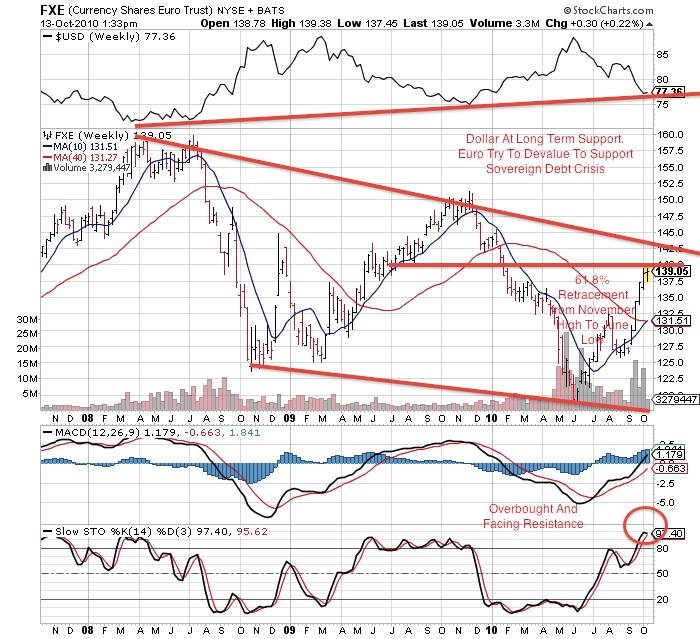
| A Currency Devaluation War: When Will The Next Crisis Start? Posted: 13 Oct 2010 04:19 PM PDT These past few weeks as the equity markets rallied based on the belief of further quantitative easing by the Fed in November's meeting, the dollar has collapsed which I warned readers about a couple of weeks ago. Since that time gold and silver have had a historic and parabolic rise as investors feel the Fed will continue to ease through the end of the year. Investor sentiment has reversed completely over the last 8-12 weeks since I signaled a buy on gold. There are no concerns as bullish sentiment on equities and precious metals reach record levels. Investors feel the Fed will solve everyone's problem by devaluing the U.S. Dollar. The temporary band aid is not fixing any of the core problems. Unemployment is still high and housing is weak. Both the financials and the homebuilders are not participating in this rally which leads me to suspect this entire rise in the markets is not sustainable as it has been on low volume and key sectors have not yet participated. In countries where there is a huge deficit the only solution to pay back debts is through a devalued currency. Japan has recently intervened to try to devalue the strengthening yen. A strengthening currency to countries with huge obligations can heighten the risk of default which many countries are facing. Also a strong currency puts pressure on international corporations who export products abroad. A weak dollar will cause the products to be more expensive to American consumers which will hurt demand and growth. More sovereign debt defaults in emerging markets are expected. It appears that from the European Debt Crisis that many investors ran to the dollar from the Euro. I expect something similar to occur now. The Euro is overbought and the U.S. dollar is reaching long term support. The Euro is reaching a key resistance level and is overbought. This means a pullback should occur. The U.S. Dollar is extremely oversold and at long term support. The bearish sentiment on the U.S. Dollar is extremely bearish which indicates a reversal should occur. As global economies feel the consequences of the United States actions, I expect further fallout from weak economic growth and the sovereignvdebt burdens in Europe. Many investors are pricing in a major move from the Fed. I am not so convinced, equity markets are higher and the dollar has moved significantly lower. Investors should realize that unless we see another sovereign debt issue or another bank failure that another major round of easing is unlikely at this point. I believe the investment community is expecting too much from the Fed and it appears the Fed is doing an excellent job stimulating the markets just through speculation of a move rather than the actual move itself. This last easing from the Fed has met with some more critics and it has definitely increased international tensions. The U.S. dollar has collapsed and is now testing long term support. I don't know at this point if the Fed will be so quick to act the next time around unless there is another deflationary crisis. Technically the dollar is due for a bounce and investors should look for any pullbacks in gold and silver as a buy point. Instead of the risk associated with buying bullion at these extended prices, many juniors who would be extremely profitable at lower gold and silver prices have not broken out yet. To find out the juniors I am following subscribe to my free newsletter at goldstocktrades.com. I believe these junior mining companies are presenting a great buying opportunity. Remember on these recent parabolic moves, the faster it goes up, the faster and harder the correction. Last Thursday showed a huge volume reversal day. This indicates to me that some of the smart money are hedging their long gold and silver bullion positions for a correction. Although we may see further upside the move is about to get exhausted as it has taken out many technical targets and measured moves. Be careful of getting caught up in the hysteria.
|
| RealtyTrac Reports Q3 Foreclosures Hit All Time Record... Just In Time For The Plunge Posted: 13 Oct 2010 04:06 PM PDT
Looks like someone may have had a little advance notice on October's foreclosure semi-moratorium festivities. According to RealtyTrac, September foreclosures marked a 5 month high of 347,420, jumping 3% from the previous month and 1% from September 2009, even as the 3rd quarters marked the highest foreclosure activity on record. For the first time in history, bank repossessions (REOs) surpassed 100K, hitting 102,134. Providing some much needed color on what is actually happening in the foreclosure market, James Saccio, CEO of RealtyTrac said: "Lenders foreclosed on a record number of properties in September and in the third quarter, taking a bite out of the backlog of distressed properties where the foreclosure process was delayed by foreclosure prevention efforts over the past 20 months. We expect to see a dip in those bank repossessions — and possibly earlier stages of the foreclosure process — in the fourth quarter as several major lenders have halted foreclosure sales in some states while they review irregularities in foreclosure-processing documentation that has been called into question in recent weeks." And plunge, foreclosure activity will: the 24 judicial foreclosure states most affected by the foreclosure documentation issue accounted for 40 percent of all foreclosure activity in the third quarter and 36 percent of bank repossessions, or REOs. And the worst part is precisely what Jim Cramer thought was going to represent a boost to home prices, confirming just how little the man understand basic market principles: "If the lenders can resolve the documentation issue quickly, then we would expect the temporary lull in foreclosure activity to be followed by a parallel spike in activity as many of the delayed foreclosures move forward in the foreclosure process. However, if the documentation issue cannot be quickly resolved and expands to more lenders we could see a chilling effect on the overall housing market as sales of pre-foreclosure and foreclosed properties, which account for nearly one-third of all sales, dry up and the shadow inventory of distressed properties grows — causing more uncertainty about home prices.” In other words: a complete housing market collapse. The chart below summarizes the monthly foreclosure activity by type (NOD + LIS, NTS+NFS, and REOs):
Some more details from RealtyTrac:
And just like an inverse cash for clunkers, look for the mid-November update on October numbers to be a 50%+ plunge in numbers, especially in the Notice of Trustee and Foreclosure Sale categories.
|
| Monetary Policy, Competitive Devaluation, Inflation Targeting . . . and the Future Price of Gold Posted: 13 Oct 2010 04:00 PM PDT
|
| Posted: 13 Oct 2010 03:48 PM PDT 
The truth is that there was fraud going on in every segment of the mortgage industry over the past decade. Predatory lending institutions were aggressively signing consumers up for mortgages that they knew they could never repay. Many consumers were also committing fraud because a lot of them also knew that they could never possibly repay the mortgages. These bad mortgages were fraudulently bundled up and securitized, and these securitized financial instruments were fraudulently marketed as solid investments. Those who certified that these junk securities were "AAA rated" also committed fraud. Then these securities were traded at lightning speed all over the globe and a ton of mortgage paperwork became "lost" or "missing". Then, when it came time to foreclose on these bad mortgages, a whole bunch more fraud started being committed. The reality is that the "robo-signing" scandal is just the time of the iceberg. The following are six things that you should know about how deep this foreclosure fraud crisis really goes.... #1 According to the Associated Press, financial institutions were hiring just about whoever they could find, including hair stylists and Wal-Mart employees, as "foreclosure experts" to help them rush through the massive backlog of foreclosures that were rapidly piling up. Apparently many of these "foreclosure experts" barely even knew what a "mortgage" was according to the AP.... In depositions released Tuesday, many of those workers testified that they barely knew what a mortgage was. Some couldn't define the word "affidavit." Others didn't know what a complaint was, or even what was meant by personal property. Most troubling, several said they knew they were lying when they signed the foreclosure affidavits and that they agreed with the defense lawyers' accusations about document fraud. #2 There is soon going to be a colossal legal scramble to figure out who actually owns millions of U.S. mortgages. In his recent article entitled "Invasion Of The Robot Home Snatchers", Robert Scheer described the complete and total mess that the U.S. mortgage industry has created.... How do you foreclose on a home when you can't figure out who owns it because the original mortgage is part of a derivatives package that has been sliced and diced so many ways that its legal ownership is often unrecognizable? You cannot get much help from those who signed off on the process because they turn out to be robot signers acting on automatic pilot. Fully 65 million homes in question are tied to a computerized program, the national Mortgage Electronic Registration Systems (MERS), that is often identified in foreclosure proceedings as the owner of record. Meanwhile, more organizations are stepping forward to help homeowners fight foreclosures. National People's Action, PICO National Network, Industrial Areas Foundation, Alliance of Californians for Community Empowerment and the Northwest Federation of Community Organizations have all partnered with the SEIU to launch the "Where's The Note" campaign which is going to encourage homeowners to demand to see the note before submitting to a foreclosure. Campaigns such as this are going to make foreclosures much more costly for banks. #3 Legal battles over foreclosure documents could soon spawn thousands upon thousands of lawsuits across the United States. Adam Levitin, a Georgetown University Law professor who specializes in mortgage finance and financial regulatory issues was recently quoted in an article on CNBC as saying the following about the situation we are currently in.... The mortgage is still owed, but there's going to be a problem figuring out who actually holds the mortgage, and they would be the ones bringing the foreclosure. You have a trust that has been getting payments from borrowers for years that it has no right to receive. So you might see borrowers suing the trusts saying give me my money back, you're stealing my money. You're going to then have trusts that don't have any assets that have been issuing securities that say they're backed by a whole bunch of assets, and you're going to have investors suing the trustees for failing to inspect the collateral files, which the trustees say they're going to do, and you're going to have trustees suing the securitization sponsors for violating their representations and warrantees about what they were transferring. #4 The problems with foreclosure paperwork may be more widespread than anyone would have dared to imagine. Attorney Richard Kessler recently conducted a study in which he found "serious errors" in approximately 75 percent of the court filings related to home repossessions that he examined. Now he says that the foreclosure crisis could haunt the U.S. mortgage industry for the next ten years.... "Defective documentation has created millions of blighted titles that will plague the nation for the next decade." #5 If some banks discover that they are missing the paperwork for large numbers of mortgages (as is currently being alleged), those banks could be forced to significantly revalue those assets (as in "close to zero") on their balance sheets. John Carney of CNBC recently described it this way.... The most damaging thing that could happen to banks would be the discovery that they simply cannot prove they hold a mortgage on a house. In that case, the loan would probably have to be written down to near zero. Even for current loans, the regulatory reserve requirements would double as the loan would no longer be a functional mortgage but an ordinary consumer loan. Depending on the size of the "no docs" portion of the loan portfolio, this might be a minor blip or require a bank to raise new capital to fill the hole in the balance sheet. #6 Renowned investor Jim Sinclair is actually warning that the collapse of securitized mortgage debt could be the "final shot" that will wipe out many financial institutions across the United States. The recent warning that Sinclair posted on his blog is more than a little sobering.... I am asking for your attention again because of the depth of the fraud and now the size of the securitized mortgage debt OTC derivative pile of garbage that is in the trillions. This entire mountain of weapons of mass financial and social destruction is now in question. I have been telling you this for more than 2 years since the manufacturers and distributors of this crap were called by the NY Fed due to the loss of control over the paperwork. I had dinner with my former partner, then lead director of and CEO of Bear Stearns. I could not contain myself so I asked him why he did so much business in OTC derivatives which were certain to bankrupt them. The answer I got was it was more than 50% of their profit. The right answer should have been it was more than 80% of their earnings. Securitized mortgage debt is going to be the final shot that kills all kinds of financial entities in the Western world. The biggest holder of this putrid junk is pension funds. Meanwhile, the stock market continues to go up, up, up as if everything is right in the world and as if a juicy new bull market is now upon us. Well, let's all join hands and sing happy songs around the campfire. Perhaps if we all close our eyes and wish real hard all of this foreclosure fraud will just go away. Then again, maybe not.
|
| Researching Gold/Silver Mining Companies III Posted: 13 Oct 2010 03:31 PM PDT In Part I of this series, I introduced novice investors to this sector to some of the basic metrics we use to do a preliminary evaluation of these companies. This was followed-up by our Mining Coordinator, Brian Boutilier explaining how he uses similar criteria in his initial "screening process" with these companies. In Part II, I delved more deeply into the data on these companies, focusing on the "producers" and "near-term producers". In Part III, I will move even further back up the "food chain" of these companies, to the earliest stages of development, to explain to readers the differences in how such companies are evaluated (and valued). This will be complimented by Brian Boutilier's hands-on "tutorial", where he applies this methodology in doing a real-life evaluation of one of these companies. As investors saw in the previous installment, valuing producers and near-term producers is a relatively straightforward process. The producers can be evaluated through operational data, while the near-term producers (by definition) have already engaged in some sort of "feasability study" – which is a detailed, scientific analysis of how a particular miner will extract and process the resource, along with a detailed estimate of profitability/return on investment. With earlier-stage mining companies, such simple and straightforward evaluations are not possible, which is why these companies are geared for investors who have already acquired a significant amount of experience/expertise in evaluating these miners. In fact, before we can attempt to evaluate such companies, we must engage in more detailed categorization – which involves ascertaining the objective of a mining company regarding a particular project(s). Why should we bother to take the time (and added risk) to evaluate and invest in such companies? Buy one of these earlier-stage companies at the right time, and you can obtain a return on your investment in weeks which might take years to duplicate through holding a producer/near-producer. Sensing "visions of dollar signs" dancing before the eyes of readers, I will pause at this point to provide a cautionary note to those who are suddenly thinking "get rich quick". As the old adage goes, markets have a habit of ensuring that "pigs get slaughtered". Those who think they can waltz into these companies figuring they will make quick trades for fabulous profits almost always manage to destroy themselves. They buy into a promising company, and (as is usually the case) it does not immediately explode higher. Instead, it drifts sideways, or perhaps even lower. The greedy investors, expecting quick profits become impatient. Inevitably they succumb to the oldest and most fatal of investor diseases: "the grass is always greener on the other side of the fence"-itis. These impatient, overly-aggressive dolts see other companies doing what their company was supposed to do. They sell what they are holding for no gain (or a loss), in order to buy something else which has already had a "run". This is otherwise known as selling "low" and buying "high" – and is not the way to make money investing. Investors buying into the earlier-stage companies (if anything) need more patience with these companes than with the further-advanced miners. There is another very important reason why even experienced investors don't simply "load up" with nothing but early-stage companies. As we saw in the Crash of '08, equities of companies which don't produce earnings got massacred. The mining sector was especially hard-hit. The producers were (relatively) lightly damaged. The near-term producers (which were fully financed) also were only semi-annihilated. All of the earlier-stage companies (without revenue-generating capacity) were absolutely crushed. On a personal note, not being able to exit before the equities-meltdown in 2008, I simply sat and held. I saw my entire portfolio decline by approximately 90%...and two years later, I have gotten that all back, plus I'm now seeing some very nice net-profits on those investments. This illustrates the crucial difference between volatility and risk (a distinction which is misunderstood by the vast majority of financial advisors). The commodity-producers, and commodities in general, are very volatile. It's always been that way, and it likely always will. In today's manipulated markets, that volatility is only being amplified. However, commodities also represent hard assets, unlike the $10's of trillions in banker-paper floating around in markets – and not counting the $1.5 quadrillion of derivatives in the banksters' private casino. Naturally, all of this paper is very heavily leveraged and totally dependent for its value on the fiat-currencies bankers have foisted upon it. If the U.S. dollar goes to zero, a gold mining company is not only as valuable as ever, but more valuable – since it produces the world's best "money". Conversely, if the U.S. dollar goes to zero, every dollar of U.S. bonds is also worth $0 – along with almost all the rest of those $trillions in banker-paper. And those "investments" can never regain their value. That is "risk". Given the choice, I will accept volatility over risk any day – as an investor with a medium- to long-term investment horizon. Obviously older investors need to be somewhat more cautious – which is why God invented bullion. Now back to the miners. |

| You are subscribed to email updates from Gold World News Flash To stop receiving these emails, you may unsubscribe now. | Email delivery powered by Google |
| Google Inc., 20 West Kinzie, Chicago IL USA 60610 | |

No comments:
Post a Comment